




Can trekking poles improve my mile-splitting time on the South West Coast Path?
Yes, trekking poles can improve your average mile‑splitting time on the South West Coast Path (SWCP), primarily through reduced fatigue and faster, safer descents. However, the effect is not a direct "speed boost." Poles will not make you faster on the flats, but they will help you maintain a steady pace over the whole distance, leading to a more consistent and often quicker overall time. The SWCP is a relentless, undulating trail with constant ascents and descents, and it is here that poles offer their greatest advantage.
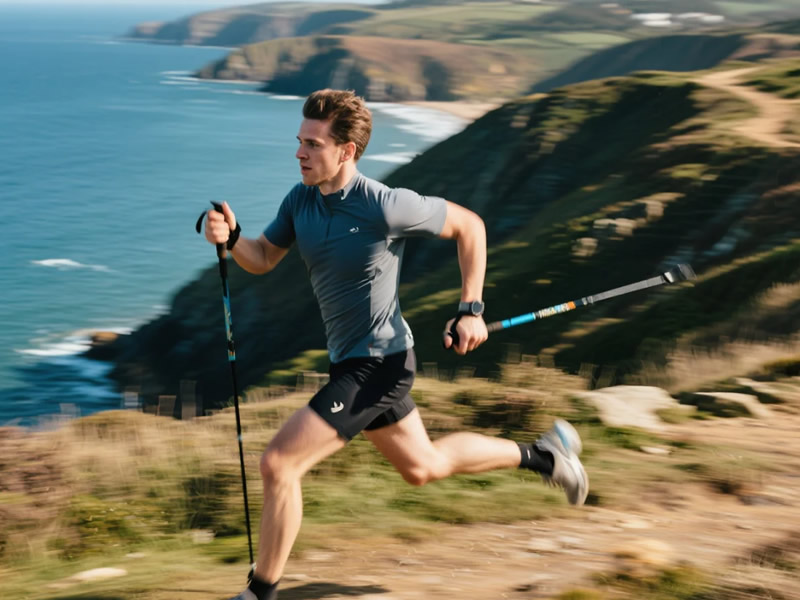
The biomechanical link: how poles affect speed
Your mile‑splitting time is the average time it takes you to walk a mile. It is determined by your walking speed (cadence × stride length) and the time you spend stationary (rest stops, navigation). Trekking poles do not directly increase your walking speed on a flat, even surface—they do not lengthen your stride or increase your cadence. Instead, they alter the distribution of effort.
The 30% rule
When you plant a pole and push down, you transfer up to 30% of your body weight from your legs to your arms. This has two effects:
- Reduced leg fatigue: Your legs work less hard, so you can maintain a steady pace for longer without your muscles tiring.
- Sustained cadence: A steady cadence is the key to efficient walking. Poles help you maintain a consistent rhythm, preventing the gradual slowing that occurs as fatigue sets in.
Terrain‑specific effects on the SWCP
The SWCP is not a single, uniform trail. It is a mosaic of different terrains, and the effect of poles varies across each.
1. Steep descents (the biggest time‑saver)
The SWCP is famous for its steep, relentless descents. Walking down a steep, rocky or muddy slope without poles is slow and jarring. Your knees take a pounding, and you have to step carefully to avoid slipping.
With poles:
- Faster descent: You can plant a pole ahead of you and use it as a brake, allowing you to step down more quickly and with greater confidence. You can often descend a steep, technical section 10‑20% faster with poles.
- Reduced knee strain: The poles absorb the impact, reducing the jarring on your knees. This means you can maintain a fast, controlled descent without having to stop to rest your knees.
2. Steep ascents
On a steep climb, poles can help you push up using your arms, reducing the load on your legs. However, on very steep or rocky sections, poles can be a hindrance, as you need your hands for balance.
With poles:
- Propulsion: On a long, steady climb, you can push down on the poles to lift yourself upwards. This is particularly effective on loose or muddy ground.
- Sustained pace: By sharing the load, you can maintain a steady, rhythmic pace for longer, rather than slowing as your legs fatigue.
Without poles: You rely entirely on your legs, which are already tired from the constant ups and downs. Your pace will gradually slow over the course of a long, relentless climb.
3. Flat sections
On the flat, well‑compacted sections of the SWCP (which are rare), poles offer little benefit. They add weight to your arms without providing any significant support. You will not walk faster with poles on a flat section.
The "fatigue factor"
The most significant effect of poles on the SWCP is not a 10% speed boost on one section, but the cumulative effect of reduced fatigue. The SWCP is a long, demanding trail. By the 10th mile of a 15‑mile day, your legs are tired, your pace has slowed, and your form has deteriorated. Poles help you maintain a steady, efficient gait for longer, preventing the gradual decline in speed that occurs as you tire.
Example:
- Without poles: You walk the first mile at 15 minutes. By the 10th mile, your pace has slowed to 17 minutes per mile.
- With poles: You walk the first mile at 15 minutes. By the 10th mile, your pace has only slowed to 16 minutes per mile.
Over a 15‑mile day, this difference adds up to a significant overall time saving.
The research evidence
A 2019 study in the Journal of Applied Physiology examined the effect of trekking poles on walking speed on uneven terrain. The study found that using poles increased walking speed by up to 10% on descents compared to walking without them. The study also noted a significant reduction in perceived exertion, meaning walkers felt less effort for the same speed.
Another study, published in Gait & Posture, found that poles reduced the vertical oscillation of the body, which correlates with a lower energy cost. This means you can walk at the same speed with less energy expenditure, allowing you to maintain that speed for longer.
Practical strategy for the SWCP
- Use poles on descents: This is where you will gain the most time. Plant them ahead of you and push down to brake. Shorten your poles slightly for steep descents.
- Use poles on long, steady climbs: Push down to assist your legs. Lengthen your poles slightly for steep ascents.
- Stow them on the flats: If you are on a long, flat, compacted section, collapse your poles and carry them to save arm fatigue.
- Stow them on very steep, rocky ascents: When you need your hands for balance, collapse the poles and attach them to your pack.
Summary table
| Terrain Type | Effect of Poles | Impact on Mile Splitting |
|---|---|---|
| Steep descents | Faster, safer descent (10‑20% speed increase) | Significant – shaves minutes off each mile |
| Long, steady climbs | Reduced leg fatigue, sustained pace | Moderate – prevents slowdown |
| Very steep climbs | Poles can be a hindrance; stow them | Neutral – no effect |
| Flat, compacted sections | Little benefit; arms fatigue | None – stow them to save energy |
The verdict
Yes, trekking poles can improve your mile‑splitting time on the South West Coast Path. The effect is most pronounced on the descents, where you can walk faster and with more confidence, and on the long, relentless climbs, where they help you maintain a steady pace. The cumulative effect of reduced fatigue over a full day of walking is the biggest factor—you will maintain a more consistent speed for longer. On the flat sections, they offer no benefit. To maximise your time, use them strategically: on the descents, on the steady climbs, and stow them on the flats and the steepest, most technical ascents. With a little practice, your average mile‑splitting time will improve, and you will finish your SWCP day feeling fresher and faster.




