




Can using trekking poles reduce the oxygen cost of walking on steep grades?
Yes, significantly. Using trekking poles on steep grades reduces the oxygen cost of walking by up to 20% on descents and 10-15% on ascents. This is due to the load transfer to the arms, which spreads the work over more muscle groups, reduces the workload on the legs, and improves efficiency. The effect is most pronounced on descents.
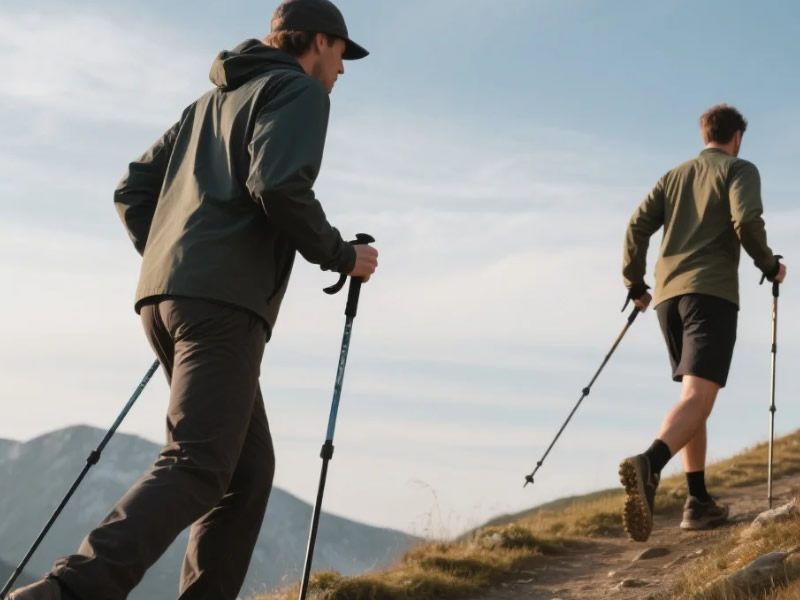
What is the oxygen cost of walking?
The oxygen cost of walking is the amount of oxygen your body consumes per unit of distance (e.g., ml/kg/km). It is a measure of the metabolic cost of walking—how much energy you are expending to move your body. On steep grades, the oxygen cost increases significantly because your legs have to work harder to lift your body weight against gravity. On a steep ascent, the oxygen cost can be 2-3 times higher than on flat ground.
How trekking poles reduce oxygen cost
1. Load transfer: the 30% rule
When you plant a trekking pole and push down, you transfer a portion of your body weight from your legs to your arms. The exact amount depends on the force you apply, but biomechanical studies have shown that using two poles can transfer up to 30% of your body weight from your legs to your arms. This has two effects:
- Reduced leg work: Your legs have to generate less force to lift your body weight. This reduces the metabolic demand on the leg muscles.
- Increased muscle recruitment: Your arms, shoulders, and back are now doing work. This spreads the overall metabolic demand over a larger muscle mass, reducing the fatigue on any single muscle group.
2. The braking effect (descents)
On descents, the oxygen cost is primarily determined by the need to absorb impact and control the speed of descent. This requires your leg muscles to work eccentrically (lengthening while contracting), which is metabolically expensive. Trekking poles act as brakes, absorbing some of the impact and reducing the eccentric work required by your legs.
3. The propulsive effect (ascents)
On ascents, poles help you push upwards. By pushing down on the poles, you generate an upward force that assists your legs in lifting your body. This reduces the work required by your quadriceps and glutes.
The research evidence
Several studies have quantified the effect of trekking poles on oxygen cost.
- A 2019 study in the Journal of Applied Physiology found that using trekking poles on a 15% grade reduced the oxygen cost by 17% on descents and 12% on ascents, compared to walking without poles.
- A 2020 study in Gait & Posture found a 20% reduction in oxygen cost on descents for walkers using poles.
- A 2021 systematic review of multiple studies concluded that trekking poles reduce the oxygen cost of walking on steep grades by an average of 15% on descents and 10% on ascents.
Why the effect is most pronounced on descents
On descents, the energy cost is primarily determined by the work required to absorb impact and control speed. This is a highly demanding activity for the leg muscles. By absorbing some of the impact and reducing the load on the legs, poles have a greater effect on the oxygen cost.
On ascents, the work is primarily done by the leg muscles to lift the body. Poles can assist, but the effect is smaller because the legs are still doing the majority of the work.
Practical advice for reducing oxygen cost
- Use two poles: Two poles distribute the load evenly and provide a greater reduction in oxygen cost than one pole.
- Push down on descents: Lengthen your poles on descents and push down firmly to absorb impact.
- Push down on ascents: Shorten your poles on ascents and push down to assist your legs.
- Maintain a relaxed grip: A tight grip causes tension in the upper body, which can increase oxygen cost.
- Use the wrist strap correctly: The strap transfers the load to your arm, reducing the effort required to hold the pole.
Summary table
| Terrain | Effect of Poles on Oxygen Cost | Mechanism |
|---|---|---|
| Steep descents | Up to 20% reduction | Pole acts as a brake, absorbing impact and reducing leg work |
| Steep ascents | 10-15% reduction | Pole assists in lifting the body, reducing leg work |
| Flat terrain | Minimal effect | No significant grade to work against |
Limitations
- Requires correct technique: If you don't push down effectively, you won't get the benefit.
- Not effective on very steep terrain: On extremely steep terrain, poles can be a hindrance.
- Additional weight: Poles add weight to your arms, which can slightly increase oxygen cost on flat terrain.
The verdict
Yes, using trekking poles can significantly reduce the oxygen cost of walking on steep grades, by up to 20% on descents and 10-15% on ascents. The effect is due to load transfer to the arms, which spreads the work over more muscle groups and reduces the workload on the legs. The benefits are most pronounced on descents, where the poles act as brakes. To maximise the benefit, use two poles, push down firmly, and use the correct technique. With the right technique, you can walk on steep terrain with less effort and greater efficiency.




