




What is the safe load rating for trekking poles used with a hammock?
In the growing world of ultralight camping and bikepacking, trekking poles have become multi‑use heroes—they prop up tarps, serve as emergency splints, and, increasingly, act as supports for lightweight hammocks. But unlike dedicated hammock stands or tree straps, trekking poles were never engineered for lateral loads. So when you ask, "What is the safe load rating for trekking poles used with a hammock?" the honest answer is: there is no official rating. Manufacturers do not test or certify their poles for this application. However, through engineering reasoning, field experience, and cautious extrapolation, we can establish practical safety guidelines. This article will explain the physics, quantify the risks, and give you actionable rules to stay safe.
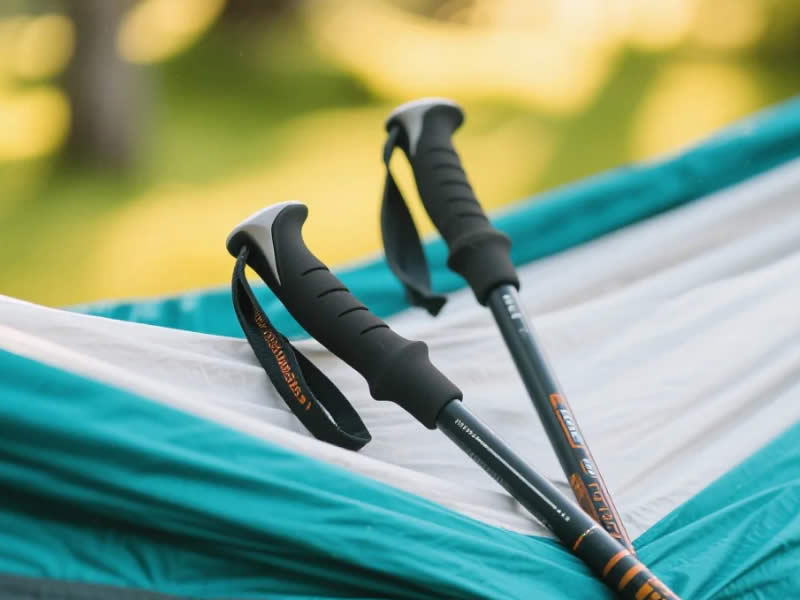
1. Why Trekking Poles Aren't Rated for Hammocks
Trekking poles are designed for axial compression – the force applied straight down along the shaft when you plant them on the ground. Their load ratings (typically 100‑140 kg or 220‑310 lbs) refer to this vertical, aligned pressure. The locking mechanisms and tube walls are optimised to resist buckling under that specific direction.
A hammock, however, applies lateral (side) forces. When you sit or lie in a hammock, the suspension lines pull the poles inward and downward at an angle. This creates a bending moment—a force that tries to snap the pole sideways. Carbon fibre, in particular, is weak under bending; aluminium bends or buckles under side loads much more easily than under compression. The ferrule joints and locking cams also experience shear stress they were never designed for.
For these reasons, even the most reputable brands explicitly state in their manuals: "Do not use as a hammock support." They avoid giving a rating because any number would be misleading and legally risky.
2. Deriving a Practical Safe Load – The 1/3 Rule
If you choose to use trekking poles for a hammock (and many ultralighters do, despite the warnings), you must drastically de‑rate the load capacity. Based on structural analysis and user reports, a reasonable safety factor is one‑third of the axial rating.
- If your pole is rated for 120 kg axially, treat it as 40 kg (88 lbs) per pole for hammock use.
- If rated for 150 kg, treat it as 50 kg (110 lbs).
This reduction accounts for the bending moment, the unpredictability of ground conditions, and the dynamic loading when you shift your weight. Using two poles doesn't simply double the capacity—the load distribution depends on the hammock's geometry and how the poles are angled.
3. The Geometry Factor – Angle Matters Massively
The load on each pole is not just your body weight; it's the tension in the suspension lines. For a hammock hung at a typical 30‑degree angle, the tension on each suspension line is approximately equal to your weight. If you weigh 80 kg, each line pulls with about 80 kg. That force is transmitted to the top of the pole.
However, if the pole is set at a shallow angle (leaning away from the hammock), the side load is increased. At a 15‑degree pole angle from vertical, the lateral force component can be over 60% of the tension. At a steep angle (closer to vertical), that side force reduces significantly.
Practical rule: Set your poles as vertical as possible (no more than 10‑15 degrees off vertical). The more upright, the more the load becomes compression (which the pole can handle) rather than bending (which it cannot).
4. Real‑World Failure Reports – What Can Go Wrong
Online forums and gear reviews contain numerous accounts of snapped poles during hammock use. Common failure modes:
- Buckling at the lower joint – The thinnest section is the weakest. A sudden sit‑down creates a shock load that buckles it.
- Ferrule separation – The push‑button or cam lock gives way under the lateral pull, and the pole collapses.
- Tip penetration – The carbide tip sinks into soft ground, changing the angle and increasing bending.
- Cord failure (folding poles) – The internal elastic cord snaps under repeated tension, causing the sections to separate.
These incidents almost always involve users exceeding about 60 kg total weight on a single pole, or using poles with a shallow angle. They serve as real‑world evidence that the 1/3 rule is not over‑cautious.
5. How to Use Trekking Poles Safely for Hammocks
If you decide to proceed, follow these strict guidelines:
- Use two poles – Place one at each end of the hammock. This spreads the load and prevents a single point of failure.
- Widen the stance – Angle the poles outwards slightly (like an inverted V) to increase stability, but keep them as vertical as possible relative to the ground.
- Reinforce the tips – Use large rubber feet or plastic cups to prevent the tips from sinking, which changes the load angle.
- Guy lines – Add two additional guy lines from the pole tops to stakes in the ground, counteracting the inward pull of the hammock. This transforms much of the lateral force into tension on the lines, reducing the bending on the poles.
- Test progressively – Before lying down, sit gently and bounce slightly to check for any creaking or slipping. Increase load slowly.
- Never exceed 70 kg (155 lbs) total user weight – Even with two good poles and ideal geometry, this is a sensible upper limit for safety.
6. Better Alternatives – Dedicated Hammock Stands
For any regular hammock use, the safest and most reliable solution is a dedicated hammock stand, collapsible frame, or tree‑strap system. Products like the Tensa4 or Wingman stand are lightweight, foldable, and rated for 150‑200 kg. They are engineered for lateral loads and provide peace of mind. The weight penalty (1‑2 kg) is a small price for safety compared to using trekking poles as a makeshift support.
Similarly, some manufacturers (like Black Diamond) offer "hammock adapter kits" that include a reinforced yoke that distributes the load better—but even these are not a full guarantee.
7. The Manufacturer's Liability Perspective
No major pole brand will ever endorse hammock use, because doing so would expose them to liability. They test only for walking and skiing, not for static suspension. So if you break a pole this way, you void the warranty. Understanding this legal backdrop, you realise that any "safe load" you derive is your own responsibility. The numbers we've discussed are based on community consensus and basic mechanics—not official engineering data.
8. Conclusion – Respect the Limits
To directly answer the title: there is no standard safe load rating for trekking poles used with a hammock, because they aren't designed for it. If you must use them, apply a derating factor of at least 3, keep the poles nearly vertical, use two poles, add guy lines, and never exceed a total user weight of about 70 kg. For everyone else—especially heavier hikers or those camping regularly—invest in a proper hammock stand. Trekking poles are brilliant tools, but like any tool, they have boundaries. Respect those boundaries, and both you and your gear will stay intact for many adventures to come.




