




Can I use budget poles if I weigh over 100kg with a full backpack?
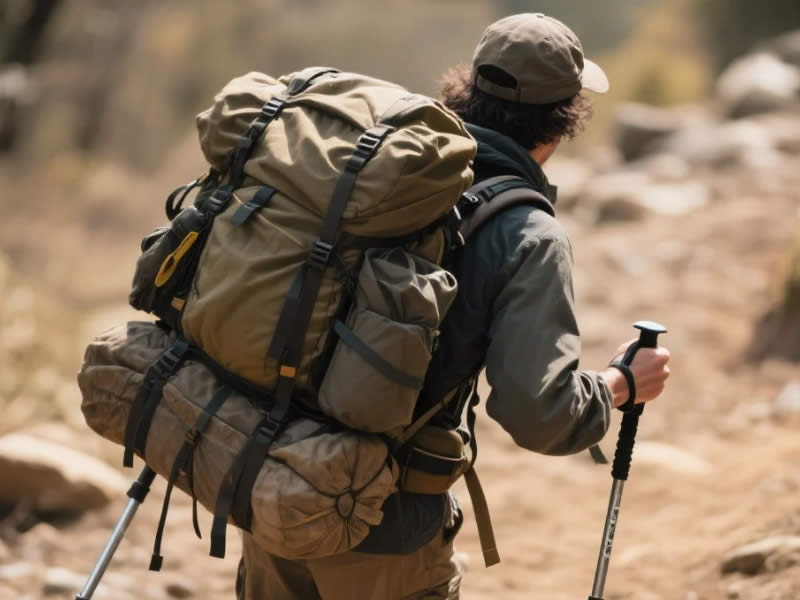
If you're a heavier hiker—say, over 100 kg (220 lbs) in body weight—and you typically carry a 15‑20 kg (33‑44 lbs) pack, you might look at those attractively priced budget trekking poles and wonder: "Could they handle me?" The honest, safety‑first answer is almost certainly not, and definitely not for long. While budget poles have their place for light day‑hikers under 80 kg, they are engineered to minimal specifications that simply don't account for the sustained forces generated by a heavy user with a loaded pack. In this article, we'll break down exactly why this combination is risky, what numbers matter, and what alternatives you can consider without breaking the bank.
1. The Load Math – It's Not Just Your Body Weight
Most budget poles (priced under £40 / $50) are made from basic 6061 aluminium or low‑grade carbon. Their maximum user weight ratings, when stated at all, typically fall between 100‑110 kg (220‑240 lbs) . Crucially, that figure usually refers to bare body weight—not your total loaded system.
Consider a realistic scenario:
- Your body: 105 kg
- Backpack: 17 kg (incl. water, food, shelter)
- Total downward force when leaning on one pole momentarily: up to 60‑70 kg per pole (when using two poles)
- But during a steep descent or a stumble, one pole can briefly take your full system weight—over 120 kg dynamic load.
That's already above the nominal rating. Now add the dynamic factor: walking creates shock loads that can spike to 1.5‑2× your static weight. A 122 kg system can momentarily exert nearly 180 kg of force on a single pole if you lurch. Budget poles are not tested for these spikes—their thin walls and weak locks will deform, slip, or buckle.
2. Where Budget Poles Cut Corners – The Structural Reality
To understand why they fail, look at the components:
- Tube thickness – Budget poles often have 0.7‑0.8 mm wall thickness. Premium poles use 1.0‑1.2 mm. That 25‑30% difference doubles the buckling resistance.
- Alloy quality – Cheap 6061 aluminium has a yield strength of ~240 MPa. 7075‑T6, used in quality poles, reaches ~500 MPa—over twice as strong for the same weight.
- Locking mechanism – Budget flip‑locks are often plastic, with shallow clamping bands. Under high compression, they slip or crack. Premium locks have steel cams and deep, wide bands.
- Ferrule connections – In folding poles, the joints are shorter and made of softer metal, which deforms under repeated heavy load.
A budget pole might feel fine in the shop, but after 10 km of rocky terrain with a full pack, the internal damage accumulates—micro‑bends, anodising wear, and lock creep—until a sudden failure occurs.
3. Real‑World Failure Stories – Not Worth the Risk
Online hiking forums and user reviews are full of cautionary tales: a 105‑kg hiker buys a £25 pole, uses it for two days, and on the third, the twist‑lock gives way on a scree descent, sending them stumbling. Others report the lower section bending visibly after a moderate side‑load against a rock. In many cases, the pole doesn't snap instantly—it slowly deforms, becoming unusable and leaving the hiker with one functional pole for the rest of the trip.
Experienced heavy hikers almost universally recommend investing in quality. They note that a pole failure on a steep, exposed trail is not just an inconvenience—it can lead to a fall with a heavy pack, potentially causing serious injury to the user or damage to the gear.
4. Is There Any Budget Option That Works?
If your budget is truly tight, you have two viable paths:
Option A: Second‑Hand Premium Poles
A used pair of Leki, Black Diamond, or Komperdell poles, even with cosmetic wear, often outperforms a brand‑new budget pair. The engineering—thicker walls, robust locks, replaceable parts—remains intact. Check the sections for straightness and the locks for grip. You can often find excellent deals on eBay or gear‑swap forums for under $50.
Option B: Heavy‑Duty "Budget‑ish" Poles
Some less‑expensive brands (e.g., Cascade Mountain Tech's carbon poles, or Decathlon's Forclaz 500) offer models with explicit 120‑130 kg ratings at prices around $60‑80. These are not "ultra‑budget," but they are affordable and have thicker walls and better locks. Always look for the stated load rating on the packaging or product page—if it's not listed, assume it's under 110 kg.
Avoid any pole that doesn't specify a weight limit. That's a red flag indicating the manufacturer didn't bother testing.
5. How to Use Your Poles Safely if You Must Use Budget Ones
If you already own budget poles and can't afford an upgrade immediately, follow these strict survival rules:
- Never, ever put all your weight on one pole – Always use both, and keep your body centred.
- Plant vertically – Avoid angling the pole, as that multiplies the bending force. Each degree of lean increases the load on the locking mechanism.
- Reduce pack weight – Aim for under 12 kg if possible. Every kilogram you shed reduces the peak load.
- Check locks every hour – Retighten flip‑locks; twist‑locks often need a half‑turn after 5 km.
- Inspect after every hike – Look for any bending, scuff marks, or cracks. Replace at the first sign of damage.
- Avoid shock‑loading – Don't use the pole to push off vigorously; plant gently and rhythmically.
These measures can extend the life of budget poles, but they do not eliminate the risk. You are essentially operating outside the design envelope.
6. When the Extra Cost Is Worth It
Consider the cost of a premium pole (approx. $100‑150) against the cost of:
- A hospital visit from a fall – even a minor ankle sprain can cost hundreds in treatment or lost work time.
- Replacing your gear if the pole snaps and damages your tent or camera.
- Ruining a multi‑day trek because your pole fails and you can't continue safely.
From this perspective, spending an extra $50‑70 for a reliable, rated pole is not an expense—it's insurance. Good poles also last 5‑10 years, making the per‑trip cost negligible.
7. Recommended Models for Heavy Hikers on a Budget
- Cascade Mountain Tech Carbon Trekking Poles – ~$50, rated 120 kg, with flip‑locks. Decent value.
- Decathlon Forclaz 500 Aluminium – ~$60, rated 130 kg, 7075 alloy, thick walls.
- Fizan Compact (used) – Lightweight aluminium, often rated 120‑130 kg; find used pairs.
- Black Diamond Trail (pre‑owned) – Classic 3‑section telescopic, 7075, easily handles 130 kg.
These are not "cheap," but they are "inexpensive for the safety they provide."
8. Final Verdict – Don't Gamble on Your Safety
To directly answer the question: No, you should not use budget poles if you weigh over 100 kg with a full backpack. The risk of sudden failure is too high, the engineering margin too narrow, and the consequences too serious. Invest in poles with a clear 130‑140 kg rating—whether new from a value brand or used from a premium one. Your knees, your back, and your peace of mind will thank you. Trekking poles are safety equipment, not fashion accessories. Treat them as such, and they'll carry you safely for thousands of kilometres.




