




Are there heavy-duty "plus-size" trekking poles for larger framed walkers?
If you're a taller, broader, or heavier hiker, you've probably noticed that standard trekking poles feel like they belong to someone else. The shafts are too thin, the grips are too short, and the weight ratings seem to stop just short of your body weight—let alone your pack. The good news is that yes, heavy‑duty "plus‑size" trekking poles absolutely exist. They are specifically engineered for larger‑framed walkers, with thicker tubes, reinforced locks, oversized grips, and load ratings that can handle 130‑150 kg or more. This article will guide you through what makes a pole "plus‑size," which models to consider, and how to choose the perfect pair for your frame.
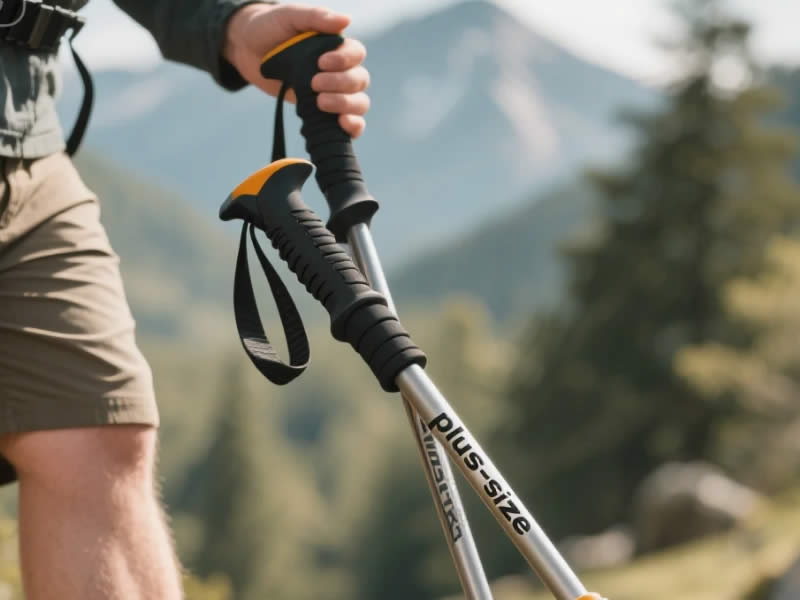
1. What Defines a "Plus‑Size" Trekking Pole?
Unlike clothing, there is no official industry standard for "plus‑size" poles. However, manufacturers and seasoned hikers agree on several key features that distinguish heavy‑duty models from regular ones:
- Larger shaft diameter – Standard poles are 14‑16 mm in the lower sections. Heavy‑duty models start at 18 mm and can go up to 20 mm. This extra girth dramatically increases resistance to bending and buckling.
- Thicker walls – While regular poles use 0.8‑1.0 mm wall thickness, plus‑size versions often use 1.2‑1.5 mm aluminium or comparable carbon layups, adding significant strength.
- Higher alloy grade – The best heavy‑duty poles use 7075‑T6 aluminium, which has a yield strength of over 500 MPa—more than double that of basic 6061. Some premium carbon models also use high‑modulus fibre with reinforced weaves.
- Enhanced locking mechanisms – Instead of plastic cams or basic twist‑locks, plus‑size poles feature dual‑metal flip‑locks with wide clamping bands and stainless steel screws that can be tightened for maximum grip.
- Extended or contoured grips – Larger hands need more real estate. These poles come with longer foam or cork handles (often 20‑25 cm) and sometimes a wider diameter grip to reduce hand fatigue.
- Explicit weight rating – While standard poles may not list a limit, heavy‑duty models almost always display a maximum user weight of 130‑150 kg (285‑330 lbs), often with a note that they are tested for heavy packs.
2. Top Brands and Models for Larger Walkers
Several reputable brands offer dedicated heavy‑duty lines that are perfect for larger‑framed users:
- Black Diamond Expedition 3 – A classic 3‑section telescopic pole with a 18 mm lower shaft, 7075 aluminium, and the proven FlickLock mechanism. Rated for 140 kg and available in lengths up to 145 cm for tall walkers.
- Leki Makalu – Built for trekking and mountaineering, the Makalu uses an 18 mm shaft, a robust SpeedLock 2 system, and is rated at 130‑140 kg. The cork grip is extra‑long to accommodate larger palms.
- Komperdell Titan – This heavy‑duty model features a 18 mm 7075 shaft, a dual‑cam locking system, and is tested to 145 kg. The ergonomic grip with an extended support area is designed for big hands.
- MSR Revo – A folding pole with a twist? Yes, but the Revo uses a thick‑wall aluminium design and a reinforced joint, rated for 130 kg. It’s a good choice for those who need packability without sacrificing strength.
- Trekology Titan 2.0 – A more budget‑friendly option with a 18 mm 7075 shaft and 130 kg rating, though the grip is slightly shorter—still, it offers value for taller hikers.
For carbon lovers, Black Diamond Pursuit Carbon and Leki Cressida Carbon are available in heavy‑duty variants with ratings up to 135 kg, though they are considerably more expensive and more brittle under side‑impacts—so aluminium is often the safer bet for larger users on rocky terrain.
3. Beyond Shaft Thickness – The Grip and Strap Matter
A larger frame often means bigger hands. Standard grips with a circumference of 90‑95 mm can feel cramped, leading to hot spots and blisters. Plus‑size poles address this with:
- Oversized grips – Some models (like the Komperdell Titan) have a grip diameter of 35‑38 mm, compared to 28‑30 mm on regular poles.
- Extended length – A longer grip allows you to choke up on steep ascents or shift your hand position without hitting the end of the handle.
- Wide, padded straps – Thicker straps with easy‑adjust buckles reduce pressure points and accommodate larger wrists or gloves.
If you buy a pole with a standard grip, aftermarket grip wraps or foam tubing can be added, but it's better to start with a model designed for your hand size.
4. How to Choose the Right Plus‑Size Pole for You
Follow this decision tree:
- Check your total system weight – Weigh yourself fully clothed with your full pack. Add 5‑10 kg for safety margin. If your total is 115 kg, look for a pole rated ≥130 kg. For 130 kg total, seek a 150‑kg rating.
- Measure your height – Pole length should be roughly your height in cm × 0.66 for Nordic walking or 0.68 for general trekking. Ensure the model you choose can extend to that length with at least 5 cm of overlap remaining for safety.
- Consider your terrain – If you hike mostly on muddy or snowy trails, larger baskets are available—but the shaft strength is the priority. For sharp rock, aluminium is more forgiving than carbon.
- Test the locking feel – If possible, extend and lock the pole; push down hard. A solid stop with no creaking or slipping indicates a good lock.
5. Using Plus‑Size Poles – Technique Matters
Even with the strongest poles, poor technique can overload them:
- Always use two poles – This halves the load per pole and provides better balance.
- Plant vertically – Keep the shaft near perpendicular to the ground. Angled planting multiplies bending forces.
- Avoid prying – Never use a pole to lever a rock or pull yourself up a steep edge; that's a common cause of breakage even in heavy‑duty models.
- Check tightness regularly – Heavy use can loosen flip‑locks; retighten the adjuster screw every few hours.
6. When Even Plus‑Size Isn't Enough – Custom Options
For exceptionally heavy users (over 150 kg), some specialist brands like Pacerpole or Wanderlust offer custom‑built poles with larger‑diameter tubing (up to 22 mm) and custom‑welded joints. These are expensive but necessary for absolute safety. Alternatively, some mobility‑aid walking sticks (designed for bariatric use) can be adapted for trekking, though they lack the ergonomic grip and lightweight design.
7. The Verdict – Yes, They Exist and They're Worth It
To directly answer the question: Absolutely, there are heavy‑duty "plus‑size" trekking poles for larger‑framed walkers. They are not a niche rarity; they are a growing category with clear choices from every major brand. The key is to look past marketing fluff and focus on the specifications: shaft diameter, wall thickness, alloy, lock type, and the all‑important maximum user weight—printed clearly on the box. Investing in a proper plus‑size pole is not an indulgence; it's a necessity for safety, comfort, and enjoyment on the trail. With the right pair, your height and build become an asset, not a limitation. So go ahead, measure your needs, choose wisely, and enjoy the stability and confidence that properly sized gear brings.




