




Are ultralight poles strong enough for the rocky summit of Ben Nevis?
When you're standing at the foot of the UK's highest mountain, every gram in your pack feels like a pound. The allure of ultralight trekking poles – those featherweight sticks weighing under 200g per pair – is undeniable. But as you gaze up at the jagged, boulder‑strewn summit plateau of Ben Nevis, a critical question arises: will these delicate shafts survive the relentless abuse of frost‑shattered rock, or will they leave you stranded halfway down? The honest answer is nuanced: for most hikers, ultralight poles are not strong enough – but with careful selection and impeccable technique, a select few models can handle the challenge.
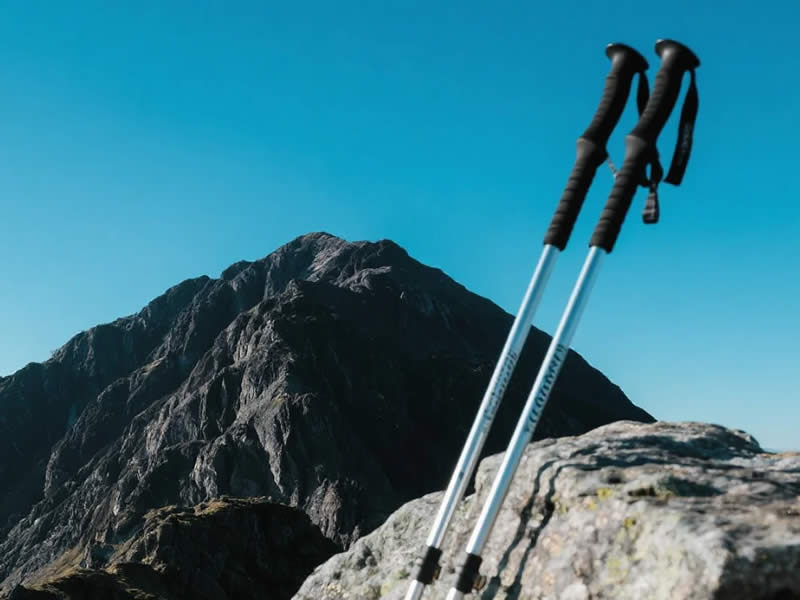
1. Understanding Ultralight Pole Construction
Ultralight poles typically fall into two categories:
- Carbon fibre Z‑fold – 3‑ or 4‑section designs with internal cords, collapsing to around 30‑40 cm. Weighing 130‑180g per pole.
- Thin‑wall aluminium telescopic – 2‑ or 3‑section poles with wall thicknesses of 0.7‑0.8mm, often using 6061 or low‑grade 7075 alloy. Weighing 160‑220g.
The weight savings come from reduced material – thinner tubes, smaller diameters (often 12‑14mm lower sections), and minimalist locking mechanisms. In exchange, you sacrifice bending stiffness and impact resistance.
2. The Critical Weakness: Lateral (Side) Loads
In laboratory tests, ultralight poles perform admirably under axial compression – straight downward force. A well‑made carbon pole can support 120‑150 kg static load without buckling. That's well above the weight of any hiker.
However, the summit of Ben Nevis is not a laboratory. Its "felsenmeer" – a sea of angular, loose blocks – demands constant diagonal planting. When you place a pole at an angle to brace against a descent, or when you accidentally wedge the tip between two rocks and lean sideways, you introduce bending moments that the pole was never designed for.
Carbon fibre is strong in tension and compression but weak in shear and point‑impact. A sideways strike against a sharp edge can create a stress riser, causing the shaft to shatter without warning. Aluminium ultralights fare better – they bend rather than snap – but the thin walls mean they deform permanently at surprisingly low side‑loads, leaving you with a crooked pole that may not lock properly.
3. Why Ben Nevis Is Particularly Demanding
The summit of Ben Nevis is not a smooth path. It's a chaotic jumble of rocks, often wet and greasy. The descent is particularly punishing: you're braking with every step, transferring significant horizontal force through your poles. Furthermore, the weather can change from calm to gale‑force in minutes, adding unpredictable gusts that can catch your poles and twist them.
Most ultralight poles come with tiny baskets (or none at all) to save weight. On Ben Nevis's loose scree, a larger basket helps prevent the tip from sinking deep between rocks, reducing the chance of a side‑loading jam. Without it, you're more likely to get your tip stuck, and the inevitable yank to free it can exceed the pole's lateral strength.
4. The Numbers: What the Specs Don't Tell You
While many ultralight poles proudly display a "max user weight" of 120 kg, that figure is almost always based on a static vertical test performed at room temperature with a perfectly aligned load. In the real world, dynamic loads during a stumble can spike to 2‑3× your body weight, and those loads are rarely vertical.
Independent gear testers have found that typical ultralight carbon poles fail at side‑loads as low as 25‑30 kg – less than the force you'd exert leaning on a pole for a rest. Aluminium ultralights may withstand 40‑50 kg of lateral force before permanent bending. Compare that to a heavy‑duty 18mm 7075 aluminium pole, which can handle over 80 kg of side‑load without deforming. The difference is stark.
5. Exceptions: Ultralight Poles That Can Handle the Summit
Not all ultralight poles are created equal. A few premium models deliberately reinforce the critical areas:
- Durston Iceline – Uses a 16mm lower section (vs the usual 12‑14mm) and high‑modulus carbon with a proprietary layup. Rated for 130 kg and tested on rocky terrain by thru‑hikers.
- Black Diamond Distance Carbon Z – The newest version features a larger diameter and a stiffer weave. Many users report success on the Scottish Highlands, but they still advise careful planting.
- Leki Micro Vario Carbon – Its hybrid folding/telescopic design allows the lower section to have a thicker wall, and the locking system is more robust than typical Z‑poles.
Even with these, the consensus among experienced Munro‑baggers is: use them only if you are a lightweight walker (under 75 kg), you carry a minimalist pack (under 8 kg), and you have flawless pole technique – always planting directly under your shoulder, never angling the shaft, and never using the pole as a lever.
6. The Safer Alternative for Ben Nevis
For the vast majority of walkers, a pair of 3‑section telescopic poles with:
- 18mm lower shaft diameter
- 7075‑T6 aluminium (or comparable thick‑wall carbon)
- Flip‑locks with metal cams (not twist‑locks)
- Weight rating of at least 130 kg (and preferably 140‑150 kg)
...is the wise choice. Models like the Black Diamond Trail Pro, Leki Makalu, or Komperdell Titan add only 100‑150g per pole over ultralight options but multiply the margin of safety. That extra half‑pound on your back is a small price for the confidence that your poles won't snap on a loose, wet rock when you need them most.
7. Technique Tips for Rocky Summits
Regardless of your pole choice, these habits will reduce stress:
- Shorten poles on the descent – This lowers your centre of gravity and reduces leverage on the shaft.
- Keep wrists relaxed – Let the strap take the load, not your grip, which can transmit sudden jerks.
- Avoid planting behind you – Place the tip slightly ahead or beside your foot to maintain a vertical shaft angle.
- Tap before you lean – Test the ground with a light tap to ensure the tip is stable before putting weight on it.
8. Final Verdict
To answer the title directly: For most walkers, no – ultralight poles are not strong enough for the rocky summit of Ben Nevis. The combination of lateral forces, sharp edges, and unpredictable terrain exceeds the safe operating envelope of typical lightweight designs. If you are a highly experienced, lightweight hiker using a reinforced premium model, you may succeed – but you're accepting a narrower margin of error. For everyone else, invest in a sturdy, rated pole that prioritises durability over grams. Your knees and your safety will thank you when you're negotiating that final boulder field in the mist.




