




What length poles for the steep descent of Pen-y-Ghent?
Pen-y-Ghent, the northernmost of the Yorkshire Three Peaks, is famous for its dramatic, steep descent on the southern side. As you leave the summit behind, the path plunges down a rocky, exposed ridge that demands careful footwork and, if you're wise, a well‑adjusted pair of trekking poles. The question of pole length isn't trivial – set them too short and you'll feel hunched and unstable; too long and you'll lose leverage and perhaps even overbalance. In this guide, we'll cut through the guesswork and give you a precise, field‑tested formula for the ideal length, along with the technique to make that descent feel controlled and confident.
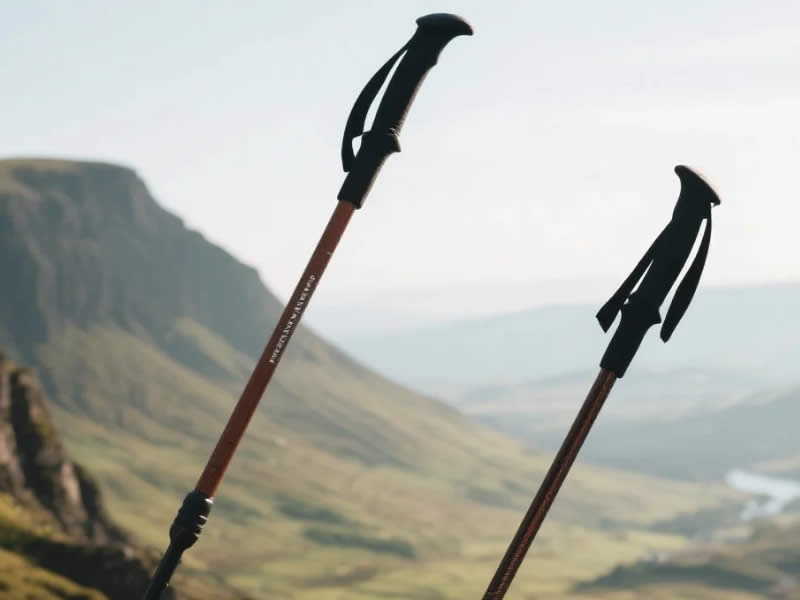
1. The Goldilocks Rule for Descending Pen-y-Ghent
The golden rule for any steep descent is: extend your poles 5–10 cm (2–4 inches) longer than your standard flat‑ground setting.
Your flat‑ground length is determined by the 90‑degree elbow rule – with the tip on the ground, your elbow forms a right angle. For most walkers between 170–185 cm (5'7"–6'1") tall, that flat length typically falls between 115–125 cm (45–49 inches). On a steep, rocky descent like Pen-y-Ghent's, you'll want to add 5–10 cm, bringing you into the 120–135 cm range.
But why exactly that extra length? When you're descending, the slope drops away in front of you. A longer pole allows you to plant the tip well ahead of your foot, creating a stable brace that acts as a brake. It also keeps your torso more upright, reducing the strain on your lower back and allowing your heels to absorb the impact more effectively. Without that extra length, you'd have to lean forwards to reach the ground, putting your centre of gravity in a more precarious position.
2. A More Precise Method – The Forearm Test
For a truly tailored setting, use this simple arm test:
- Start with your pole at your normal flat length.
- Stand on the descent and place the tip on the ground about one step ahead of your forward foot.
- Now, your forearm should be roughly horizontal (parallel to the slope), and your elbow should be slightly more than 90 degrees – think 100–110 degrees.
- If your elbow is bent at a sharp angle (less than 90°), your poles are too short – lengthen them.
- If your elbow is nearly straight (more than 120°), they're too long – shorten them.
This method works because it accounts for your personal arm length, stride, and the steepness of the slope at that moment. It's more accurate than relying solely on height charts.
3. Practical Recommendations Based on Height
To give you a concrete starting point, here are the recommended descent lengths for Pen-y-Ghent based on walker height:
| Walker Height | Flat Length (approx.) | Descent Length (Pen-y-Ghent) |
|---|---|---|
| 160–170 cm | 105–115 cm | 115–125 cm |
| 170–180 cm | 115–120 cm | 120–130 cm |
| 180–190 cm | 120–125 cm | 125–135 cm |
| 190–200 cm | 125–130 cm | 130–140 cm |
These are guidelines – always fine‑tune on the spot.
4. Why Flip‑Locks Are Your Friend on This Descent
The descent of Pen-y-Ghent is not a place for fiddly adjustments. The path is steep, the rocks are loose, and you'll want to change your pole length several times as the gradient varies. This is where flip‑locks (cam locks) shine. They allow you to release, slide, and re‑tighten in seconds, even with cold, sweaty hands. Twist‑locks, by contrast, require twisting the lower section, which can be awkward when you're leaning on the pole, and they're more prone to slipping under the heavy loads of a steep descent.
If you're using flip‑locks, make sure the locking screw is tight enough that the sections won't slip when you push hard – but not so tight that you can't adjust them on the move. A quick check before you start the descent can save you a lot of hassle.
5. The Impact of Pack Weight
Your pack weight influences the ideal length. If you're carrying a heavy overnight pack (say, 12–15 kg), the extra load will compress your body more, and you may find that you need your poles slightly longer – by about 1–2 cm – to maintain an upright posture. Conversely, if you're going light (a small daypack of 5–8 kg), the standard guidelines will serve you well. The key is to test a few paces with your full pack on, not at the summit in a static position.
6. How to Adjust Mid‑Descent
Pen-y-Ghent's descent isn't a uniform gradient. It has sections of gentle slope, then sudden steep drops, and finally a flatter moorland track. You should adjust your poles accordingly:
- Gentle slopes – Keep them at your flat length.
- Steep drops (like the main rocky gully) – Lengthen them to the maximum recommended.
- Flat sections – Shorten back to your flat length to maintain efficient rhythm.
Don't be afraid to stop for 10 seconds and tweak. Walkers who set their poles once and forget them often finish the descent with aching wrists or a sense of instability.
7. Technique Tips for a Safe Descent
Length is only half the story – how you use the poles matters equally:
- Plant ahead, not beside – On steep ground, plant the pole about a foot in front of your leading foot, on the downhill side. This creates a tripod with your legs and prevents you from pitching forward.
- Lean into the straps – Use the wrist straps so you don't have to grip the handle tightly. This allows you to put your weight through the strap while your hand stays relaxed.
- Shorten your stride – Smaller, deliberate steps on the steep sections give you more time to plant each pole securely.
- Use both poles equally – Don't rely on one pole; distribute the braking force between both.
8. When to Go Shorter – A Note on Very Steep, Scrambly Sections
Near the top of the descent, the path becomes almost scrambly, with large boulders that require hands as well as feet. Here, you might actually want to shorten your poles or collapse them entirely and tuck them into your pack, freeing your hands for the rocky steps. This is a personal call – many walkers prefer to keep one pole out for balance, but two poles on very steep terrain can become a hindrance.
9. Final Verdict – Trust Your Body, Adjust Constantly
There is no single, perfect number for every walker. But armed with the 5–10 cm extension rule, the forearm test, and the understanding of your pack weight and the changing gradient, you can find your optimal length in seconds. Start with 125 cm if you're average height, test on the first steep step, and lengthen or shorten until you feel balanced, stable, and able to brake with confidence. The descent of Pen-y-Ghent is a highlight of the Three Peaks – with the right pole length, you'll enjoy every step of it, rather than fearing the strain on your knees.




