




Can I use trekking poles for the "Welsh 3000s" challenge?
Yes – and you'd be foolish to leave them behind. The Welsh 3000s – the legendary 15‑peak traverse across all of Snowdonia's 3,000‑foot summits – is a punishing 30‑mile (48‑km) day with over 3,000 metres of ascent and descent. It's a test of endurance, navigation, and sheer mental grit. In that context, trekking poles aren't a luxury; they're a performance‑enhancing tool that can make the difference between finishing strong and hobbling to a premature stop. However – and it's a critical "however" – you need to use the right poles and deploy them correctly across the varied terrain. This guide will tell you exactly how.
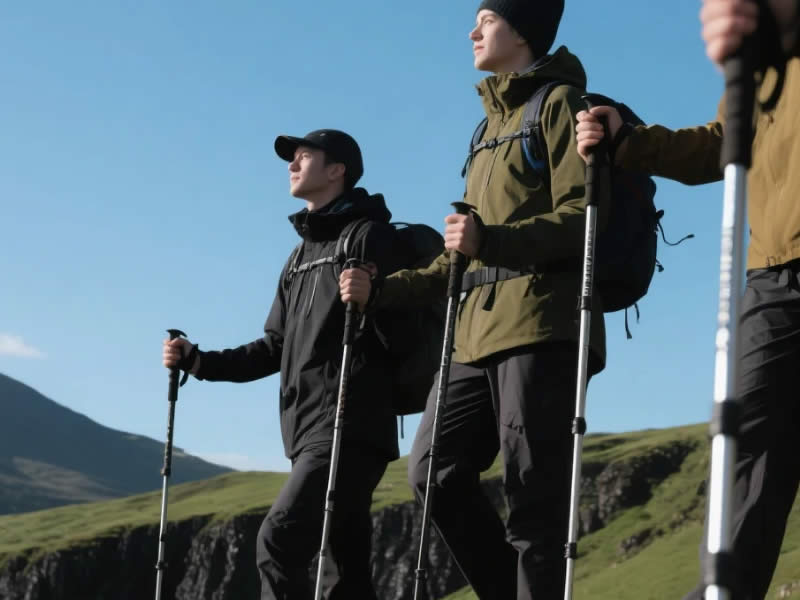
1. Why poles are essential for the Welsh 3000s
The challenge involves relentless ascents and descents, often on steep, rocky ground. Over 30 miles, your knees absorb thousands of jarring impacts. Research shows that poles can reduce compressive forces on the knees by up to 25% – a massive saving over a long day. They also:
- Improve balance on loose scree and wet rock – vital on descents from Tryfan or the Glyderau.
- Increase walking speed on flat sections by engaging your upper body and maintaining rhythm.
- Reduce hand swelling – when arms hang for hours, blood pools; poles keep them gently working.
- Provide stability when you're fatigued – and you will be, deep into the challenge.
2. The terrain challenge – poles need to be adaptable
The Welsh 3000s isn't a uniform walk. It throws everything at you:
- Grassy approaches – long, steep pulls up Pen‑y‑Ole‑Wen and Elidir Fawr, where poles are pure support.
- Scree and boulder fields – the descent off Tryfan and the Glyderau, where poles give you four points of contact.
- Exposed ridges – like Crib Goch and Bwlch Tryfan, where you cannot use poles and must have your hands free.
- Long, flat-ish traverses – between Carnedd Llewelyn and Foel-fras, where poles help maintain a steady, efficient stride.
This variety means you need a pole that can be deployed quickly, stowed securely, and adjusted on the move.
3. What type of pole works best?
For the Welsh 3000s, you have two strong options:
- Lightweight folding (Z‑style) poles – These are the most popular choice. They pack down to around 30‑40 cm, fitting inside a small daypack, and deploy in seconds. Models like the Black Diamond Distance Z, Leki Micro Vario, or Fizan Compact are excellent. They're light enough (under 250g per pole) that you barely notice them when carried, and they give you the support you need on the long climbs and descents.
- Telescopic poles – These are also fine, but you'll need to collapse them to their shortest length (often 60‑70 cm) for the scrambles. This can be awkward to stash on a small pack. If you use them, ensure they have flip‑locks for quick adjustment and a secure way to attach them horizontally to your pack.
Avoid heavy, all‑metal poles – the weight will exhaust you over 30 miles.
4. The critical phase – Crib Goch
Crib Goch is the sharp, knife‑edged arête that many consider the highlight – and the crux – of the Welsh 3000s. It's a genuine scramble where you need both hands on rock. You cannot, and should not, try to use poles on the ridge itself. You have two choices:
- Stow them before you start the ridge – Collapse your poles and secure them to the outside of your pack, ensuring they won't swing loose.
- Leave them in a cache – Some walkers leave their poles at the base of Crib Goch (e.g., at the top of the Pyg Track) and collect them later. This saves carrying weight but means you'll be without poles for the descent off Crib Goch and the ascent of Yr Wyddfa (Snowdon).
The majority of experienced challengers stow their poles – it's simpler, and you can deploy them immediately after the ridge for the long descent to Llyn Llydaw.
5. Length adjustment – a key technique
On the Welsh 3000s, you'll be constantly changing gradient. Adjust your pole length throughout the day:
- On flat ground – Set to the 90‑degree elbow angle (your standard length).
- On ascents – Shorten by 5‑10 cm. This keeps your elbows from rising too high and allows a comfortable push.
- On descents – Lengthen by 5‑10 cm. This gives you a longer reach to brake and plant ahead.
With flip‑locks, this takes seconds. With twist‑locks, it's more awkward – another reason to favour flip‑locks.
6. What to carry for your poles
- Spare tips – The Welsh 3000s includes rocky sections that will blunt carbide tips. Carry a spare pair in your pack.
- A small multi‑tool – For tightening a loose screw on a flip‑lock.
- Rubber tip protectors – Useful for the long road sections between some peaks (e.g., the A5 crossing near Capel Curig). Slip them on for tarmac, take them off for the hills.
7. A note on technique – don't become a "polo player"
Some walkers use poles inefficiently, swinging them too widely or planting too far behind. For maximum efficiency on a long day:
- Swing in opposition – Right foot, left pole; left foot, right pole.
- Plant at the right time – The pole should touch the ground just as your opposite foot is about to land, creating a natural stride.
- Use the straps – Don't grip the handle tightly; use the wrist straps to take the load. Your hands should be relaxed.
- Plant vertically – Avoid angled plants, especially on descents, to reduce side‑load on the shaft.
8. Will poles slow you down?
A common concern is that poles add complexity and slow you down. In reality, once you're used to them, they speed you up on flats and uphills, and they save time on descents by giving you confidence to move faster. The only time they slow you is when you're stowing or deploying them – and with practice, this takes just 10‑15 seconds. Over a 30‑mile day, that's negligible.
9. Final verdict – yes, and make them a key part of your plan
To directly answer the question: Yes, you can and absolutely should use trekking poles for the Welsh 3000s challenge. Choose lightweight folding poles with flip‑locks, stow them securely for Crib Goch, adjust length for each section, and master the basic technique. They will protect your knees, boost your rhythm, and give you the confidence to tackle the descents at speed. On the Welsh 3000s, where endurance is everything, poles are not a luxury – they're a necessity. With the right pair and a smart approach, you'll stand a much better chance of completing the challenge and enjoying every step of it.




