




What is the best length for trekking poles for a 6ft man?
If you're a 6‑foot (183 cm) man, you might have seen generic sizing charts that suggest a single number – but the truth is that pole length isn't determined by height alone. Your arm length, boot sole thickness, and the terrain you walk on all play a role. This guide gives you a precise starting point, explains how to fine‑tune with the 90° elbow test, and shows you how to adjust for ascents, descents, and personal comfort. By the end, you'll know exactly what length works for you – not just a chart number.
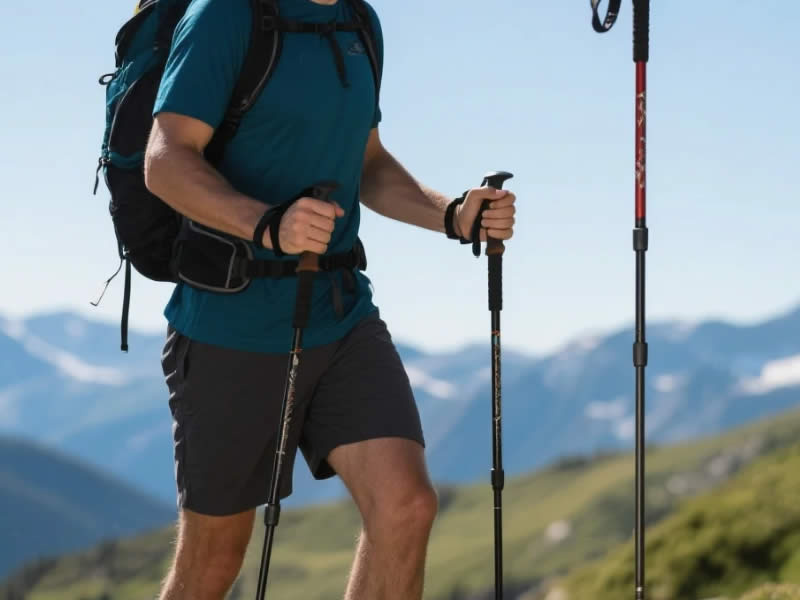
The quick answer – starting point
For a 6ft (183 cm) man, the typical flat‑terrain length is 120–125 cm. A widely used formula – height (cm) × 0.68 – gives 183 × 0.68 = 124 cm. However, this is a starting point, not a final verdict. Individual arm span, shoulder width, and the thickness of your hiking boots can shift the ideal length by several centimetres.
Important: If you're between sizes on a telescopic pole (e.g., the markings jump in 5‑cm increments), size down if you're close to the lower mark. A slightly shorter pole is easier to manage on uphills and less likely to strain your shoulders than an overly long one.
The 90° elbow test – the most reliable method
Forget formulas – the 90° elbow test is the gold standard because it accounts for your personal proportions. Here's how to do it:
- Put on your hiking boots – the soles add 1‑2 cm to your effective height.
- Stand on a flat, level surface – not a slope.
- Hold a pole vertically with the tip resting on the ground beside your foot.
- Bend your elbow to 90° – your forearm should be horizontal, parallel to the ground.
- Adjust the pole length – slide the lower section until your hand grips the handle comfortably with your wrist straight. The tip should just touch the ground without you leaning.
For a 6ft man, this usually yields a length between 120 cm and 125 cm – but you'll know it's right when your shoulder feels relaxed and your wrist is in a neutral, unbent position.
Why you need different lengths for different terrain
Once you have your flat‑terrain length, you need to adjust it for the hills. Here's the rule:
- Uphill – shorten by 5‑10 cm. A shorter pole lets you plant higher up the slope without raising your shoulder. This keeps your torso upright and your breathing efficient. On a steep ascent, you might shorten to 115‑118 cm.
- Downhill – lengthen by 5‑10 cm. A longer pole gives you reach for braking and absorbs shock on steep descents. For a 6ft man, this could mean extending to 128‑132 cm.
- Side‑hill (traversing) – shorten the uphill pole and lengthen the downhill pole by about 3‑5 cm each to keep your shoulders level.
Mark your flat, uphill, and downhill settings on the shaft with a permanent marker – this saves time when you're on the trail.
Common mistakes and how to avoid them
- Using the same length for everything – a single length may feel fine on flat ground but will cause shoulder strain on uphills and insufficient reach on downhills. Adjust every time the gradient changes – it takes 5 seconds.
- Relying solely on height charts – charts give averages, not individual fit. A 6ft man with long arms may need 127 cm; a 6ft man with a short torso and long legs may need 118 cm. The 90° test is your real guide.
- Setting poles too long for uphills – this forces you to hike with your shoulders hunched, reducing your lung capacity and tiring your upper back. If you feel tension between your shoulder blades on a climb, your poles are too long – shorten them.
- Setting poles too short for downhills – you'll have to stoop to plant the tip ahead, which strains your lower back. Lengthen until your elbow is slightly more open than 90° (about 100‑110°) – that's the sweet spot for braking.
- Forgetting to account for boot sole thickness – a thick Vibram sole can add 1.5‑2 cm. If you set your length in bare feet, your poles will be too short when you're actually walking. Always test with your walking boots on.
The role of personal preference
Some walkers prefer their poles slightly longer on the flat because it encourages an upright posture. Others like them a little shorter because it feels more "agile" and responsive. The 90° test gives you a solid starting point, but after a few miles, you may want to tweak by 1‑2 cm in either direction.
A practical tip: On your next walk, deliberately set your poles 2 cm longer than your usual setting for the first mile, then 2 cm shorter for the second mile. Pay attention to how your shoulders, wrists, and lower back feel. That experiment will tell you more than any chart.
How to measure accurately
If your poles have markings on the lower shaft (most do), they usually indicate the total length when the lower section is set to that marking. If yours don't have markings, you can:
- Use a tape measure from the tip (on the ground) to the top of the grip.
- Mark your preferred length with a small piece of tape or a fine permanent marker.
What about folding poles?
Folding Z‑poles come in fixed lengths – you choose a size when you buy. For a 6ft man, the typical sizes are:
- 120 cm – suitable for most 6ft walkers on flat to moderate terrain.
- 125 cm – if you have longer arms or prefer a more upright posture.
With folding poles, you can't adjust on the trail, so the 90° test is even more critical – and you may want to size down slightly to make uphills easier, accepting that downhills will require a slightly more bent knee.
Final recommendation
- Start with the 90° test in your boots – that gives you your flat length.
- Mark that length on your pole.
- Mark a "‑7 cm" setting for uphills and a "+7 cm" for downhills.
- Walk a few miles and adjust by 1‑2 cm if you feel any shoulder, wrist, or back strain.
For a 6ft (183 cm) man, the most common final settings are:
- Flat: 122‑124 cm
- Uphill: 115‑117 cm
- Downhill: 128‑130 cm
But these are averages – your body may prefer 120/113/127 or 125/118/132. The only true answer is the length that feels natural when you're moving.
Over to you
Don't obsess over a single number. The best length is the one that changes with your terrain and feels comfortable after a full day of walking. Use the 90° test as your anchor, adjust for hills as a habit, and trust what your body tells you. Within a few outings, you'll have a personalised set of settings that make your poles feel like a natural extension of your arms – and that's the real goal.




