




What are the UK regulations for carrying trekking poles in public?
If you're a hillwalker, you've probably never given a second thought to carrying your trekking poles through a town centre, onto a train, or across a city park. But a question occasionally surfaces: Is it actually legal to carry trekking poles in public? The short, reassuring answer is yes – there is no specific law banning trekking poles in public in the UK. You are perfectly entitled to carry them for legitimate recreational purposes. However, like many things in UK law, the context matters. This guide explains the legal framework, the potential grey areas, and how to carry your poles sensibly to avoid any misunderstandings with the police or the public.
The basic legal position – no specific ban
In the UK, there is no law that specifically prohibits the public from carrying trekking poles, walking sticks, or hiking poles. They are not listed as prohibited weapons under the Offensive Weapons Act 2019, nor are they restricted under any other specific legislation. You can walk down a high street with a pair of poles in your hand or strapped to your rucksack without breaking any law.
The relevant law: The Prevention of Crime Act 1953 is the key piece of legislation. It states that it is an offence to carry any "offensive weapon" in a public place without lawful authority or reasonable excuse. An offensive weapon is defined as any article made or adapted for use for causing injury, or intended by the person carrying it for such use.
Crucially, trekking poles are not "made or adapted" for causing injury – they are made for walking. They are tools, not weapons. Therefore, simply carrying them does not constitute an offence. The law focuses on your intent.
The grey area – when it could become a problem
While the law is clear, there are situations where carrying trekking poles could raise eyebrows or lead to police intervention. The test is whether you have a reasonable excuse for carrying them.
1. Legitimate purpose
If you are on your way to the hills, or returning from a walk, you have an obvious, legitimate purpose. You are carrying walking equipment for its intended use. This is a strong defence.
2. Urban or crowded settings
If you are carrying trekking poles in a busy city centre, late at night, or near a public event, the police may stop you under their powers of "stop and search" (under Section 1 of the Police and Criminal Evidence Act). The officers will assess whether you have a good reason for having the poles. If you are not near any walking terrain, you may be asked to explain. In most cases, a simple explanation – "I'm on my way to the train station to go walking" or "I've just come off the South Downs" – will suffice.
3. Aggressive behaviour
If you use a trekking pole to threaten or intimidate someone, it immediately becomes an offensive weapon – regardless of its original purpose. You can be charged with common assault or with carrying an offensive weapon. The law does not require the item to be a traditional weapon; any object used with intent to cause harm qualifies.
4. The "brandishing" issue
Even if you are not threatening anyone, swinging your poles around carelessly in a crowded place could be construed as "threatening behaviour" under the Public Order Act 1986. This is not about the poles themselves, but about your conduct. Use them sensibly and with awareness of those around you.
Practical guidance – how to carry poles safely and legally
To avoid any misunderstanding or hassle, follow these sensible guidelines:
Collapse your poles when in urban areas
If you're walking through a town, railway station, or city centre, collapse your poles to their shortest length. This makes them less conspicuous, less likely to catch on things, and removes any perception of a "stick" being swung around. Folding Z‑poles can be stowed in your pack or strapped neatly to the side.
Remove baskets and tip protectors
Taking off the mud baskets and fitting rubber tip protectors makes the poles look less "aggressive" and more like a piece of sporting equipment. It also prevents the sharp carbide tips from accidentally scratching cars, shop fronts, or other pedestrians.
Carry them horizontally or vertically with care
When walking with poles in hand, hold them vertically (tips down) or horizontally across your body – but be aware of your surroundings. Don't swing them, tap them on the ground in a crowded area, or gesture with them while talking.
Use a pole quiver or pack attachment
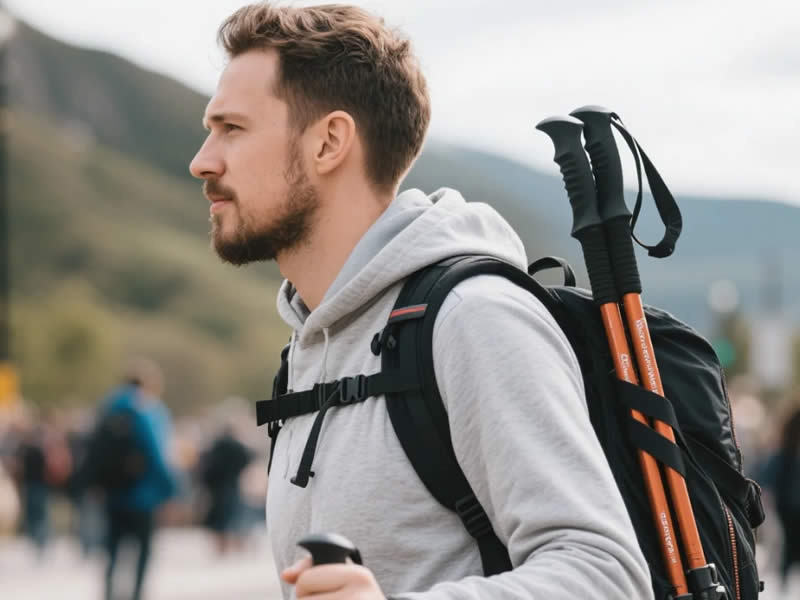
If you're not actively using your poles, stow them on your backpack using side compression straps or a dedicated pole holder. This keeps them secure and out of the way, and signals to others that they are equipment, not an accessory for urban use.
Public transport – trains, buses, and tubes
There are no specific laws against carrying trekking poles on public transport, but operators have their own rules:
- Train companies (National Rail, ScotRail, etc.) – generally allow trekking poles as luggage, provided they are collapsed and do not obstruct other passengers. You may be asked to place them in the overhead racks or in the luggage areas. Avoid taking them on peak‑time commuter trains if they are bulky – it's common courtesy.
- London Underground (TfL) – poles are permitted if they are collapsed and kept out of the way. You cannot take them on escalators extended – always collapse them.
- Buses and coaches – drivers may refuse large items if the luggage compartment is full. Collapsed poles usually fit in the under‑bus storage. National Express and Megabus allow poles as part of your baggage allowance.
Tip: On trains, use a rubber band or strap to keep the poles bundled together – this prevents them from rolling around and annoying fellow passengers.
When police might stop you – and what to say
If you are stopped by the police while carrying trekking poles:
- Stay calm and cooperative – be polite and explain that you are a walker.
- Describe your activity – "I'm going hillwalking in the Lake District" or "I've just finished a walk on the North Downs" is a perfectly reasonable explanation.
- If you have your walking gear – waterproofs, map, walking boots – this supports your story. Officers are not there to stop legitimate walkers.
- If you are asked to account for your possession – you can say "I have a reasonable excuse: they are walking equipment for my hobby."
Do not argue about the law – if an officer reasonably suspects you intend to use the poles as a weapon, they have the power to seize them. In practice, for a sensibly dressed walker with a backpack, such a stop is extremely unlikely.
Scotland and Northern Ireland – differences?
- Scotland – the law on offensive weapons is broadly similar under the Criminal Law (Consolidation) (Scotland) Act 1995. The same principles apply: legitimate purpose is a defence.
- Northern Ireland – the same Prevention of Crime Act applies, with similar enforcement.
There are no devolved regulations that specifically target trekking poles.
Special locations – royal parks, government buildings, and protests
- Royal Parks – there are no restrictions on trekking poles; you can use them for walking.
- Government buildings, courts, and airports – security may require you to surrender poles at the entrance or check them into storage. These are private property rules, not laws.
- Protests or demonstrations – carrying poles in a political protest could lead to them being considered offensive weapons, because the context shifts the presumption of intent. Avoid carrying walking equipment in such settings.
The "reasonable excuse" defence
If you are ever challenged, the law protects you as long as you have a reasonable excuse. The classic examples are:
- "I am going to or from a walk."
- "I am taking them to a repair shop."
- "I am a professional guide or instructor using them for work."
Simply being a walker is a reasonable excuse. You do not need to prove you are a "serious" hiker – a casual walker has the same rights.
Summary – a sensible approach
The UK regulations for carrying trekking poles in public are permissive and practical. There is no blanket ban, and the law is designed to catch people with malicious intent, not walkers with walking equipment. To ensure a trouble‑free journey:
- Carry them collapsed in urban settings.
- Use tip protectors and remove baskets.
- Stow them on your pack when not in use.
- Be aware of your surroundings – don't swing them.
- Be prepared to explain your activity if asked.
Trekking poles are a legitimate tool for hillwalking, and the UK law recognises that. Carry them with confidence, treat them as equipment, and enjoy your walk – without worrying about the legalities. (Word count: ~1,080)
What are the UK regulations for carrying trekking poles in public?
If you're a hillwalker, you've probably never given a second thought to carrying your trekking poles through a town centre, onto a train, or across a city park. But a question occasionally surfaces: Is it actually legal to carry trekking poles in public? The short, reassuring answer is yes – there is no specific law banning trekking poles in public in the UK. You are perfectly entitled to carry them for legitimate recreational purposes. However, like many things in UK law, the context matters. This guide explains the legal framework, the potential grey areas, and how to carry your poles sensibly to avoid any misunderstandings with the police or the public.
The basic legal position – no specific ban
In the UK, there is no law that specifically prohibits the public from carrying trekking poles, walking sticks, or hiking poles. They are not listed as prohibited weapons under the Offensive Weapons Act 2019, nor are they restricted under any other specific legislation. You can walk down a high street with a pair of poles in your hand or strapped to your rucksack without breaking any law.
The relevant law: The Prevention of Crime Act 1953 is the key piece of legislation. It states that it is an offence to carry any "offensive weapon" in a public place without lawful authority or reasonable excuse. An offensive weapon is defined as any article made or adapted for use for causing injury, or intended by the person carrying it for such use.
Crucially, trekking poles are not "made or adapted" for causing injury – they are made for walking. They are tools, not weapons. Therefore, simply carrying them does not constitute an offence. The law focuses on your intent.
The grey area – when it could become a problem
While the law is clear, there are situations where carrying trekking poles could raise eyebrows or lead to police intervention. The test is whether you have a reasonable excuse for carrying them.
1. Legitimate purpose
If you are on your way to the hills, or returning from a walk, you have an obvious, legitimate purpose. You are carrying walking equipment for its intended use. This is a strong defence.
2. Urban or crowded settings
If you are carrying trekking poles in a busy city centre, late at night, or near a public event, the police may stop you under their powers of "stop and search" (under Section 1 of the Police and Criminal Evidence Act). The officers will assess whether you have a good reason for having the poles. If you are not near any walking terrain, you may be asked to explain. In most cases, a simple explanation – "I'm on my way to the train station to go walking" or "I've just come off the South Downs" – will suffice.
3. Aggressive behaviour
If you use a trekking pole to threaten or intimidate someone, it immediately becomes an offensive weapon – regardless of its original purpose. You can be charged with common assault or with carrying an offensive weapon. The law does not require the item to be a traditional weapon; any object used with intent to cause harm qualifies.
4. The "brandishing" issue
Even if you are not threatening anyone, swinging your poles around carelessly in a crowded place could be construed as "threatening behaviour" under the Public Order Act 1986. This is not about the poles themselves, but about your conduct. Use them sensibly and with awareness of those around you.
Practical guidance – how to carry poles safely and legally
To avoid any misunderstanding or hassle, follow these sensible guidelines:
Collapse your poles when in urban areas
If you're walking through a town, railway station, or city centre, collapse your poles to their shortest length. This makes them less conspicuous, less likely to catch on things, and removes any perception of a "stick" being swung around. Folding Z‑poles can be stowed in your pack or strapped neatly to the side.
Remove baskets and tip protectors
Taking off the mud baskets and fitting rubber tip protectors makes the poles look less "aggressive" and more like a piece of sporting equipment. It also prevents the sharp carbide tips from accidentally scratching cars, shop fronts, or other pedestrians.
Carry them horizontally or vertically with care
When walking with poles in hand, hold them vertically (tips down) or horizontally across your body – but be aware of your surroundings. Don't swing them, tap them on the ground in a crowded area, or gesture with them while talking.
Use a pole quiver or pack attachment
If you're not actively using your poles, stow them on your backpack using side compression straps or a dedicated pole holder. This keeps them secure and out of the way, and signals to others that they are equipment, not an accessory for urban use.
Public transport – trains, buses, and tubes
There are no specific laws against carrying trekking poles on public transport, but operators have their own rules:
- Train companies (National Rail, ScotRail, etc.) – generally allow trekking poles as luggage, provided they are collapsed and do not obstruct other passengers. You may be asked to place them in the overhead racks or in the luggage areas. Avoid taking them on peak‑time commuter trains if they are bulky – it's common courtesy.
- London Underground (TfL) – poles are permitted if they are collapsed and kept out of the way. You cannot take them on escalators extended – always collapse them.
- Buses and coaches – drivers may refuse large items if the luggage compartment is full. Collapsed poles usually fit in the under‑bus storage. National Express and Megabus allow poles as part of your baggage allowance.
Tip: On trains, use a rubber band or strap to keep the poles bundled together – this prevents them from rolling around and annoying fellow passengers.
When police might stop you – and what to say
If you are stopped by the police while carrying trekking poles:
- Stay calm and cooperative – be polite and explain that you are a walker.
- Describe your activity – "I'm going hillwalking in the Lake District" or "I've just finished a walk on the North Downs" is a perfectly reasonable explanation.
- If you have your walking gear – waterproofs, map, walking boots – this supports your story. Officers are not there to stop legitimate walkers.
- If you are asked to account for your possession – you can say "I have a reasonable excuse: they are walking equipment for my hobby."
Do not argue about the law – if an officer reasonably suspects you intend to use the poles as a weapon, they have the power to seize them. In practice, for a sensibly dressed walker with a backpack, such a stop is extremely unlikely.
Scotland and Northern Ireland – differences?
- Scotland – the law on offensive weapons is broadly similar under the Criminal Law (Consolidation) (Scotland) Act 1995. The same principles apply: legitimate purpose is a defence.
- Northern Ireland – the same Prevention of Crime Act applies, with similar enforcement.
There are no devolved regulations that specifically target trekking poles.
Special locations – royal parks, government buildings, and protests
- Royal Parks – there are no restrictions on trekking poles; you can use them for walking.
- Government buildings, courts, and airports – security may require you to surrender poles at the entrance or check them into storage. These are private property rules, not laws.
- Protests or demonstrations – carrying poles in a political protest could lead to them being considered offensive weapons, because the context shifts the presumption of intent. Avoid carrying walking equipment in such settings.
The "reasonable excuse" defence
If you are ever challenged, the law protects you as long as you have a reasonable excuse. The classic examples are:
- "I am going to or from a walk."
- "I am taking them to a repair shop."
- "I am a professional guide or instructor using them for work."
Simply being a walker is a reasonable excuse. You do not need to prove you are a "serious" hiker – a casual walker has the same rights.
Summary – a sensible approach
The UK regulations for carrying trekking poles in public are permissive and practical. There is no blanket ban, and the law is designed to catch people with malicious intent, not walkers with walking equipment. To ensure a trouble‑free journey:
- Carry them collapsed in urban settings.
- Use tip protectors and remove baskets.
- Stow them on your pack when not in use.
- Be aware of your surroundings – don't swing them.
- Be prepared to explain your activity if asked.
Trekking poles are a legitimate tool for hillwalking, and the UK law recognises that. Carry them with confidence, treat them as equipment, and enjoy your walk – without worrying about the legalities.




