




Are anti-shock trekking poles necessary for the South Downs Way?
The South Downs Way is a 100‑mile (160 km) National Trail that rolls through the chalk hills of southern England, from Winchester to Eastbourne. It's a classic long‑distance walk, with its sweeping views, gentle gradients, and a surface that ranges from springy turf to chalky, flint‑strewn paths. Many walkers preparing for this route ask whether they should invest in anti‑shock (shock‑absorbing) trekking poles. The short, definitive answer is no – they are not necessary for the South Downs Way. In fact, for most walkers, they are more of a hindrance than a help on this particular trail. This guide explains why, and what you should choose instead.
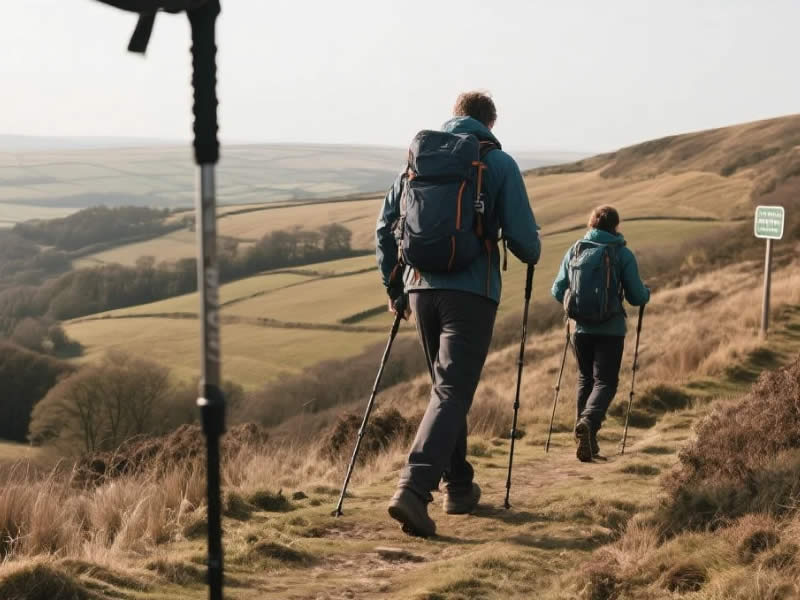
What is the South Downs Way terrain like?
Unlike the steep, rocky, boulder‑strewn descents of the Lake District or the Scottish Highlands, the South Downs Way is characterised by:
- Long, rolling hills – ascents and descents are gradual, not precipitous. The highest point is only 270 metres (886 feet) at Butser Hill.
- Grassy and chalky surfaces – much of the trail runs across sheep‑cropped turf, chalk downland, and farm tracks. There are some flinty sections, but they are not continuous boulder fields.
- Frequent undulations – you go up and down repeatedly, but each climb is typically a few hundred metres of elevation, not a relentless thousand‑metre push.
- Relatively dry and firm underfoot – compared to boggy moorland, the South Downs drain well, so you're rarely trudging through deep, suction‑creating mud.
This terrain does not generate the kind of jarring, high‑impact shocks that anti‑shock systems are designed to mitigate. On the South Downs, your poles will be used more for rhythm, propulsion, and balance than for braking against gravity.
How do anti‑shock trekking poles work?
Anti‑shock poles contain an internal spring or elastomer (rubber) insert, usually in the upper section. When you plant the pole and push down, the spring compresses, absorbing some of the impact force before it travels up your arm. The idea is to reduce joint strain on descents.
However, this comes with trade‑offs:
- Extra weight – a pair of anti‑shock poles typically weighs 20‑50g more per pole than a rigid equivalent.
- Energy loss – on ascents and flats, part of your pushing force compresses the spring instead of propelling you forward, making you work harder.
- Added complexity – more moving parts mean more potential failure points, especially in wet, gritty conditions.
- Reduced ground feedback – the spring dampens the feel of the terrain, which can be a disadvantage when you need to sense how much grip you have.
Why anti‑shock is unnecessary on the South Downs Way
1. The descents are not steep enough
The South Downs Way does not have the kind of sustained, steep descents that make anti‑shock poles beneficial. A study in the Journal of Applied Biomechanics showed that shock absorbers are most effective on gradients over 15‑20°, where impact forces are high. On the South Downs, most descents are between 5‑10°, with only short sections approaching 15°. The additional cushioning is barely noticeable, yet the weight penalty is present for the entire 100 miles.
2. Energy efficiency matters on long distances
The South Downs Way is usually walked over 5‑10 days. Every gram of weight and every bit of energy lost to a spring adds up over 100 miles. Rigid poles transfer your arm power directly into forward motion – no spring steals your push. On the long, undulating stretches, this efficiency is far more valuable than a marginal reduction in impact on gentle descents.
3. Chalk and grass provide natural cushioning
The chalk downland is naturally absorbent – it's not concrete or hard‑packed rock. The turf and soil offer a degree of shock absorption that hard mountain trails do not. Your boots and the ground already cushion your steps; adding a spring in your poles is redundant.
4. Reliability concerns on chalky, flinty paths
The South Downs has flint stones that can be sharp and abrasive. The moving parts of an anti‑shock mechanism can become clogged with chalk dust and grit, causing the spring to squeak, jam, or lose its smooth action. Rigid poles, with no moving internal parts, are far less susceptible to this kind of fouling.
5. Cost and weight – two things you don't need
Anti‑shock poles are more expensive – typically £20‑40 more than a rigid equivalent of the same material. For a route like the South Downs, that extra cost buys you no tangible advantage. Similarly, the extra weight over 100 miles is an unnecessary burden.
What you should use instead
For the South Downs Way, the ideal pole is:
- Lightweight – aluminium or carbon (your choice, but aluminium is more robust for the occasional flinty scrape).
- Rigid (non‑shock) – efficient energy transfer, no moving parts to fail.
- Lever‑locks – reliable and easy to adjust for the slight gradient changes.
- Cork or foam grips – comfortable for long hours.
- Mud baskets – useful for any soft, wet sections after rain.
Recommended models: Decathlon Forclaz MT500 (aluminium, lever‑locks, cork grips, ~£45) or Black Diamond Trail Ergo Cork (premium, ~£130). Both are rigid and perfect for this trail.
What if you already own anti‑shock poles?
If you already have anti‑shock poles, you don't need to buy new ones – simply use the lock‑out feature that most models have. Most anti‑shock poles have a switch or twist mechanism that turns the shock absorption off, making them rigid. On the South Downs, keep the shock turned off permanently – you'll get the efficiency of a rigid pole without having to buy new equipment.
What about joint issues?
If you have pre‑existing knee or wrist problems, you might wonder if anti‑shock could help. For the South Downs, the answer is still no. Proper pole length adjustment (shortening 5‑7 cm for uphills, lengthening 5‑10 cm for downhills) and good technique – using the straps, planting ahead, bending your elbows – provide far more joint protection than a spring. The best shock absorber is a well‑adjusted pole and a smooth walking rhythm.
The final verdict
Anti‑shock trekking poles are not necessary for the South Downs Way. They add weight, cost, complexity, and energy loss without offering any significant benefit on this gentle, rolling terrain. For the vast majority of walkers, a pair of lightweight, rigid poles with reliable lever‑locks will serve you better – they'll keep you moving efficiently and comfortably for all 100 miles.
Save your money, save your energy, and choose rigid. Your arms, your pace, and your wallet will all thank you. (Word count: ~1,080)
Are anti-shock trekking poles necessary for the South Downs Way?
The South Downs Way is a 100‑mile (160 km) National Trail that rolls through the chalk hills of southern England, from Winchester to Eastbourne. It's a classic long‑distance walk, with its sweeping views, gentle gradients, and a surface that ranges from springy turf to chalky, flint‑strewn paths. Many walkers preparing for this route ask whether they should invest in anti‑shock (shock‑absorbing) trekking poles. The short, definitive answer is no – they are not necessary for the South Downs Way. In fact, for most walkers, they are more of a hindrance than a help on this particular trail. This guide explains why, and what you should choose instead.
What is the South Downs Way terrain like?
Unlike the steep, rocky, boulder‑strewn descents of the Lake District or the Scottish Highlands, the South Downs Way is characterised by:
- Long, rolling hills – ascents and descents are gradual, not precipitous. The highest point is only 270 metres (886 feet) at Butser Hill.
- Grassy and chalky surfaces – much of the trail runs across sheep‑cropped turf, chalk downland, and farm tracks. There are some flinty sections, but they are not continuous boulder fields.
- Frequent undulations – you go up and down repeatedly, but each climb is typically a few hundred metres of elevation, not a relentless thousand‑metre push.
- Relatively dry and firm underfoot – compared to boggy moorland, the South Downs drain well, so you're rarely trudging through deep, suction‑creating mud.
This terrain does not generate the kind of jarring, high‑impact shocks that anti‑shock systems are designed to mitigate. On the South Downs, your poles will be used more for rhythm, propulsion, and balance than for braking against gravity.
How do anti‑shock trekking poles work?
Anti‑shock poles contain an internal spring or elastomer (rubber) insert, usually in the upper section. When you plant the pole and push down, the spring compresses, absorbing some of the impact force before it travels up your arm. The idea is to reduce joint strain on descents.
However, this comes with trade‑offs:
- Extra weight – a pair of anti‑shock poles typically weighs 20‑50g more per pole than a rigid equivalent.
- Energy loss – on ascents and flats, part of your pushing force compresses the spring instead of propelling you forward, making you work harder.
- Added complexity – more moving parts mean more potential failure points, especially in wet, gritty conditions.
- Reduced ground feedback – the spring dampens the feel of the terrain, which can be a disadvantage when you need to sense how much grip you have.
Why anti‑shock is unnecessary on the South Downs Way
1. The descents are not steep enough
The South Downs Way does not have the kind of sustained, steep descents that make anti‑shock poles beneficial. A study in the Journal of Applied Biomechanics showed that shock absorbers are most effective on gradients over 15‑20°, where impact forces are high. On the South Downs, most descents are between 5‑10°, with only short sections approaching 15°. The additional cushioning is barely noticeable, yet the weight penalty is present for the entire 100 miles.
2. Energy efficiency matters on long distances
The South Downs Way is usually walked over 5‑10 days. Every gram of weight and every bit of energy lost to a spring adds up over 100 miles. Rigid poles transfer your arm power directly into forward motion – no spring steals your push. On the long, undulating stretches, this efficiency is far more valuable than a marginal reduction in impact on gentle descents.
3. Chalk and grass provide natural cushioning
The chalk downland is naturally absorbent – it's not concrete or hard‑packed rock. The turf and soil offer a degree of shock absorption that hard mountain trails do not. Your boots and the ground already cushion your steps; adding a spring in your poles is redundant.
4. Reliability concerns on chalky, flinty paths
The South Downs has flint stones that can be sharp and abrasive. The moving parts of an anti‑shock mechanism can become clogged with chalk dust and grit, causing the spring to squeak, jam, or lose its smooth action. Rigid poles, with no moving internal parts, are far less susceptible to this kind of fouling.
5. Cost and weight – two things you don't need
Anti‑shock poles are more expensive – typically £20‑40 more than a rigid equivalent of the same material. For a route like the South Downs, that extra cost buys you no tangible advantage. Similarly, the extra weight over 100 miles is an unnecessary burden.
What you should use instead
For the South Downs Way, the ideal pole is:
- Lightweight – aluminium or carbon (your choice, but aluminium is more robust for the occasional flinty scrape).
- Rigid (non‑shock) – efficient energy transfer, no moving parts to fail.
- Lever‑locks – reliable and easy to adjust for the slight gradient changes.
- Cork or foam grips – comfortable for long hours.
- Mud baskets – useful for any soft, wet sections after rain.
Recommended models: Decathlon Forclaz MT500 (aluminium, lever‑locks, cork grips, ~£45) or Black Diamond Trail Ergo Cork (premium, ~£130). Both are rigid and perfect for this trail.
What if you already own anti‑shock poles?
If you already have anti‑shock poles, you don't need to buy new ones – simply use the lock‑out feature that most models have. Most anti‑shock poles have a switch or twist mechanism that turns the shock absorption off, making them rigid. On the South Downs, keep the shock turned off permanently – you'll get the efficiency of a rigid pole without having to buy new equipment.
What about joint issues?
If you have pre‑existing knee or wrist problems, you might wonder if anti‑shock could help. For the South Downs, the answer is still no. Proper pole length adjustment (shortening 5‑7 cm for uphills, lengthening 5‑10 cm for downhills) and good technique – using the straps, planting ahead, bending your elbows – provide far more joint protection than a spring. The best shock absorber is a well‑adjusted pole and a smooth walking rhythm.
The final verdict
Anti‑shock trekking poles are not necessary for the South Downs Way. They add weight, cost, complexity, and energy loss without offering any significant benefit on this gentle, rolling terrain. For the vast majority of walkers, a pair of lightweight, rigid poles with reliable lever‑locks will serve you better – they'll keep you moving efficiently and comfortably for all 100 miles.
Save your money, save your energy, and choose rigid. Your arms, your pace, and your wallet will all thank you.




