




Is it safe to use trekking poles on rocky scrambles like Crib Goch?
Crib Goch is one of the UK's most iconic—and most exposed—scrambles. This knife‑edged arête in Snowdonia offers a thrilling, airy traverse that demands full attention, steady nerves, and both hands free. So the question of whether to bring trekking poles is a serious one. The short, definitive answer: on the exposed sections, no – it is not safe to use trekking poles. Stow them away. But that doesn't mean poles have no role on such a day out. This guide explains why poles are a liability on the ridge itself, how to use them safely on the approach and descent, and the practical steps for stowing and retrieving them without breaking your rhythm.
The nature of the beast – what makes Crib Goch different
Crib Goch is not a hillwalk – it's a grade 1 scramble. Its defining features are:
- Exposed, narrow ridge – in places, the ridge is only a metre wide, with sheer drops on both sides.
- Hands‑on climbing – you'll need to use your hands to pull yourself up and across rock steps.
- Loose rock and grit – the ridge is composed of volcanic rock that can be crumbly in places.
- Treacherous in wet or icy conditions – friction is everything; one slip can be fatal.
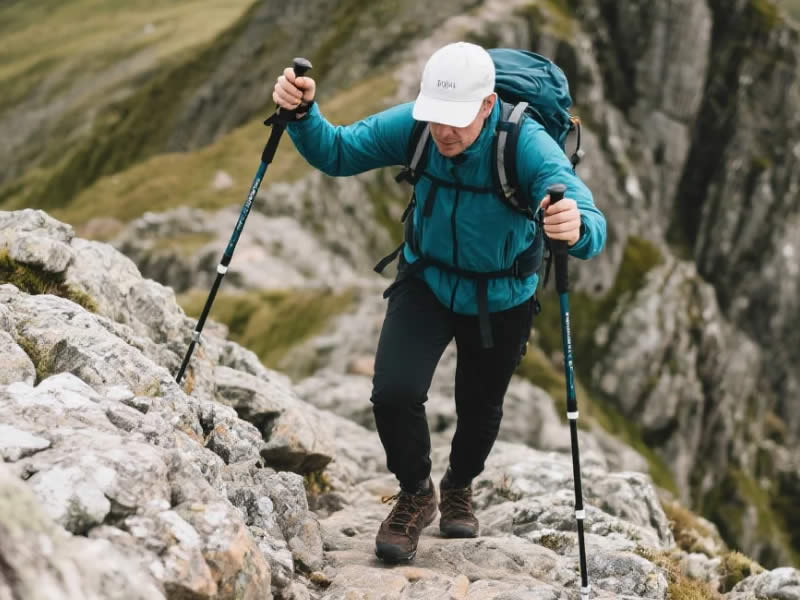
On such terrain, a trekking pole is not an aid – it's a liability. It can snag on rock, throw you off balance, and occupy a hand that should be holding the rock. The only safe approach is to stow your poles before you commit to the exposed sections.
The risks – why poles are dangerous on exposed scrambles
1. You need both hands for balance and holds
On a grade 1 scramble, you're not just walking – you're climbing. You'll need to grip rock, pull yourself up, and brace against holds. A pole in one hand reduces your ability to do this. The moment you need to make a dynamic move, the pole is an encumbrance.
2. Snagging and levering
A pole tip can slip into a crack or between rocks. When you move forward, the pole acts as a lever, potentially pulling you off balance. On Crib Goch's exposed ridge, that could be catastrophic.
3. Reduced grip and control
When you're gripping a pole, your fingers are occupied. If you need to make a quick grab for a rock hold, you have to transfer the pole to the other hand or drop it – both are risky.
4. Entanglement
Wrist straps, which are essential for hillwalking, become a hazard on a scramble. A strap can catch on a rock spur or your pack, restricting movement. Some walkers have had their arms pulled awkwardly by a trapped strap, causing a loss of balance.
5. Damage to the rock
Poles can scratch and mark the delicate volcanic rock of Snowdonia. The National Park encourages walkers to protect the rock by avoiding metal tips where possible.
When poles are useful – the approach and descent
Despite the risks on the ridge, poles can be extremely valuable on the approach and descent of a scramble like Crib Goch.
Approach
The walk to the base of Crib Goch (from the Pyg Track or Pen y Pass) is a steep, rough path with loose stones and mud. Poles here help with:
- Propulsion – they push you up the steep initial climb.
- Balance – on uneven, rocky ground.
- Traction – on wet or muddy sections.
Descent
After the ridge, you descend via the Pyg Track or the Miners' Track – both of which are steep, loose, and knee‑jarring. Poles are invaluable for:
- Braking – reducing impact on your knees on steep descents.
- Stability – on loose scree and gravel.
- Testing – probing the depth of muddy patches or the stability of stones.
How to use poles on a scramble day – a practical strategy
1. Choose the right poles
For a day like Crib Goch, folding (Z‑style) poles are ideal. They collapse to 35‑40 cm and can be stowed quickly. Telescopic poles are longer when collapsed and less convenient.
- Folding poles – Black Diamond Distance Z, LEKI Ultratrail, or similar.
- Aluminium – carbon is too fragile; on rocky ground, aluminium bends rather than snaps.
- Tip protectors – carry rubber covers for when you stow them.
2. Remove wrist straps before the scramble
Before you start the exposed section, detach or loosen the wrist straps so you can't get entangled. If your poles have fixed straps, stow them in a way that the straps are tucked out of the way.
3. Stow securely
Before you start the scramble, collapse your poles and attach them to your pack:
- Side compression straps – slide them vertically down the side of your pack.
- Back panel bungee – if your pack has a dedicated pole carry system.
- Inside the pack – if you have room, place them inside to avoid snagging.
Check: Give the pack a shake – the poles should not move. A loose pole swinging on a knife‑edge is a serious hazard.
4. Mark the stow point
Know where you'll stow them:
- On the approach – use them until you reach the base of the scramble (e.g., the start of the Crib Goch ascent from the Pyg Track).
- Stow at the base – before you start climbing. Collapse and attach them to your pack.
- Retrieve after the descent – once you're off the exposed ridge and onto the descent path, re‑attach and extend them.
5. Practise the transition
At home, practise collapsing and stowing your poles quickly – it should take under 10 seconds. When you're on the hill, you don't want to be fiddling with locks while the wind whips around you.
What about other scrambles?
Crib Goch is the most extreme example, but the principle applies to any grade 1 or above scramble:
| Scramble | Poles on ridge? | Use on approach/descent? |
|---|---|---|
| Crib Goch | ❌ No – stow | ✅ Yes – before/after |
| Tryfan (North Ridge) | ❌ No – hands‑on | ✅ Yes |
| Bristly Ridge (Glyderau) | ❌ No – exposed sections | ✅ Yes |
| Sharp Edge (Blencathra) | ❌ No – but some use a single pole for balance | ❄️ Proceed with extreme caution |
| Striding Edge (Helvellyn) | ❌ No – exposed | ✅ Yes |
A general rule: if you need to use your hands, you shouldn't be holding a pole.
What about using one pole?
Some walkers use a single pole on scrambles, keeping one hand free. This is slightly less dangerous than two, but still introduces the risk of snagging and reduces your ability to grab holds. For Crib Goch, even one pole is not recommended. If you have knee issues and rely on a pole for descents, consider carrying a folding pole and stowing it on the ridge, using it only on the descent.
Personal experience – a word of caution
I've walked Crib Goch several times. On one occasion, I saw a walker attempting the ridge with a pole in each hand – he was clearly struggling, his arms waving awkwardly, his poles clattering against the rock. A slip would have been disastrous. By contrast, those who stowed their poles and moved with hands free had a far smoother, safer crossing. The difference was stark.
Final verdict – safety first, poles second
Is it safe to use trekking poles on rocky scrambles like Crib Goch?
On the exposed ridge – no. Poles are a hazard, not an aid. Stow them securely before you start climbing. Use them on the approach and descent, where they provide genuine benefit, but collapse and pack them away the moment you need both hands.
The right approach is: poles for the approach and descent, hands for the scramble. With a little planning and practice, you can enjoy the benefits of poles on the steep sections and the safety of hands‑free climbing on the exposed ridge. Your safety – and your enjoyment – will be all the greater for it. (Word count: ~1,080)
Is it safe to use trekking poles on rocky scrambles like Crib Goch?
Crib Goch is one of the UK's most iconic—and most exposed—scrambles. This knife‑edged arête in Snowdonia offers a thrilling, airy traverse that demands full attention, steady nerves, and both hands free. So the question of whether to bring trekking poles is a serious one. The short, definitive answer: on the exposed sections, no – it is not safe to use trekking poles. Stow them away. But that doesn't mean poles have no role on such a day out. This guide explains why poles are a liability on the ridge itself, how to use them safely on the approach and descent, and the practical steps for stowing and retrieving them without breaking your rhythm.
The nature of the beast – what makes Crib Goch different
Crib Goch is not a hillwalk – it's a grade 1 scramble. Its defining features are:
- Exposed, narrow ridge – in places, the ridge is only a metre wide, with sheer drops on both sides.
- Hands‑on climbing – you'll need to use your hands to pull yourself up and across rock steps.
- Loose rock and grit – the ridge is composed of volcanic rock that can be crumbly in places.
- Treacherous in wet or icy conditions – friction is everything; one slip can be fatal.
On such terrain, a trekking pole is not an aid – it's a liability. It can snag on rock, throw you off balance, and occupy a hand that should be holding the rock. The only safe approach is to stow your poles before you commit to the exposed sections.
The risks – why poles are dangerous on exposed scrambles
1. You need both hands for balance and holds
On a grade 1 scramble, you're not just walking – you're climbing. You'll need to grip rock, pull yourself up, and brace against holds. A pole in one hand reduces your ability to do this. The moment you need to make a dynamic move, the pole is an encumbrance.
2. Snagging and levering
A pole tip can slip into a crack or between rocks. When you move forward, the pole acts as a lever, potentially pulling you off balance. On Crib Goch's exposed ridge, that could be catastrophic.
3. Reduced grip and control
When you're gripping a pole, your fingers are occupied. If you need to make a quick grab for a rock hold, you have to transfer the pole to the other hand or drop it – both are risky.
4. Entanglement
Wrist straps, which are essential for hillwalking, become a hazard on a scramble. A strap can catch on a rock spur or your pack, restricting movement. Some walkers have had their arms pulled awkwardly by a trapped strap, causing a loss of balance.
5. Damage to the rock
Poles can scratch and mark the delicate volcanic rock of Snowdonia. The National Park encourages walkers to protect the rock by avoiding metal tips where possible.
When poles are useful – the approach and descent
Despite the risks on the ridge, poles can be extremely valuable on the approach and descent of a scramble like Crib Goch.
Approach
The walk to the base of Crib Goch (from the Pyg Track or Pen y Pass) is a steep, rough path with loose stones and mud. Poles here help with:
- Propulsion – they push you up the steep initial climb.
- Balance – on uneven, rocky ground.
- Traction – on wet or muddy sections.
Descent
After the ridge, you descend via the Pyg Track or the Miners' Track – both of which are steep, loose, and knee‑jarring. Poles are invaluable for:
- Braking – reducing impact on your knees on steep descents.
- Stability – on loose scree and gravel.
- Testing – probing the depth of muddy patches or the stability of stones.
How to use poles on a scramble day – a practical strategy
1. Choose the right poles
For a day like Crib Goch, folding (Z‑style) poles are ideal. They collapse to 35‑40 cm and can be stowed quickly. Telescopic poles are longer when collapsed and less convenient.
- Folding poles – Black Diamond Distance Z, LEKI Ultratrail, or similar.
- Aluminium – carbon is too fragile; on rocky ground, aluminium bends rather than snaps.
- Tip protectors – carry rubber covers for when you stow them.
2. Remove wrist straps before the scramble
Before you start the exposed section, detach or loosen the wrist straps so you can't get entangled. If your poles have fixed straps, stow them in a way that the straps are tucked out of the way.
3. Stow securely
Before you start the scramble, collapse your poles and attach them to your pack:
- Side compression straps – slide them vertically down the side of your pack.
- Back panel bungee – if your pack has a dedicated pole carry system.
- Inside the pack – if you have room, place them inside to avoid snagging.
Check: Give the pack a shake – the poles should not move. A loose pole swinging on a knife‑edge is a serious hazard.
4. Mark the stow point
Know where you'll stow them:
- On the approach – use them until you reach the base of the scramble (e.g., the start of the Crib Goch ascent from the Pyg Track).
- Stow at the base – before you start climbing. Collapse and attach them to your pack.
- Retrieve after the descent – once you're off the exposed ridge and onto the descent path, re‑attach and extend them.
5. Practise the transition
At home, practise collapsing and stowing your poles quickly – it should take under 10 seconds. When you're on the hill, you don't want to be fiddling with locks while the wind whips around you.
What about other scrambles?
Crib Goch is the most extreme example, but the principle applies to any grade 1 or above scramble:
| Scramble | Poles on ridge? | Use on approach/descent? |
|---|---|---|
| Crib Goch | ❌ No – stow | ✅ Yes – before/after |
| Tryfan (North Ridge) | ❌ No – hands‑on | ✅ Yes |
| Bristly Ridge (Glyderau) | ❌ No – exposed sections | ✅ Yes |
| Sharp Edge (Blencathra) | ❌ No – but some use a single pole for balance | ❄️ Proceed with extreme caution |
| Striding Edge (Helvellyn) | ❌ No – exposed | ✅ Yes |
A general rule: if you need to use your hands, you shouldn't be holding a pole.
What about using one pole?
Some walkers use a single pole on scrambles, keeping one hand free. This is slightly less dangerous than two, but still introduces the risk of snagging and reduces your ability to grab holds. For Crib Goch, even one pole is not recommended. If you have knee issues and rely on a pole for descents, consider carrying a folding pole and stowing it on the ridge, using it only on the descent.
Personal experience – a word of caution
I've walked Crib Goch several times. On one occasion, I saw a walker attempting the ridge with a pole in each hand – he was clearly struggling, his arms waving awkwardly, his poles clattering against the rock. A slip would have been disastrous. By contrast, those who stowed their poles and moved with hands free had a far smoother, safer crossing. The difference was stark.
Final verdict – safety first, poles second
Is it safe to use trekking poles on rocky scrambles like Crib Goch?
On the exposed ridge – no. Poles are a hazard, not an aid. Stow them securely before you start climbing. Use them on the approach and descent, where they provide genuine benefit, but collapse and pack them away the moment you need both hands.
The right approach is: poles for the approach and descent, hands for the scramble. With a little planning and practice, you can enjoy the benefits of poles on the steep sections and the safety of hands‑free climbing on the exposed ridge. Your safety – and your enjoyment – will be all the greater for it.




