




Do I need walking poles for the Coast to Coast walk?
The Coast to Coast Walk—Alfred Wainwright's legendary 190‑mile (306 km) route from St Bees on the Irish Sea to Robin Hood's Bay on the North Sea—is Britain's most iconic long‑distance trail. It traverses the Lake District, the Pennines, the Yorkshire Dales, and the North York Moors, encompassing every type of terrain: beaches, bogs, limestone pavements, steep fells, and rolling farmland. The question of whether to carry walking poles is a common one. The short answer is strongly recommended—they are not mandatory, but they will make your journey safer, more comfortable, and more enjoyable. This guide explains why, section by section, and offers practical advice for choosing and using poles on this classic route.
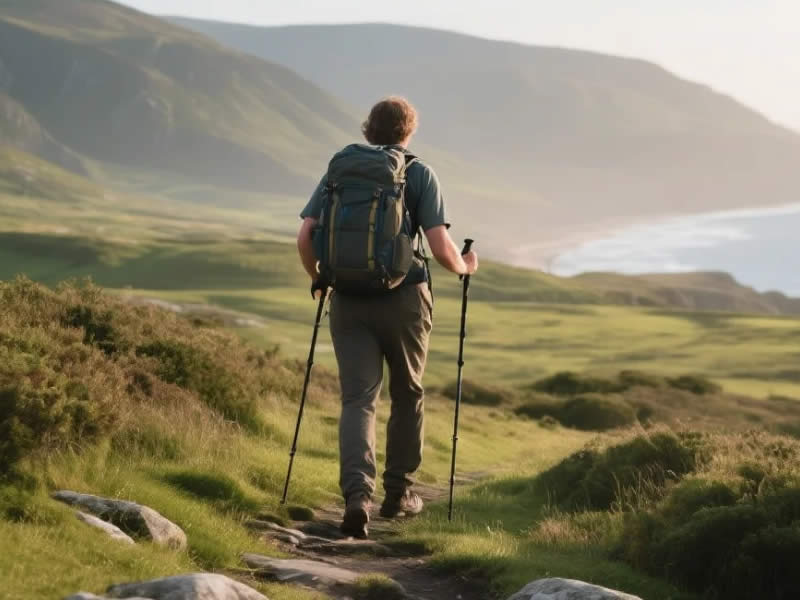
The Coast to Coast terrain – a challenge for your knees and balance
The Coast to Coast is not a single, uniform trail. It's a mosaic of vastly different ground conditions, each placing different demands on your body:
- The Lake District fells – steep ascents and descents, rocky paths, and often wet, slippery conditions. The descent from High Street or Kidsty Pike can be knee‑jarring.
- The Pennine moorland – miles of boggy, energy‑sapping peat, where every step is uncertain and balance is tested.
- Limestone pavements and drystone walls – the Dales are riddled with limestone scars and countless stiles, where you need stability and a free hand at times.
- Farmland and road sections – long, flat stretches that can fatigue your legs through repetition.
- Beach and cliff paths – the final coastal section is uneven, with loose stones and soft sand.
Add to this the unpredictability of British weather—rain, wind, and even occasional heat—and you have a walk where knee protection and stability are not luxuries but necessities.
Why walking poles are a game‑changer on the Coast to Coast
1. Knee protection on the descents
The Coast to Coast has around 5,800 metres (19,000 feet) of cumulative ascent and an equal amount of descent. The descents—particularly off the Lake District fells and into Swaledale—are steep and often loose. Without poles, your quadriceps act as your primary brakes, taking a pounding with every step. Research shows that using two poles can reduce knee impact by up to 25% on descents. Over a 10‑14 day walk, that's a huge difference—your knees will be far less sore at the end of each day.
2. Stability on boggy moorland
The Pennine section, particularly from Kirkby Stephen to Keld, is notorious for deep, sticky peat. Every step can be a gamble—you might be on firm ground or sink into a bog up to your ankle. Walking poles act as probes: you can test the ground ahead before committing your weight. They also provide two extra points of contact, making you far more stable when the path turns into a quagmire.
3. Propulsion on the long uphill slogs
The Coast to Coast has several long, grinding climbs: the ascent of Kidsty Pike, the long pull over Nine Standards Rigg, and the steady rise over the North York Moors. Poles help you push forward and upward, taking some of the load off your legs. Many walkers report that they can maintain a steadier pace and feel less fatigue on the big climbs when using poles.
4. Support on the long, flat sections
The route includes long stretches of flat or gently undulating terrain—along the edge of Lake Windermere, through the Vale of Mowbray, and across the rolling farmland of the Dales. On these sections, poles are less about propulsion and more about rhythm. They keep you in a steady, consistent pace, reducing the mental fatigue that can set in on seemingly endless green lanes.
5. River crossings and tricky sections
The Coast to Coast has a few river crossings, some of which can be tricky after rain. Poles provide a stable, three‑point stance (two poles and one foot) as you cross, and they allow you to test the depth and stability of the riverbed before you commit.
6. Help on the hundreds of stiles
The Coast to Coast has an astonishing number of stiles—you'll cross dozens every day. Poles with a comfortable grip help you balance as you climb over, and the wrist straps allow you to free a hand quickly. A folding pole that can be collapsed and re‑extended in seconds is a big advantage here.
What about not using poles?
Some walkers complete the Coast to Coast without poles, relying on strong knees and good balance. If you're young, fit, and have no history of knee or back problems, you may manage fine. However, even the strongest walkers often find that poles make the long days feel shorter and less punishing. The reality is that after 10‑14 days of walking, your legs will be tired—and tired legs are more prone to stumbles. Poles provide a safety net.
Anecdotal evidence: On the Coast to Coast, it's common to see walkers who started without poles buying a pair at a village shop (there's an outdoor shop in Ambleside, and one in Kirkby Stephen) halfway through. They almost always say they wished they'd had them from the start.
Which poles are best for the Coast to Coast?
For a 190‑mile walk, you need poles that are:
- Lightweight but durable – aim for 240‑280g per pole. Aluminium is more robust than carbon for this mixed terrain.
- With lever‑locks – twist‑locks can seize in the wet, muddy conditions you'll encounter. Lever‑locks are more reliable and easier to adjust with cold hands.
- With cork or comfortable foam grips – you'll be holding these for hours; comfort is critical.
- Collapsible or folding – for easy stowage on the flat sections and for packing into your bag when not in use. Folding Z‑poles are great for this.
- With mud baskets – essential for the boggy Pennine sections.
Recommended models: Black Diamond Trail Ergo Cork (aluminium, lever‑locks), Leki Makalu (aluminium, SpeedLock), or Decathlon Forclaz MT500 (budget‑friendly but excellent). For folding, the Black Diamond Distance Z is a popular choice.
How to use poles on the Coast to Coast – a quick guide
- Flat terrain – set your length using the 90° elbow test (your forearm horizontal when the tip is on the ground).
- Uphill – shorten by 5‑7 cm to keep your shoulders relaxed.
- Downhill – lengthen by 5‑10 cm to give you braking reach.
- Boggy ground – use mud baskets and plant the pole with a slight angle to test the ground.
- Stiles – collapse one or both poles to pass through, then re‑extend on the other side.
- Flat sections – use them rhythmically to maintain a steady pace; you can stow them if you prefer a free‑handed walk.
The "one pole or two" debate on the Coast to Coast
Two poles are better for balance, knee protection, and propulsion. Some walkers prefer one pole on the flat sections, but for the demanding terrain of the Coast to Coast, two poles are the safer, more efficient choice. You can always stow one when you don't need it.
What if you've never used poles before?
If you're new to poles, start using them a few weeks before your Coast to Coast trip. Practice adjusting the length, walking with them, and stowing them. You'll quickly develop a natural rhythm, and by the time you reach St Bees, they'll feel like a natural extension of your arms.
Final verdict – do you need them?
Do you need them? No—the Coast to Coast can be walked without poles.
Should you bring them? Yes—unless you have exceptionally strong knees and excellent balance. For 90% of walkers, poles will make the walk safer, more comfortable, and less physically punishing. They are a small investment in gear and weight that pays back in knee health, stability, and overall enjoyment.
If you're planning this classic British walk, give yourself the advantage. Your knees, your balance, and your post‑walk pint will all thank you. (Word count: ~1,080)
Do I need walking poles for the Coast to Coast walk?
The Coast to Coast Walk—Alfred Wainwright's legendary 190‑mile (306 km) route from St Bees on the Irish Sea to Robin Hood's Bay on the North Sea—is Britain's most iconic long‑distance trail. It traverses the Lake District, the Pennines, the Yorkshire Dales, and the North York Moors, encompassing every type of terrain: beaches, bogs, limestone pavements, steep fells, and rolling farmland. The question of whether to carry walking poles is a common one. The short answer is strongly recommended—they are not mandatory, but they will make your journey safer, more comfortable, and more enjoyable. This guide explains why, section by section, and offers practical advice for choosing and using poles on this classic route.
The Coast to Coast terrain – a challenge for your knees and balance
The Coast to Coast is not a single, uniform trail. It's a mosaic of vastly different ground conditions, each placing different demands on your body:
- The Lake District fells – steep ascents and descents, rocky paths, and often wet, slippery conditions. The descent from High Street or Kidsty Pike can be knee‑jarring.
- The Pennine moorland – miles of boggy, energy‑sapping peat, where every step is uncertain and balance is tested.
- Limestone pavements and drystone walls – the Dales are riddled with limestone scars and countless stiles, where you need stability and a free hand at times.
- Farmland and road sections – long, flat stretches that can fatigue your legs through repetition.
- Beach and cliff paths – the final coastal section is uneven, with loose stones and soft sand.
Add to this the unpredictability of British weather—rain, wind, and even occasional heat—and you have a walk where knee protection and stability are not luxuries but necessities.
Why walking poles are a game‑changer on the Coast to Coast
1. Knee protection on the descents
The Coast to Coast has around 5,800 metres (19,000 feet) of cumulative ascent and an equal amount of descent. The descents—particularly off the Lake District fells and into Swaledale—are steep and often loose. Without poles, your quadriceps act as your primary brakes, taking a pounding with every step. Research shows that using two poles can reduce knee impact by up to 25% on descents. Over a 10‑14 day walk, that's a huge difference—your knees will be far less sore at the end of each day.
2. Stability on boggy moorland
The Pennine section, particularly from Kirkby Stephen to Keld, is notorious for deep, sticky peat. Every step can be a gamble—you might be on firm ground or sink into a bog up to your ankle. Walking poles act as probes: you can test the ground ahead before committing your weight. They also provide two extra points of contact, making you far more stable when the path turns into a quagmire.
3. Propulsion on the long uphill slogs
The Coast to Coast has several long, grinding climbs: the ascent of Kidsty Pike, the long pull over Nine Standards Rigg, and the steady rise over the North York Moors. Poles help you push forward and upward, taking some of the load off your legs. Many walkers report that they can maintain a steadier pace and feel less fatigue on the big climbs when using poles.
4. Support on the long, flat sections
The route includes long stretches of flat or gently undulating terrain—along the edge of Lake Windermere, through the Vale of Mowbray, and across the rolling farmland of the Dales. On these sections, poles are less about propulsion and more about rhythm. They keep you in a steady, consistent pace, reducing the mental fatigue that can set in on seemingly endless green lanes.
5. River crossings and tricky sections
The Coast to Coast has a few river crossings, some of which can be tricky after rain. Poles provide a stable, three‑point stance (two poles and one foot) as you cross, and they allow you to test the depth and stability of the riverbed before you commit.
6. Help on the hundreds of stiles
The Coast to Coast has an astonishing number of stiles—you'll cross dozens every day. Poles with a comfortable grip help you balance as you climb over, and the wrist straps allow you to free a hand quickly. A folding pole that can be collapsed and re‑extended in seconds is a big advantage here.
What about not using poles?
Some walkers complete the Coast to Coast without poles, relying on strong knees and good balance. If you're young, fit, and have no history of knee or back problems, you may manage fine. However, even the strongest walkers often find that poles make the long days feel shorter and less punishing. The reality is that after 10‑14 days of walking, your legs will be tired—and tired legs are more prone to stumbles. Poles provide a safety net.
Anecdotal evidence: On the Coast to Coast, it's common to see walkers who started without poles buying a pair at a village shop (there's an outdoor shop in Ambleside, and one in Kirkby Stephen) halfway through. They almost always say they wished they'd had them from the start.
Which poles are best for the Coast to Coast?
For a 190‑mile walk, you need poles that are:
- Lightweight but durable – aim for 240‑280g per pole. Aluminium is more robust than carbon for this mixed terrain.
- With lever‑locks – twist‑locks can seize in the wet, muddy conditions you'll encounter. Lever‑locks are more reliable and easier to adjust with cold hands.
- With cork or comfortable foam grips – you'll be holding these for hours; comfort is critical.
- Collapsible or folding – for easy stowage on the flat sections and for packing into your bag when not in use. Folding Z‑poles are great for this.
- With mud baskets – essential for the boggy Pennine sections.
Recommended models: Black Diamond Trail Ergo Cork (aluminium, lever‑locks), Leki Makalu (aluminium, SpeedLock), or Decathlon Forclaz MT500 (budget‑friendly but excellent). For folding, the Black Diamond Distance Z is a popular choice.
How to use poles on the Coast to Coast – a quick guide
- Flat terrain – set your length using the 90° elbow test (your forearm horizontal when the tip is on the ground).
- Uphill – shorten by 5‑7 cm to keep your shoulders relaxed.
- Downhill – lengthen by 5‑10 cm to give you braking reach.
- Boggy ground – use mud baskets and plant the pole with a slight angle to test the ground.
- Stiles – collapse one or both poles to pass through, then re‑extend on the other side.
- Flat sections – use them rhythmically to maintain a steady pace; you can stow them if you prefer a free‑handed walk.
The "one pole or two" debate on the Coast to Coast
Two poles are better for balance, knee protection, and propulsion. Some walkers prefer one pole on the flat sections, but for the demanding terrain of the Coast to Coast, two poles are the safer, more efficient choice. You can always stow one when you don't need it.
What if you've never used poles before?
If you're new to poles, start using them a few weeks before your Coast to Coast trip. Practice adjusting the length, walking with them, and stowing them. You'll quickly develop a natural rhythm, and by the time you reach St Bees, they'll feel like a natural extension of your arms.
Final verdict – do you need them?
Do you need them? No—the Coast to Coast can be walked without poles.
Should you bring them? Yes—unless you have exceptionally strong knees and excellent balance. For 90% of walkers, poles will make the walk safer, more comfortable, and less physically punishing. They are a small investment in gear and weight that pays back in knee health, stability, and overall enjoyment.
If you're planning this classic British walk, give yourself the advantage. Your knees, your balance, and your post‑walk pint will all thank you.




