




What is the difference between carbide and steel tips for trekking poles?
When you're scaling a steep, rocky peak or navigating a slick, wet path, the only thing between you and a nasty fall is often the tip of your trekking pole. It's a small component, but it's arguably one of the most critical for your safety and performance on the trail. The two most common materials for these tips are tungsten carbide and steel.
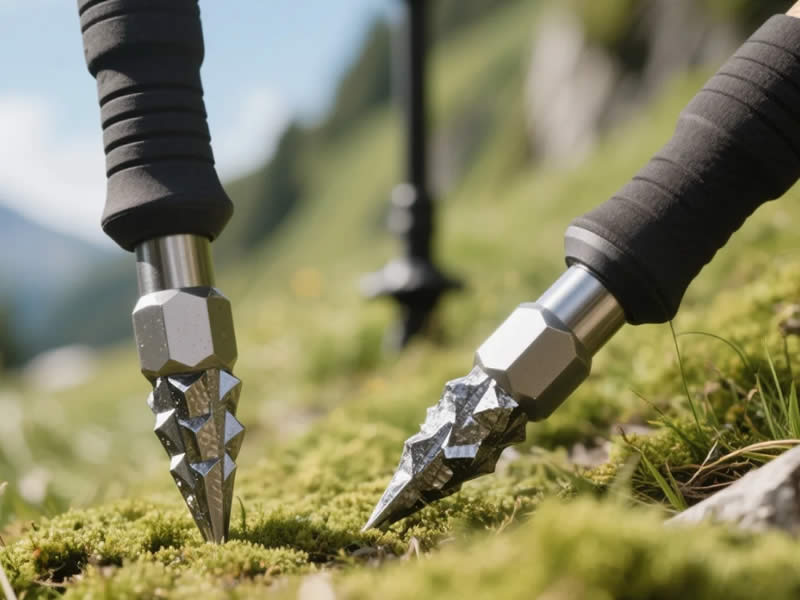
The difference is stark: Carbide tips are the undisputed champions for serious hiking, offering vastly superior durability and grip, while steel tips are a budget compromise that can quickly become a safety hazard.
Material Science: Why Carbide is King
The performance difference comes down to hardness.
Tungsten carbide is an incredibly hard ceramic-metal composite, rating 8.5 to 9 on the Mohs scale—just below a diamond. This extreme hardness gives it unparalleled resistance to wear.
Steel, even "hardened" steel used in budget poles, is much softer at about 5 to 6 on the Mohs scale. This fundamental difference dictates how each tip performs.
Performance Comparison: Carbide vs. Steel
Durability & Longevity
- Carbide: Lasts 500 to 1,000 kilometers (300-600 miles) on abrasive rock. One test showed carbide tips surviving 800 km of Appalachian Trail rock with minimal wear.
- Steel: May wear out in just 50 to 100 kilometers. The same test showed steel tips completely rounded after 80 km.
Grip on Rock & Wet Surfaces
- Carbide: The sharp point bites into the microscopic texture of rock, providing traction even on wet or polished stone.
- Steel: Rounds off quickly into a blunt nub that skids, especially on wet rock.
Failure Mode
- Carbide: Maintains its shape and sharpness over hundreds of miles.
- Steel: "Mushrooms," flattening and spreading out; also prone to rust and corrosion.
The "Carbide" Catch on Cheap Poles
Be wary of budget poles advertised with "carbide tips." Some use a tiny carbide pellet embedded in a steel point. Once the surrounding steel wears down, the tiny pellet falls out, leaving you with a useless tip. Genuine carbide tips are solid carbide or have a large carbide head.
When to Use Rubber Tips & Tip Protectors
While carbide is essential on the trail, rubber tip protectors are crucial for certain situations:
- Pavement & Hard Surfaces: Carbide tips are loud on asphalt and wear down much faster. Rubber caps silence and protect the tip.
- Travel: Crucial for air travel. Many airlines prohibit exposed metal tips in carry-on luggage. Always fit rubber protectors when flying.
- Indoor Use: Protects floors from scratches.
Maintenance: Replacing Worn Tips
Even the best carbide tips will eventually wear down. A worn tip is a safety hazard. Fortunately, most quality poles have replaceable tips. They are either screw-in or press-fit into a housing.
Replacing them is a simple DIY task:
- Remove the Old Tip: Soften the adhesive by submerging the tip in boiling water for 30-60 seconds or using a hairdryer. Then, pull or twist it off with pliers.
- Install the New Tip: Clean the ferrule. Press or screw the new tip on firmly. For press-fit tips, tap it gently with a hammer and a wood block until it's fully seated.
Verdict: Which Should You Choose?
For any serious hillwalking in the UK—where you'll encounter rock, mud, and wet conditions—the answer is clear: choose tungsten carbide.
The initial extra cost is a small price to pay for the significant benefits in safety, performance, and long-term value. Steel tips are a false economy that can fail you when you need them most.




