




Can trekking poles reduce the impact on hips?
Hip pain is a common and often debilitating complaint among walkers. While knees often get the most attention, the hip joint—the body's largest ball-and-socket joint—can suffer significantly from the repetitive, high-impact forces of hillwalking, especially on long descents. The short answer to whether trekking poles can help is a resounding yes. When used correctly, trekking poles can significantly reduce the impact forces transmitted to your hips, offering relief for those with existing conditions like arthritis or bursitis, and acting as a preventative measure for anyone looking to protect their joints over the long haul.
The Biomechanics of Hip Impact
Every time you take a step, your body experiences an impact force known as the ground reaction force. When you walk on flat ground, this force is roughly equal to your body weight. On a steep descent, however, this force can increase to two to three times your body weight. Each step sends a shockwave up through your foot, ankle, knee, and into your pelvis, where the hip joint (the acetabulum) has to absorb the impact.
This repetitive loading is a primary contributor to:
- Osteoarthritis: The wear and tear of the cartilage cushioning the joint.
- Bursitis: Inflammation of the fluid-filled sacs that reduce friction around the joint.
- Muscle fatigue and strain: The gluteal muscles and the hip flexors work hard to control the movement of the hip, leading to fatigue and soreness.
How Trekking Poles Reduce the Load
Trekking poles are not just for balance—they are a dynamic tool that can fundamentally alter the biomechanics of your walk. The key mechanism is load transfer.
1. Direct Load Transfer
When you plant a pole and push down, you are creating an additional point of contact with the ground. This push creates an upward force that directly opposes the downward force of your body weight. The result is that a portion of your weight is transferred from your legs and hips to your arms, shoulders, and back.
The Effect: Studies on walking with poles, often in the context of knee impact, have shown that they can reduce the peak impact force on the lower body joints by 20‑25%. While the specific figure for hip impact is less widely studied, the principle holds true. By providing an alternative pathway for the force to travel, poles reduce the load the hip joint must absorb.
2. Improved Posture and Gait
A hip-friendly walking style is one that maintains a neutral, upright pelvis. When you are tired, you often slouch or lean forward, which alters the alignment of your hip joint and can increase stress on the surrounding muscles and cartilage.
Trekking poles encourage a more upright posture. They help you keep your chest open and your shoulders back. This upright stance keeps your pelvis in a neutral position, allowing the hip joint to move through its natural range of motion with less strain.
3. Smoother, More Controlled Strides
Without poles, you might take longer, heavier strides, especially on a descent. With poles, you can take shorter, more controlled steps. This reduces the jarring, high-impact force that is so damaging to the hip joint. The poles effectively force you to walk with a smoother, more rhythmical gait, which is kinder to your joints.
Which Terrain Benefits the Most?
The hip-protective benefit of trekking poles is not uniform across all terrain.
- Downhill (The Greatest Benefit): On descents, the impact force is at its highest. This is where poles are most effective at reducing the load on your hips. Lengthening your poles by 5‑10 cm and planting them firmly ahead of you acts as a brake, transferring a significant portion of your body weight through your arms and away from your pelvis.
- Uphill: On ascents, the impact is less of a concern, but poles are still beneficial. They help you pull yourself up, taking some of the workload off your gluteal muscles and hip flexors, reducing fatigue.
- Flat Ground: On the level, the hip benefit is less pronounced. However, poles can still maintain a steady rhythm and help you maintain good posture.
Who Would Benefit Most?
- Walkers with Mild Hip Arthritis: The shock absorption effect can make a long descent significantly more comfortable.
- Walkers with Hip Bursitis: The reduced impact can help alleviate the pain associated with this inflammation.
- Older Walkers: A natural part of aging involves reduced joint resilience. Poles can help extend your walking career.
- Walkers Recovering from a Hip Injury: As part of a graded return to walking, poles provide support.
The 'Crutch' vs. 'Propulsion' Mindset
To get the full hip-protective benefit, you must use the poles correctly. If you treat them as a crutch, you are not using them effectively.
The Crutch: You lean heavily on the poles, and your arms work hard, but you are not transferring the impact away from your hips. You are simply adding another point of support, which is less effective.
The Propulsion: You actively push down through the poles, creating that upward force. The poles are generating thrust, and this thrust is the key to reducing the impact on your hips.
A Word on Technique
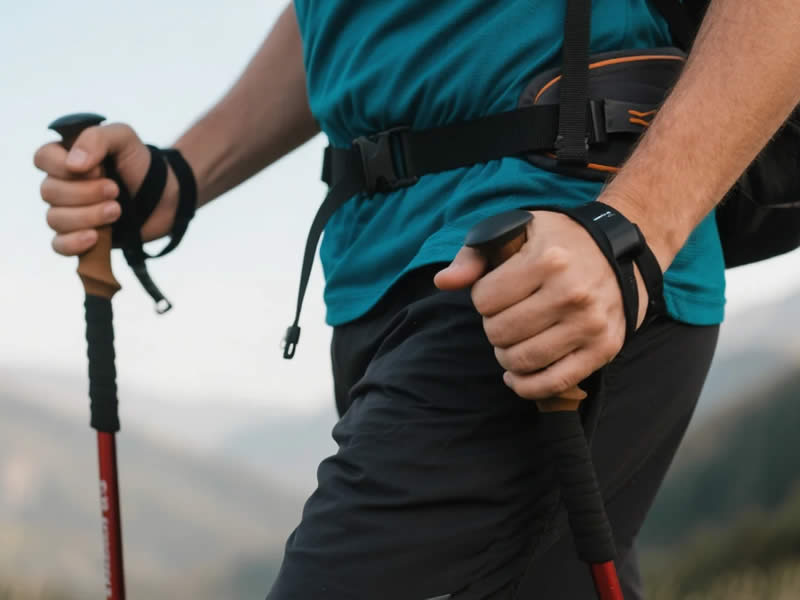
- Strap Use: Use the straps correctly. Thread your hand up through the loop so the strap sits across the base of your palm. When you push, the strap should take the load, not your grip.
- Angle: On a descent, plant the pole slightly ahead of you and at a slight backward angle. This maximizes the braking effect.
- Length: Always lengthen your poles on descents (by 5‑10 cm) to maximize the effective thrust.
What the Science Says
The evidence is compelling. A 2015 study in the Journal of Sports Sciences found that using trekking poles significantly reduced the peak impact force on the knee. While the study focused on the knee, the biomechanical principle of load transfer applies equally to the hip. The load that is removed from the knee is also removed from the hip.
Final Verdict: A Powerful Tool for Hip Health
Yes, trekking poles can significantly reduce the impact on hips. By transferring load from your lower body to your upper body, they act as a shock absorber for your pelvis. This is particularly effective on descents, where the forces are most significant. For walkers with hip pain, or anyone looking to prevent future issues, trekking poles are an essential piece of kit.
Remember: They are not a cure for a serious hip condition, but they are a powerful tool for managing impact and protecting your joints. If you have significant hip pain, you should still consult a healthcare professional before setting out.




