




How to improvise a trekking pole from a branch in an emergency?
Yes – in an emergency, you can make a functional walking aid from a sturdy branch. It will never be as good as a proper trekking pole, but it can provide crucial support if your own pole breaks, you twist an ankle, or you find yourself on steep ground without one. This guide covers how to select, prepare, and use a branch as a temporary trekking pole. The key is to remember that this is an emergency tool, not a permanent solution. The goal is to get you safely off the hill.
When Would You Need to Do This?
- A Broken Pole: Your aluminium pole bends or your carbon pole snaps.
- Lost or Forgotten Poles: You've left them at home or lost them on the trail.
- An Injury: You've twisted an ankle or strained a knee and need extra support.
- An Unexpected Situation: You're on a steep descent and your poles are not providing enough support.
Step 1: Find the Right Branch
The most important step is finding a branch that is strong enough and the right shape. You need a dead, dry, and straight branch. A green branch is too flexible and will sag under your weight. A rotten branch will snap.
What to Look For
- Species: Hardwoods like oak, ash, hazel, or beech are much stronger than softwoods like pine or spruce.
- Condition: It must be dead and dry. Look for a branch that has been dead for a while but is not rotten. It should be solid and heavy for its size.
- Thickness: A thumb's width (about 2‑3 cm) is a good starting point for a single pole. For a two‑pole setup, you can use slightly thinner branches.
- Straightness: Look for a branch that is as straight as possible. A curved branch will be uncomfortable and less stable.
The "Fork" Advantage
A branch with a natural fork at the top is a real bonus. The fork acts as a thumb rest, making it far more comfortable and secure to hold than a plain stick.
Step 2: Prepare the Branch
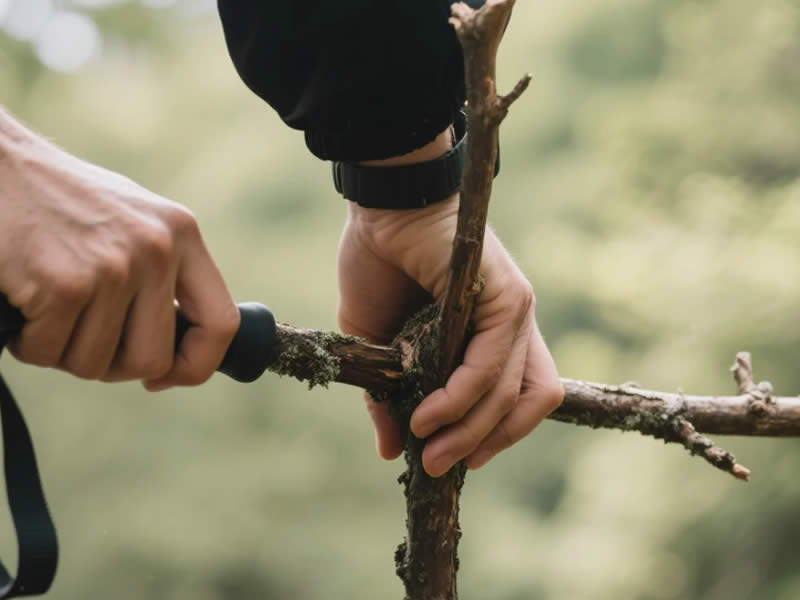
Once you have a candidate branch, you need to prepare it. You can do this with a knife, a multi‑tool, or even a sharp stone.
1. Remove Side Twigs
Snap or cut off any side twigs or smaller branches. These will dig into your hand or snag on your clothing.
2. Remove the Bark (Optional but Recommended)
If you have a knife, you can remove the bark from the top section where you will grip it. This creates a smoother, more comfortable grip and prevents splinters.
3. Check for Splinters
Run your hand up and down the branch to feel for any sharp splinters. Use your knife to smooth them down.
4. Blunt the Tip
A sharp, pointy tip is dangerous. It will dig into soft ground and could easily stab you. Blunt the tip by rubbing it against a rock or cutting it flat. A blunt tip is safer and more practical.
Step 3: Sizing the Branch
A correctly sized branch is essential for comfort and efficiency.
Use the 90° elbow test:
- Stand up straight on level ground.
- Hold the branch vertically with the tip on the ground.
- Bend your elbow to a 90° angle.
- The branch should be the length that allows your forearm to be horizontal and your wrist to be straight.
If the branch is too long, you can shorten it by breaking it off or sawing it. If it's too short, it will make you stoop and cause backache.
Step 4: Using Your Improvised Pole
Your improvised branch is a simple tool. It won't have the flick‑lock or the wrist strap of a proper pole. But it can still provide support.
The "Two‑Branch" Technique
This is the most effective method. Find two branches of similar length and use them as a pair. This provides much better balance and support than a single stick.
- The Rhythm: Use the same diagonal gait as you would with proper trekking poles: left branch with right foot, right branch with left foot.
The "Single Branch" Technique
If you can only find one suitable branch, use it on your weak side. Hold it in the hand opposite to your weak leg. This will take some of the load off your injury.
Planting the Branch
- On Flat Ground: Plant the branch slightly ahead of your foot.
- On Uphills: Shorten your grip (choke up) on the branch to keep your shoulder relaxed.
- On Downhills: Lengthen your grip (hold it further down) to help with braking.
Step 5: Safety and Limitations
This is the most important part of this guide. An improvised branch is a temporary tool, not a permanent solution.
- It Can Snap: A branch is not as strong as a 7075 aluminium pole. It can break without warning.
- It Has No Grip: The bark can be slippery when wet, and there is no wrist strap to take the load.
- It Has No Basket: It will sink into soft ground.
The Golden Rule: Use the branch to help you walk slowly and carefully to safety. Do not rely on it as a permanent walking aid. As soon as you are off the hill, buy a proper pair of trekking poles.
A Quick Comparison Table
| Feature | Proper Trekking Pole | Improvised Branch |
|---|---|---|
| Durability | Strong (7075 aluminium) | Weak (can snap) |
| Grip | Cork, comfortable | Slippery bark |
| Strap | Yes | No |
| Basket | Yes (prevents sinking) | No (sinks in mud) |
| Weight | Light | Heavy |
Pro Tips
- Use a Lanyard: If you have a piece of cord or a bootlace, you can tie a simple loop to the top of the branch to act as a makeshift strap.
- Test It First: Before you put your full weight on the branch, give it a firm push to make sure it won't snap.
- Carry Spare Parts: If you are going on a long expedition, carry a spare tip and a spare lock. Prevention is better than improvising.
Final Checklist
- □ Find a dead, dry, straight hardwood branch.
- □ Cut off all side twigs.
- □ Smooth the grip section.
- □ Blunt the tip.
- □ Size it using the 90° elbow test.
- □ Use two branches for better balance.
- □ Walk slowly and carefully.
- □ Buy a proper pair of poles when you get home.
The Verdict
Improvising a trekking pole from a branch is a useful emergency skill that could save your hike, or even your safety, in a difficult situation. By knowing how to select, prepare, and use a branch, you can turn a potential problem into a manageable one. But remember, this is an emergency stopgap. As soon as you are safely off the hill, invest in a proper pair of trekking poles for your next adventure.




