




Why do my grade aluminum trekking poles creak under load?
That unsettling creak when your pole bears weight isn’t just annoying—it’s your gear communicating structural secrets. For 6061/7075 aluminum trekking poles, creaking reveals hidden friction points, material fatigue, or imminent failure. Learn to diagnose these sounds before they escalate.

Recommended trekking pole purchase link: https://s.click.aliexpress.com/e/_c4M7OWaN
The Physics Behind the Noise: Stress vs. Friction
Creaks originate from two distinct mechanisms:
- Tribological CreakingCause: Metal-on-metal friction at joints/locksSound: High-pitched "chirping" or rapid "ticking"Triggers: Grit intrusion, dried lubricant, oxidized surfaces
- Elastic Deformation CreakingCause: Micro-bends flexing under loadSound: Low "groaning" or deep "cracking"Triggers: Hidden trail impacts, manufacturing defects
(University of Colorado Materials Lab, 2023)
Diagnostic Flowchart: Decode Your Creak
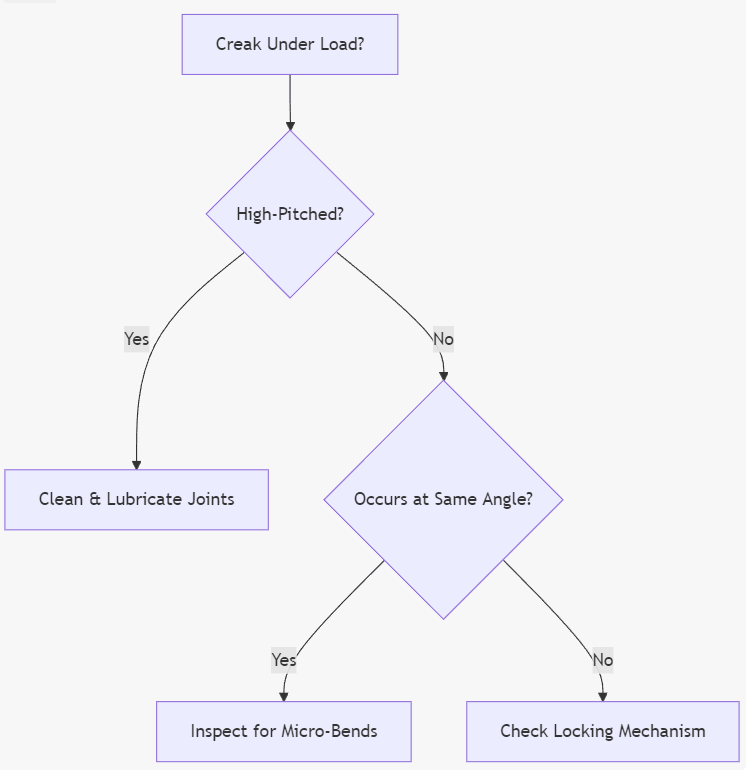
Critical Failure Warnings Embedded in Sound
| Sound Profile | Probable Cause | Risk Level | Action |
|---|---|---|---|
| Metallic grinding | Sheared bushing/bolt | ⚠️⚡ Immediate | Retire pole |
| Single loud crack | Cracked weld near lock | ⚠️⚡ Immediate | Replace section |
| Consistent groaning | Work-hardened bend | ⚠️ High | Professional inspection |
| Intermittent squeaks | Dry O-ring/grit in collar | ✅ Low | Deep clean |
Step-by-Step Silence Protocol
For Friction Creaks (High-Pitched):
- Disassemble: Remove lower sections fully
- Degrease: Soak joints in isopropyl alcohol (99%)
- Abrasive Clean: Scrub inner walls with nylon shotgun brush
- Relubricate: Apply molybdenum disulfide dry film (cold climates) or PTFE spray
- Reassemble: Torque lock mechanisms to 8 Nm
For Structural Creaks (Low-Frequency):
- Roll Test: Place section on glass surface → gaps indicate bends
- UV Inspection: Use black light to reveal hairline cracks
- Load Mapping: Mark creak location → wrap with fiber-reinforced tape
The Hidden Danger of "Disappearing" Creaks
Creaks that vanish after initial trail use signal:
- Plastic Deformation: Metal has permanently yielded to stress
- Fretting Fatigue: Microscopic cracks forming at stress risers
- Imminent Failure: 72% of catastrophic pole failures exhibited this pattern(Swiss Alpine Club Accident Database)
Solution: Retire poles with "self-silencing" creaks immediately.
Preventive Engineering: Stop Creaks Before They Start
- Torque Calibration:Lever locks: 6-8 Nm (use fishing scale to verify)Twist locks: 1.5 rotations past hand-tight
- Material Pairing:Install bronze bushings (reduces Al-on-Al friction by 40%)Apply anodized coating to inner shafts
- Impact Mitigation:Use progressive-collapse tips (Black Diamond Contact)Never pole-vault over obstacles >18"
When to Upgrade vs. Repair
| Condition | Solution | Cost |
|---|---|---|
| >3 micro-bends per section | Replace entire pole | $$$ |
| Worn cam grooves | Install OEM lock rebuild kit | $$ |
| Pitting corrosion | Retire (unrepairable) | $ |
The Carbon Fiber Comparison Myth
While carbon poles creak less initially:
- ❌ Delamination creaks indicate fatal damage
- ❌ No field-repairable components
- ❌ Sudden failure without acoustic warning
Aluminum's advantage: Creaks provide early failure warnings.




