




Can Walking Poles Help with Back Pain? The Posture-Performance Connection
Back pain is the world's leading cause of disability, affecting an estimated 568 million people globally. For hikers, walkers, and outdoor enthusiasts, back pain presents a cruel paradox: the activity that brings relief and joy is often the very activity that aggravates the pain. Walking poles have emerged as a potential solution, but the question demands rigorous examination: Can these simple tools genuinely alleviate spinal discomfort, or is the connection overstated?
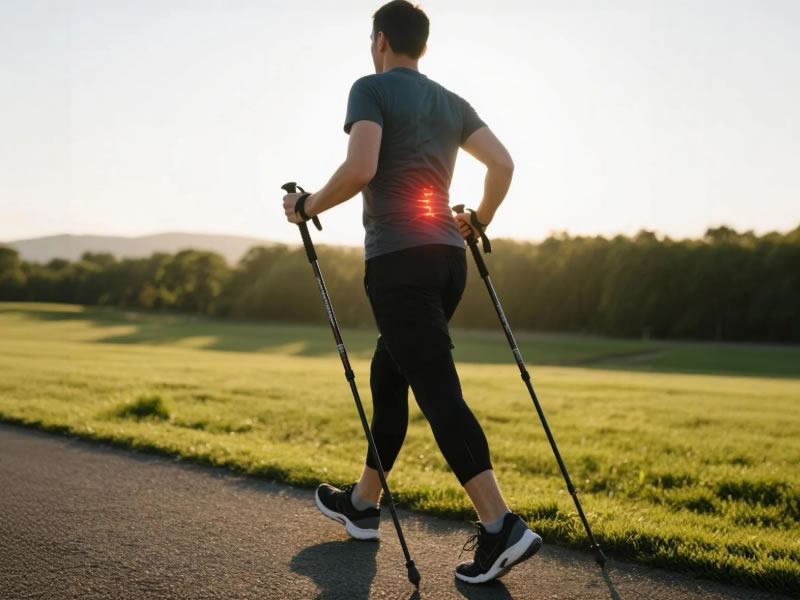
Recommended trekking pole purchase link: https://s.click.aliexpress.com/e/_c4M7OWaN
This guide synthesizes biomechanical research, clinical evidence, and the lived experience of thousands of walkers to provide a definitive answer. Yes, walking poles can help with back pain—sometimes dramatically—but the mechanisms are specific, and the technique is critical.
The Biomechanics of Back Pain During Walking
To understand how poles help, we must first understand why walking hurts.
1. The Posture Collapse
Fatigue, age, and habitual sitting create a characteristic forward-hunched posture. The shoulders round, the chin protrudes, and the upper back flexes. This position:
- Compresses the anterior spine: Vertebral bodies bear excessive load.
- Strains posterior musculature: Erector spinae and rhomboids work eccentrically to prevent complete collapse.
- Displaces the center of gravity: The head, which should balance directly above the pelvis, shifts forward, requiring constant cervical muscle activation.
2. The Impact Transmission
Each foot strike transmits a shockwave up the kinetic chain—through heel, ankle, knee, hip, and into the lumbar and cervical spine. On hard pavement, these forces are substantial. For individuals with degenerative disc disease, facet arthropathy, or prior spinal surgery, this repetitive loading is directly painful.
3. The Gait Asymmetry
Many individuals walk with subtle asymmetries—a shorter stride on one side, reduced arm swing, or pelvic rotation imbalances. These asymmetries propagate upward, creating rotational stress on the lumbar spine with every step.
Four Mechanisms: How Walking Poles Address Back Pain
Mechanism #1: Postural Realignment
This is the most significant and immediate benefit of walking poles.
When fitted correctly and used actively, walking poles force an upright torso. You cannot walk with poles while hunched forward; the poles would drag behind you, ineffective. To plant the pole ahead of your body, you must:
- Elevate your sternum
- Retract your scapulae
- Align your head over your shoulders
This is not passive suggestion; it is mechanical necessity. The poles literally pull you into proper posture.
The Clinical Relevance: Upright posture reduces intradiscal pressure, optimizes facet joint alignment, and redistributes spinal load from the anterior vertebral bodies to the posterior muscular sling. For individuals with compression fractures, degenerative disc disease, or postural kyphosis, this redistribution is therapeutic.
Mechanism #2: Load Redistribution
Each step transmits ground reaction force through your skeleton. With poles properly engaged (using the strap to bear weight), a portion of this force is diverted through your upper extremities—away from your spine.
This is directly analogous to how poles reduce knee impact, but the benefit extends proximally. Less force entering the feet means less force transmitted to the lumbar and cervical vertebrae.
Quantification: While specific spinal load reduction studies are limited, extrapolation from knee joint research suggests 15-25% reduction in axial loading during pole-assisted walking .
Mechanism #3: Core Engagement
Walking with poles is not passive upper extremity movement. Effective pole planting requires:
- Transverse abdominis activation to stabilize the pelvis before weight transfer
- Oblique engagement for rotational control during contralateral arm-leg coordination
- Erector spinae co-contraction to maintain upright posture against the forward reach
This is not theoretical. Electromyography studies demonstrate significantly higher core muscle activation during pole walking compared to unassisted walking .
For individuals with chronic low back pain characterized by core instability or poor motor control, this activation pattern is directly therapeutic.
Mechanism #4: Gait Normalization
Many back pain patients walk with a guarded, asymmetric gait—shortening stance phase on the painful side, reducing arm swing, and limiting pelvic rotation. These compensations create rotational stress on the lumbar spine.
Poles enforce symmetry. The reciprocal arm-leg rhythm (right pole with left foot) is visually and proprioceptively reinforced. You cannot pole walk with a severely asymmetric gait; the poles will literally collide. This enforced symmetry normalizes pelvic rotation and reduces compensatory spinal torsion.
The Evidence: What Research and Clinical Experience Show
1. Direct Clinical Studies
A 2018 randomized controlled trial examined Nordic walking in patients with chronic low back pain. After 12 weeks, the pole-walking group demonstrated:
- Significant reductions in pain intensity (VAS scores)
- Improved functional capacity (Oswestry Disability Index)
- Enhanced trunk muscle endurance
- Superior outcomes compared to conventional walking controls
The researchers concluded that Nordic walking is "an effective and safe therapeutic option" for chronic low back pain management .
2. Postural Outcomes
A 2020 study of older adults demonstrated that 12 weeks of pole walking significantly improved thoracic kyphosis angle and craniovertebral angle—objective measures of forward head posture and upper back curvature .
3. Clinical Consensus
Leading spine surgeons and physiotherapists increasingly recommend walking poles for patients with:
- Degenerative disc disease
- Lumbar spinal stenosis
- Osteoporotic compression fractures
- Post-laminectomy rehabilitation
- Chronic mechanical low back pain
The rationale is consistent: poles provide external support, enforce proper posture, and enable pain-free ambulation during the critical early phases of rehabilitation.
Practical Application: Using Poles for Back Pain Relief
1. Length Selection for Postural Optimization
| Goal | Pole Length | Rationale |
|---|---|---|
| Maximize upright posture | Slightly longer than 90° baseline | Promotes sternum elevation; prevents hunching |
| General walking comfort | 90° elbow angle | Balanced between posture and arm fatigue |
| Descending (if spine sensitive) | Lengthen 5-10cm | Reduces axial loading; provides braking |
Recommendation: For back pain patients, err on the slightly longer side. A pole that forces you to stand tall is preferable to one that permits slouching.
2. Technique Modifications for Spinal Protection
- Engage your core before each plant: Brace your abdominals as if preparing for a light punch. This stabilizes the spine before weight transfer.
- Maintain tall sternum: Visualize a string pulling you upward from the breastbone. Your poles should reach forward from this elevated position.
- Avoid overreaching: Excessive forward reach hyperextends the lumbar spine. Your plant should feel comfortable, not strained.
- Use the straps: Pushing through the strap, not gripping the handle, transfers weight through your skeleton rather than requiring upper back tension.
3. Equipment Considerations
| Feature | Why It Matters for Back Pain | Recommendation |
|---|---|---|
| Shaft material | Vibration transmission to spine | Carbon fiber (superior dampening) |
| Grip material | Shoulder/upper back tension | Cork (reduces required grip force) |
| Locking mechanism | Consistency of length setting | External lever locks (reliable, adjustable) |
| Shock absorption | Impact attenuation | Recommended for spinal sensitivity |
Contraindications and Cautions
Walking poles are not appropriate for all back pain patients in all stages of their condition.
Use with caution or avoid if:
- Acute radiculopathy: Sharp, shooting leg pain with ambulation may indicate nerve root irritation that requires specific postural positioning.
- Unstable spinal fractures: Pending surgical stabilization, weight-bearing activity may be contraindicated.
- Severe osteoporosis: While poles reduce impact, some patients require non-weight-bearing activity during acute phases.
- Upper extremity pathology: Shoulder, wrist, or hand conditions that prevent proper pole use will compromise technique and may cause secondary pain.
Always consult a physician or physical therapist before initiating any new exercise program for therapeutic purposes.
Beyond Pain Reduction: The Empowerment Effect
For individuals whose back pain has progressively limited their activity, walking poles offer something beyond biomechanical relief: psychological liberation.
The fear that walking will cause pain—or worse, injury—creates a debilitating cycle of avoidance, deconditioning, and increased disability. Poles provide the confidence to walk without waiting for the familiar twinge. They enable the patient to move forward rather than brace for impact.
This confidence is not ancillary to treatment; it is treatment. The restoration of self-efficacy in ambulation is a primary goal of spinal rehabilitation.
Conclusion: A Tool, Not a Cure
Can walking poles help with back pain?
Yes—but with necessary qualifications.
Walking poles are not a cure for spinal pathology. They do not reverse degenerative changes, heal herniated discs, or replace the need for appropriate medical care, therapeutic exercise, and lifestyle modification.
What they do is equally valuable:
- They enforce upright posture when fatigue and habit encourage collapse.
- They reduce axial loading with every step, sparing sensitive spinal structures.
- They engage core musculature that stabilizes and protects the spine.
- They normalize gait symmetry, reducing compensatory rotational stress.
- They restore confidence, enabling the activity that is itself therapeutic.
For millions of individuals whose back pain has stolen the simple pleasure of a walk, poles are not an admission of disability. They are instruments of liberation—tools that say, You can still do this. You can still move. You can still go forward.
The evidence is accumulating. The clinical experience is consistent. The biomechanical rationale is sound.
Walking poles cannot fix your back. But they can help you walk—and sometimes, that is everything.




