




Z-Poles vs Telescoping Trekking Poles: Which Is Better for Backpacking? A Strategic Guide
For backpackers, every gear decision carries extra weight—both literally and functionally. The choice between foldable Z-poles and adjustable telescoping poles is fundamental, impacting your daily rhythm, joint health, and pack organization. There is no universal "better" option; rather, there is a "best fit" for your specific backpacking style, terrain, and load.
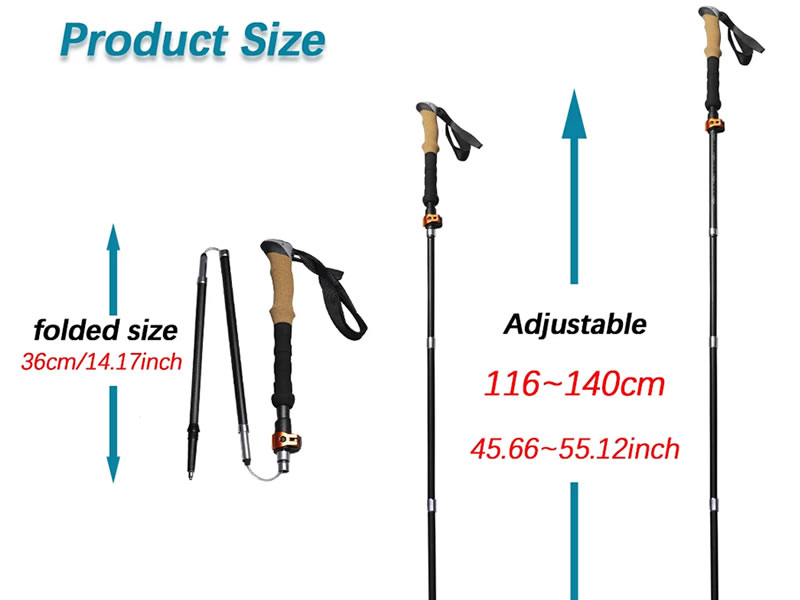
Recommended trekking pole purchase link: https://s.click.aliexpress.com/e/_c4M7OWaN
Telescoping (Adjustable) Trekking Poles: The Versatile Workhorse
How They Work: Feature 2-3 sections that slide and lock via an external lever (flick lock) or twist mechanism.
Pros for Backpacking:
- Terrain-Specific Adjustment: This is their paramount advantage. With a heavy pack, proper pole length is crucial for joint protection. You can shorten them for steep ascents and lengthen them for descents, optimally distributing load and reducing knee strain by up to 25%.
- Tent Compatibility: They are ideal for trekking pole tents. You can precisely adjust the pole height to achieve the perfect pitch tension for your shelter, a critical factor in wind or rain.
- Strength and Repairability: The simple design often has fewer failure points than internal Z-pole cords. A bent section might still function, and field repairs on locks are more straightforward.
- Load Management: The ability to slightly lengthen poles under a heavy pack can improve posture and stability.
Cons for Backpacking:
- Packability: Even collapsed, they are longer (typically 24-28 inches), often requiring external attachment to your pack.
- Weight: Generally slightly heavier than equivalent Z-poles due to the locking mechanisms.
- Potential for Mechanical Failure: Locks can freeze, clog with mud, or, if poorly maintained, slip.
Z-Poles (Foldable): The Streamlined Performer
How They Work: Collapse via internal tension cords into a compact, often 14-16 inch, bundle.
Pros for Backpacking:
- Superior Packability: Their compact size allows them to fit inside your backpack, creating a sleeker, snag-free profile and better weight distribution.
- Lightweight: The elimination of locks and overlapping sections often makes them the lightest option.
- Rapid Deployment: They can be flicked open and locked by tension in seconds.
- Cleaner Profile: No external levers to snag on brush or gear.
Cons for Backpacking:
- Fixed Length: This is their most significant limitation. You cannot adjust for varying incline, which can lead to less efficient biomechanics and increased joint fatigue over long, variable days.
- Single Point of Failure: A broken internal tension cord disables the pole. While field-repairable with a spare cord, it's a more finicky process than tightening a lock.
- Less Ideal for Trekking Pole Tents: You are stuck with the fixed height, which may not match your tent's optimal pitch requirements.
Head-to-Head Comparison for Backpacking
| Feature | Telescoping Poles | Z-Poles |
|---|---|---|
| Key Advantage | Versatility & Joint Protection | Packability & Weight |
| Terrain Adaptation | Excellent (Adjusts for ascents/descents) | Poor (One fixed length) |
| Pack Integration | Fair (Often external carry) | Excellent (Fits inside pack) |
| Tent Compatibility | Excellent (Precise height adjustment) | Good (If length matches tent) |
| Durability Concern | Locking Mechanisms | Internal Tension Cord |
The Verdict: Which Backpacker Are You?
Choose Telescoping (Adjustable) Poles If:
- Your trips involve significant, daily elevation change.
- You use a trekking pole tent.
- You carry a traditional, heavier backpack (over 30 lbs base weight).
- You have knee or joint sensitivities.
- Recommended Model: Black Diamond Alpine Carbon Cork (for premium performance) or Cascade Mountain Tech Aluminum (for outstanding value).
Choose Z-Poles If:
- You are an ultralight or fastpacking backpacker where every ounce and inch counts.
- Your routes are on relatively consistent terrain without extreme, sustained climbs or descents.
- You prioritize a clean, interior pack organization.
- Your shelter does not require specific pole adjustments.
- Recommended Model: Black Diamond Distance Carbon Z.
Hybrid/Smart Approach: Many backpackers adopt a flexible strategy. For a mountainous trip with a trekking pole tent, they choose telescoping poles. For a fast-and-light trip on a rolling long-distance trail, they opt for Z-poles.
Ultimately, the "better" pole is the one that best supports your body and your system under load. For the traditional backpacker seeking adaptability and protection, telescoping poles are the more functional and prudent choice. For the ultralight specialist prioritizing minimalism above all, Z-poles deliver peak efficiency. Assess your typical routes, your body's needs, and your overall gear system to make the strategic choice.




