




Most Durable Hiking Poles for Rugged Off-Trail Use?
Venturing off-trail—whether navigating alpine scree fields, bushwhacking through dense thickets, or crossing boulder-strewn terrain—represents the ultimate test for both hiker and gear. In these environments, your trekking poles are no longer just aids; they become essential tools for probing, stabilizing, and occasionally bearing your full weight in precarious situations. Failure is not an option. Therefore, selecting the most durable poles requires moving beyond general recommendations to focus on engineering built for abuse. The most durable poles for rugged off-trail use share a common philosophy: prioritizing absolute strength and reliability over minimal weight.
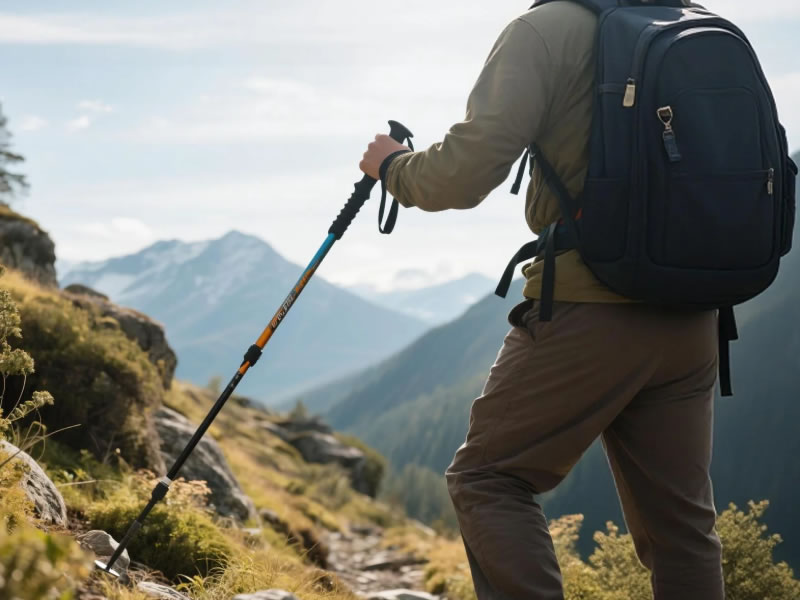
Recommended trekking pole purchase link: https://s.click.aliexpress.com/e/_c4M7OWaN
The Core Principles of Off-Trail Durability
- Material: The Unquestionable Reign of 7075-T6 AluminumWhile carbon fiber is excellent for weight and vibration dampening on trails, off-travel demands a different kind of strength. 7075-T6 aluminum is an aerospace-grade alloy known for its exceptional yield strength—its ability to withstand bending forces without permanent deformation. When jammed into a rock crevice or used to lever through brush, a 7075 aluminum pole will typically bend before it snaps, giving you a chance to field-repair or safely retreat. Carbon fiber, while strong, can suffer catastrophic failure (shattering) from a sharp, lateral impact against rock. For sheer, predictable durability in unpredictable terrain, 7075 aluminum is the undisputed champion.
- Locking Mechanism: The Case for External Lever LocksInternal twist locks are the enemy of off-trail durability. Grit, mud, and ice can render them useless. The only acceptable choice is an oversized, external lever lock (flip lock). These mechanisms are:Serviceable: Dirt can be cleaned out easily.Operable with Gloves: Critical in cold or wet conditions.Visually Verifiable: You can see and feel when they are locked.Powerful: They exert tremendous clamping force on the shaft to prevent slippage under heavy, twisting loads.
- Design and Build: Simplicity and RobustnessLook for poles with a minimal number of joints, thicker shaft diameters (often 16-18mm), and reinforced stress points. Folding Z-poles, with their multiple internal cords and small hinges, introduce more potential failure points and are generally less recommended for severe off-trail abuse than robust three-section telescoping poles.
Top Recommendations: The Off-Trail Workhorses
Based on the above principles, these models stand out for their proven ability to withstand punishment.
1. Black Diamond Trail Pro 3
* Why It's a Tank: This pole is the benchmark for off-trail durability. Its 7075-T6 aluminum shaft is famously tough, and its FlickLock Pro levers are arguably the strongest, most reliable locking system on the market. The extended foam grip allows for a secure choke-up grip in technical sections. It’s a straightforward, overbuilt tool trusted by backpackers, hunters, and mountaineers worldwide.
2. Komperdell Powerlock Alpine / Crossover Series
* Why It's a Tank: Austrian-engineered for alpine extremes, Komperdell poles are built to a different standard. The Powerlock lever is incredibly robust, often larger than competitors', and designed for use with heavy gloves. Their shafts are notoriously resilient, and many models feature permanently attached snow baskets (a sign of their mountaineering intent) and incredibly comfortable, durable rubberized grips that withstand abrasion from rock and brush.
3. Leki Khumbu or Makalu Series
* Why It's a Tank: While Leki is known for innovation, their mountaineering-focused lines are pure durability. Models like the Khumbu feature simple, single-layer aluminum construction (no thinner, weight-saving double layers) and their reliable SpeedLock 2 system. They are less about finesse and more about providing an unbreakable, trustworthy third and fourth leg in high-consequence terrain.
4. MSR DynaLock Ascent
* Why It's a Tank: MSR approaches durability with unique engineering. The DynaLock system uses a durable plastic collar that tightens down with a simple twist, avoiding small metal parts that can fail. These poles are famously tough, simple, and easy to field-maintain. They are a favorite among guides and those who operate in consistently muddy or gritty conditions.
Critical Features & Accessories for Off-Trail Use
- Baskets: Swap small trekking baskets for large, aggressive mountain baskets. These prevent poles from plunging too deeply into scree or soft ground and provide better leverage.
- Tips: Start with sharp, replaceable tungsten carbide tips. Carry spares. In some rock-heavy environments, a steel tip protector (like a "paw") can prevent the carbide from shattering.
- Grips: Dense rubber or cork is ideal. Soft foam can be shredded by rough rock contact.
- Straps: Use removable straps in dense brush to prevent snagging. In open but technical terrain, keep them on for security.
The Trade-Off: Embracing the Weight
The ultimate durability of these poles comes with a cost: weight. A pair of indestructible 7075 aluminum poles will weigh 18-22 ounces, compared to a 10-ounce ultralight carbon pair. For off-trail travel, this is a wise and necessary trade. The extra few ounces provide the confidence to push through challenging sections, test uncertain footing, and know your primary stability aid won’t fail when you need it most.
Final Verdict: Tools, Not Accessories
For rugged off-trail use, you are not buying a hiking accessory; you are selecting a critical piece of safety equipment. Compromise is not advised.
If your journeys consistently take you away from maintained paths, the Black Diamond Trail Pro 3 and Komperdell Powerlock series represent the pinnacle of proven, field-tested durability. Their superior materials, bombproof locking mechanisms, and straightforward design are engineered to survive what the backcountry throws at them. Invest in these, and you invest in the confidence to explore more demanding, remote, and rewarding landscapes.




