




Do Hiking Poles Improve Balance? The Science of Stability on the Trail
The short and resounding answer is yes, hiking poles substantially improve balance. However, this simple truth encompasses a complex interplay of biomechanics, physics, and psychology. For hikers of all skill levels, poles are not merely accessories; they are active stability tools that transform your relationship with challenging terrain by fundamentally altering your body's base of support and sensory feedback.
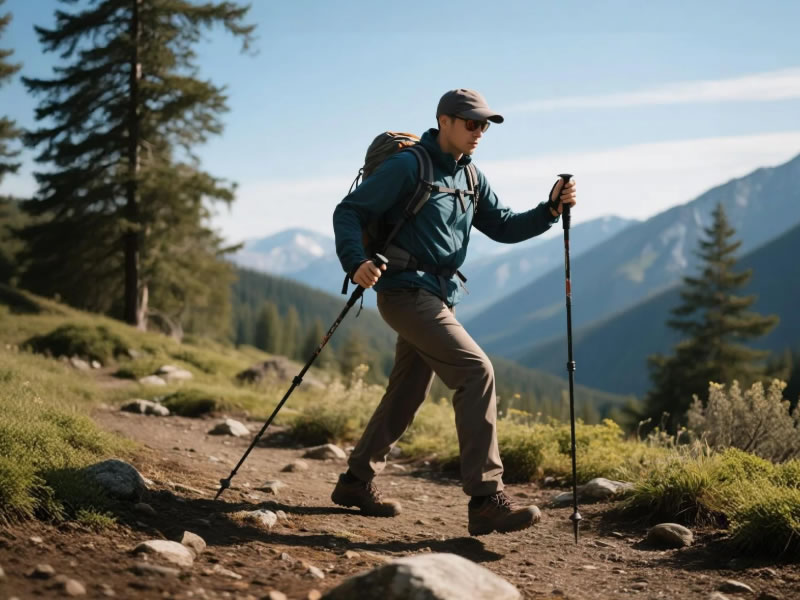
Recommended trekking pole purchase link: https://s.click.aliexpress.com/e/_c4M7OWaN
The Biomechanics: From Biped to "Quadruped"
Humans are naturally bipedal, maintaining balance on two points of contact—a system that requires constant, subtle muscular correction, especially on uneven ground. Hiking poles ingeniously extend this system.
- Expanding the Base of Support: By adding two more points of contact, poles effectively widen your base of support in the direction you plant them. This creates a dynamic "tripod" or "quadpod" stance that is geometrically far more stable than two legs alone. This is why the feeling of security is immediate on a rocky slope or a narrow path.
- Providing Active Proprioceptive Feedback: Your hands and arms are rich with sensory receptors (proprioceptors). When a pole tip contacts the ground, it sends instant tactile information about the terrain's firmness, angle, and slippage to your brain before you commit your full weight with a footstep. This acts as an advanced scout system, allowing for micro-adjustments in stride, posture, and weight distribution.
- Creating a Movable Anchor: On unstable surfaces like loose scree, muddy inclines, or slippery river rocks, a firmly planted pole serves as a temporary anchor. You can push or pull against it to maintain center of gravity, test footing, or arrest a potential slip. This control is transformative for confidence.
The Psychological Impact: Confidence Enables Capability
The balance improvement isn't just physical; it's psychological. The presence of poles reduces the fear of falling. This reduced anxiety leads to more relaxed, deliberate movements, better posture (less defensive hunching), and a willingness to tackle terrain that might otherwise feel intimidating. This confidence often allows hikers to move more efficiently and enjoy the scenery rather than fixating solely on their next footstep.
Where the Balance Benefit is Most Pronounced
The degree of balance improvement is most dramatic in specific scenarios:
- Uneven and Rocky Terrain: Poles are indispensable for navigating talus fields, root networks, and boulder hops, providing a steadying point with each step.
- Loose Surfaces (Scree, Gravel, Sand): They prevent backward slides on descents and provide purchase on ascents where feet might slip.
- Water Crossings: This is arguably where poles offer their greatest balance utility. They allow for a stable three-point contact system in fast-moving currents on slippery, unseen bottoms.
- Sidehill Traverses: On slopes where the trail slopes away, a pole planted downhill creates a crucial brace to counter the gravitational pull.
- Low-Visibility or Fatigue: In fog, dusk, or when tired—conditions where proprioception and reaction time are diminished—poles provide reliable, constant feedback and support.
The Technique Factor: Maximizing the Balance Benefit
Simply carrying poles won't magically bestow perfect balance. Proper technique is the amplifier:
- Plant Ahead and Downhill: On descents, plant the pole tip ahead and slightly downhill of your leading foot. This creates a stabilizing brace you can lean into.
- Use a Rhythmic, Opposite Arm/Leg Swing: This coordinates your movement, engaging your core and promoting a natural, balanced gait.
- Keep a Relaxed Grip: Balance comes from the pole's ground contact and your skeletal structure bearing weight through the wrist strap, not from a white-knuckled fist. A tense grip wastes energy and reduces sensory feedback.
A Critical Distinction: Balance vs. Agility
It's important to note that poles improve static and dynamic stability but can slightly reduce ultimate agility. In situations requiring rapid, cat-like leaps or very precise foot placement in tight spaces (e.g., technical rock scrambling), unencumbered hands and freedom of movement may be preferable. For the vast majority of trail hiking, however, the stability gained far outweighs any minimal loss in nimbleness.
Conclusion: A Resounding Endorsement for Stability
Scientific studies and overwhelming anecdotal evidence confirm that hiking poles are powerful tools for enhancing balance. They work by engineering a more stable physical platform and by enhancing your nervous system's awareness of the ground. This leads to tangible outcomes: fewer stumbles, a reduced fear of falling, increased confidence on technical terrain, and the ability to hike longer with less fatigue. For anyone venturing off paved paths—from casual day hikers to seasoned backpackers—integrating poles into their kit is one of the most effective single steps they can take to improve safety, stability, and overall enjoyment of the trail.




