




walking poles Double lock vs single lock safety features?
When it comes to trekking poles, the locking mechanism is your primary safety interface. It is the only thing standing between a secure stride and a sudden, potentially dangerous collapse. Among external lever systems, a critical distinction exists between double lock and single lock designs. Understanding this difference is essential for anyone who ventures onto steep, rocky, or otherwise demanding terrain where pole failure could lead to a fall.
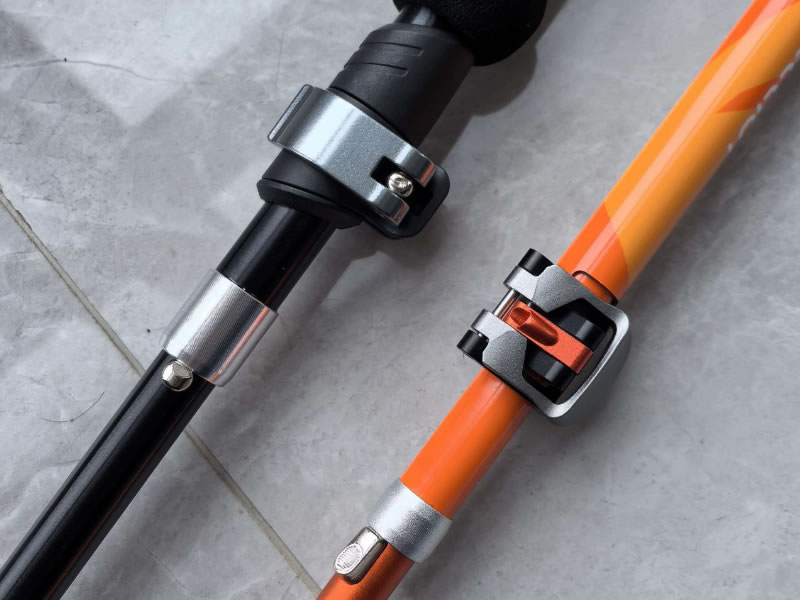
Recommended trekking pole purchase link: https://s.click.aliexpress.com/e/_c4M7OWaN
Defining the Terms
Single Lock (Single Adjustment Point):
A single-lock system uses one lever to secure the entire adjustable length of the pole. This design is most common on two types of poles:
- Folding poles: A single push-button or lever locks the folded sections into the extended position.
- Telescoping poles with one adjustable section: The upper section is fixed; only the lower section extends and locks via one lever.
Double Lock (Dual Adjustment Points):
A double-lock system features two independent locking mechanisms—typically one on the middle section and one on the lower section. This allows each telescoping section to be adjusted and locked separately. Most premium telescoping poles from brands like Black Diamond, Leki, and Komperdell use this configuration.
How Safety Differs
Redundancy:
The most significant safety advantage of double-lock systems is redundancy. If one lock fails—whether due to wear, contamination, or accidental impact—the other lock remains engaged. The pole may become wobbly or limited in adjustability, but it will not collapse completely. You retain a functional pole to finish your hike or descend safely.
With a single-lock system, failure of that one mechanism means the pole collapses entirely. On steep terrain, this sudden loss of support can cause loss of balance, a fall, or exacerbate an already precarious situation.
Failure Warning:
Double-lock systems often provide earlier warning of problems. A failing lower lock may slip slightly, but the upper lock holds, giving you time to notice the issue and address it. Single-lock systems offer no such buffer—performance is binary.
Adjustment Versatility
Beyond safety, double-lock systems offer practical benefits that enhance stability:
Fine-Tuned Length Control:
With two independent locks, you can adjust overall length more precisely. For steep climbs, you may want the pole shorter; for descents, longer. Double locks allow you to optimize both sections for your exact height and terrain.
Tension Management:
Each lock can be individually tensioned. If one section wears faster, you can tighten that specific lock without affecting the other.
Weight and Complexity Trade-Offs
| Feature | Single Lock | Double Lock |
|---|---|---|
| Weight | Lighter | Heavier by 1-2 oz per pole |
| Complexity | Simpler | More moving parts |
| Redundancy | None | Built-in backup |
| Adjustment range | Limited | Full |
| Field repairability | Simple | Slightly more complex |
Which Is Safer?
| Scenario | Single Lock | Double Lock |
|---|---|---|
| Gentle, flat trails | Safe | Safe (overkill) |
| Steep, rocky terrain | Moderate risk | Significantly safer |
| Heavy backpacking | Increased risk | Recommended |
| Winter/ice conditions | Higher risk | Recommended |
| Technical scrambling | High risk | Essential |
Double-lock systems are objectively safer for demanding conditions. The redundancy of two independent mechanisms provides a critical margin of safety that single-lock designs cannot match.
The Folding Pole Exception
It is worth noting that high-quality folding poles (like Black Diamond's Z-Poles or Gossamer Gear LT5s) often use a single locking mechanism—typically a push-button or a single lever that engages all sections simultaneously. While these lack dual-lock redundancy, they are engineered differently: the sections are joined by internal cords, meaning even if the lock fails, the pole remains connected and partially functional. However, they still lack the backup security of dual independent locks.
The Verdict
For hikers who venture onto steep, uneven, or technical terrain—or who carry heavy packs—double-lock systems provide a meaningful safety advantage. The weight penalty is minimal compared to the peace of mind that comes with knowing a single lock failure will not leave you without support mid-stride.
Single-lock systems remain a viable choice for lightweight enthusiasts, casual day hikers, and those primarily on gentle, predictable trails. But if safety is your priority, redundancy matters.
Your poles are your third and fourth points of contact with the ground. Choose a system that gives you confidence in every step.




