




Trekking poles Spike tips for ice – removable or permanent?
When winter transforms trails into sheets of ice, standard carbide tips—excellent for dirt and rock—become dangerously inadequate. Ice demands aggressive traction: sharp points, angled teeth, and the ability to bite into hard, frozen surfaces. Enter spike tips (also called ice tips, crampon tips, or winter spikes). But a critical question arises for hikers who navigate both summer trails and winter ice: are these spike tips removable or permanently fixed to the pole? The answer determines whether you need separate poles for winter or can adapt a single set year-round. This deep dive explores the design philosophies, practical trade-offs, and best choices for ice-capable trekking poles.
Recommended trekking pole purchase link: https://s.click.aliexpress.com/e/_c4M7OWaN
The Two Approaches
Removable Ice Spikes:
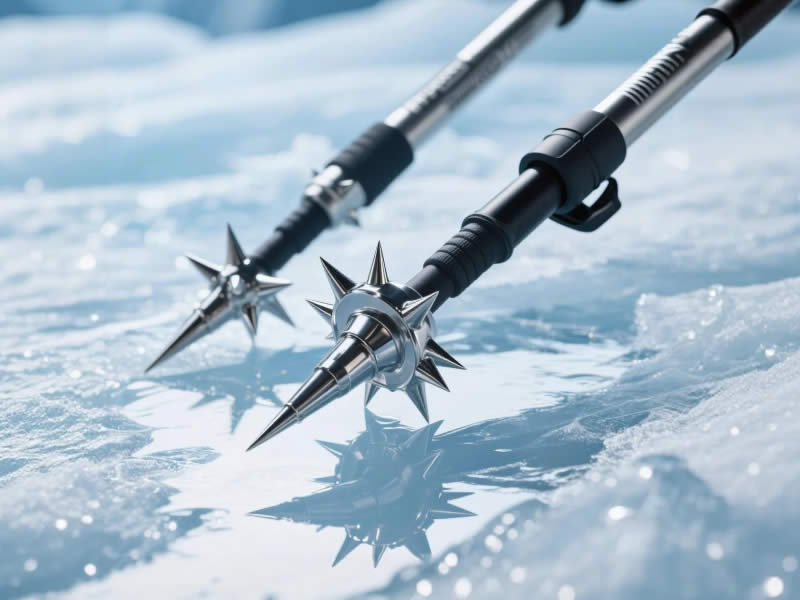
The majority of quality trekking poles designed for winter use feature interchangeable tip systems that allow you to swap the standard carbide tip for an ice-specific spike. These spikes typically screw into a threaded collar, snap into a locking mechanism, or twist onto a dedicated interface. The same system that accommodates rubber pavement boots, snow baskets, and mud baskets also accepts ice spikes.
Permanent Ice Spikes:
Some poles—particularly budget winter-specific models or poles designed exclusively for mountaineering—have fixed ice spikes permanently attached to the lower section. The tip cannot be removed or replaced. These poles are dedicated winter tools, often with integrated features like extended foam grips for gloved hands and aggressive basket designs.
Removable Ice Spikes: Versatility Wins
How they work:
Most removable ice spikes attach via the same interchangeable system as your pole’s standard tip. Common mechanisms include:
- Screw-thread: The spike screws into a threaded collar at the tip (common on Leki, Komperdell)
- Snap-lock: A button or spring clip secures the spike; press to release (common on Black Diamond)
- Push-and-twist: The spike slides onto the tip and locks with a quarter-turn
Advantages:
- Year-round versatility: One set of poles serves summer trails (carbide tips), winter ice (spike tips), and everything in between.
- Replaceability: When spikes wear down (and they will on abrasive ice), you replace only the tip, not the entire pole.
- Travel convenience: Swap to rubber tips for airline travel; pack ice spikes for destination winter trips.
- Cost efficiency: Instead of buying separate summer and winter poles, you invest in one quality pole plus accessory spikes ($20–$40 per pair).
Considerations:
- Initial cost: Poles with interchangeable systems typically cost more than fixed-tip budget poles.
- Learning curve: Remembering to swap tips before winter trips requires habit formation.
- Potential for loss: Removable tips can be lost if not properly secured.
Permanent Ice Spikes: Simplicity for Dedicated Winter Use
Design:
Poles with fixed ice spikes have the aggressive tip integrated into the lower shaft. There is no removable component. These poles are often sold as “winter” or “mountaineering” models and may include:
- Larger, more aggressive spikes with multi-directional teeth
- Extended foam grips for gloved hands
- Large snow baskets (often fixed or interchangeable)
- Reinforced lower sections for ice and rock contact
Advantages:
- Simplicity: No decisions about which tip to use; always ready for ice.
- Durability: One fewer mechanical interface to fail. Fixed spikes cannot loosen or fall off.
- Robustness: Often built with heavier-duty materials for sustained winter abuse.
Considerations:
- Limited versatility: Not suitable for summer hiking (spikes are overkill on dirt and can damage trails).
- No replacement: When the spike wears out (which takes many seasons but does happen), the pole may need replacement.
- Storage: Longer spikes can be awkward to pack and may damage gear bags without tip protectors.
- Cost: You effectively need a second set of poles for summer use.
Comparing Ice Spike Designs
| Feature | Removable Ice Spikes | Permanent Ice Spikes |
|---|---|---|
| Versatility | Excellent (swap for carbide, rubber) | Poor (dedicated winter only) |
| Replaceability | Yes (when worn) | No (replace entire pole) |
| Security | Good (if properly attached) | Excellent (no detachment risk) |
| Weight | Lighter overall (shared poles) | Heavier (second pole set) |
| Cost (over time) | Lower (one pole set + tips) | Higher (two pole sets) |
| Best for | Year-round hikers, mixed seasons | Dedicated winter-only users |
When to Choose Removable
Removable ice spikes are the better choice for:
- Hikers who enjoy both summer trails and winter ice
- Those who travel and need adaptable gear
- Anyone who prefers one high-quality pole set for all conditions
- Users who value replaceable components for long-term durability
When to Choose Permanent
Permanent ice spikes make sense for:
- Hikers who live in regions with extended winter seasons and rarely hike without snow/ice
- Mountaineers who need bombproof reliability on technical ice and mixed terrain
- Those who already own separate summer poles and want dedicated winter gear
- Users who prefer simplicity and are willing to accept the trade-offs
The Verdict
For most hikers, removable ice spikes offer the best combination of versatility, longevity, and value. The ability to swap carbide tips for aggressive ice spikes—and back again—means one high-quality pole set serves year-round. Replaceable spikes extend the life of your poles, and the flexibility to adapt to changing conditions is invaluable.
Permanent ice spikes remain a valid choice for dedicated winter specialists who prefer the simplicity of a fixed tool and are willing to maintain separate summer poles. But for the majority of outdoor enthusiasts who hike in multiple seasons, the removable approach is the smarter investment.
Let your poles adapt to the season, not the other way around.




