




Snapped Trekking Poles in backcountry – emergency repairs?
A snapped trekking pole in the backcountry can feel like a minor disaster, especially if you rely on it for stability under a heavy pack or as a support for your shelter. But a broken pole does not have to end your trip. With a few simple materials and some improvisation, you can often create a temporary repair that gets you safely back to the trailhead. This guide covers emergency fixes for both aluminum and carbon poles, what to carry in your repair kit, and when it is time to accept the loss and hike out with a shortened pole.
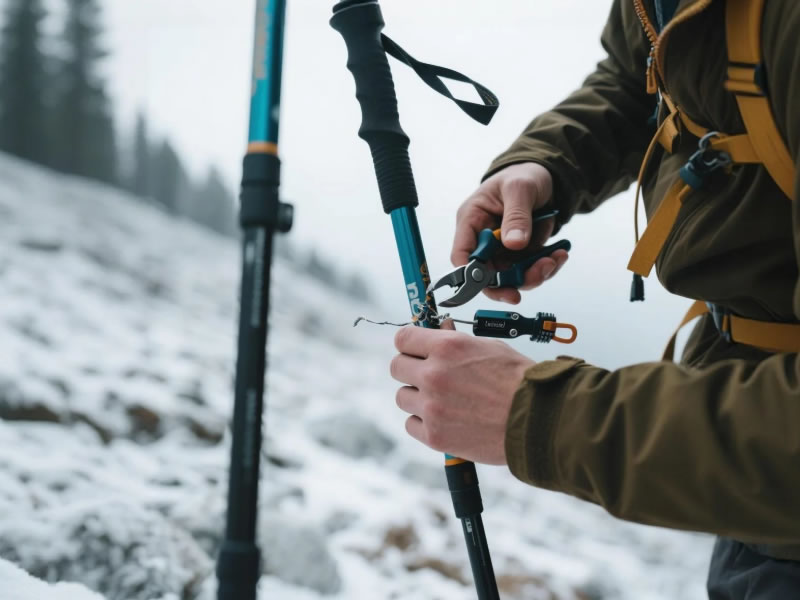
Recommended trekking pole purchase link: https://s.click.aliexpress.com/e/_c4M7OWaN
Assessing the Damage
Before attempting any repair, determine:
- Material: Aluminum bends; carbon snaps or splinters. This dictates what is possible.
- Location: Is the break in a section that can be removed, or does it involve a joint or locking mechanism?
- Resources: Do you have duct tape, a multi‑tool, and something to use as a splint (tent pole section, a stick, a spare pole section from a partner)?
Repairing Aluminum Poles
Aluminum poles sometimes bend without fully breaking. If the bend is minor and there is no crease, you may carefully straighten it:
- Remove the damaged section if it is detachable.
- Place it on a flat, solid surface (a rock will do).
- Apply slow, steady pressure—do not strike it with a rock. Gradual straightening is safer than hammering.
- Once reasonably straight, reassemble and test the lock. If the lock no longer holds, the pole will not be reliable.
If the aluminum is snapped completely:
- Internal splint: Find a stick, tent stake, or spare section of another pole that fits snugly inside the broken tube. Slide the splint into both ends, then wrap the area tightly with duct tape to immobilize the joint.
- External splint: If nothing fits inside, use two sticks or tent stakes on either side of the break, lashed with tape, cordage, or even tightly wrapped shoelaces. The splint should extend several inches past the break on both sides.
Repairing Carbon Poles
Carbon fiber does not bend; it cracks or shatters. A snapped carbon pole cannot be reliably repaired in the field to carry significant weight. However, you can still make it usable for light support:
- Remove the broken section entirely. If the break is in the lower section, you may be able to use the pole as a shorter support.
- If the break is in the middle section of a folding Z‑pole, remove the damaged section and use the remaining two sections as a shorter fixed‑length pole (some Z‑poles can be reconfigured this way).
- Wrap the sharp edges of the break with tape to prevent splinters from catching on your gear or clothing.
Do not attempt to splint a carbon pole and trust it to hold your weight. Carbon that has broken internally is unpredictable; a splint may stabilize it for light use, but it will not restore structural integrity.
Using a Broken Pole for Shelter
If your pole was meant to support a trekking‑pole tent or tarp, a break in the middle of the night can be alarming. Options:
- Use the undamaged pole for the shelter and use the broken pole as a shortened support for the other side.
- If both poles are damaged, look for natural supports: a trekking pole lashed to a tree branch, a forked stick, or even hanging the tent from a overhead branch using cordage.
- Lower the tent pitch to reduce the required height—a flatter pitch still sheds wind and rain.
Essential Field Repair Kit
Carrying a small repair kit can turn a broken pole from a trip‑ender into a minor inconvenience:
- Duct tape: Wrap 3–5 feet around one of your poles before the trip. It is the most versatile repair tool.
- Multi‑tool: Look for one with pliers for bending or cutting.
- Spare pole section: Some hikers carry a short section of aluminum tubing (often a cut‑down pole section) that can serve as an internal splint.
- Cordage: 10–15 feet of lightweight cord (e.g., Zing‑It or 2–3 mm accessory cord) for lashing splints or creating tension.
- Tent pole splint: A small aluminum tube designed to slip over broken tent poles—works perfectly for trekking poles too.
When to Abandon the Repair
If the break is at a joint, involves the locking mechanism, or the splint simply will not hold, do not waste hours trying to force a repair. Instead:
- Shorten the pole: Use only the remaining intact sections. A shorter pole is still useful for stability, especially on downhill sections.
- Use a single pole: If one pole is completely unusable, hike with the remaining good pole and use it in your stronger hand. Adjust your gait accordingly.
- Lean on a partner: If hiking with a companion, one person can use both poles while the other uses a single pole or a sturdy stick.
The Verdict
A snapped trekking pole in the backcountry is rarely a true emergency. With a roll of duct tape, a simple splint, and some creative thinking, you can often jury‑rig a temporary repair that allows you to continue safely. The key is to carry the basic materials to make that repair possible and to know when to accept that the pole is beyond fixing and simply adapt.
After the trip, replace the damaged pole or section. Field repairs are for getting home—not for long‑term use. Your next adventure deserves gear you can trust.
When the pole breaks, your wits take over. Pack a little tape, think clearly, and hike out safely.




