




GPS Trekking Poles for tracking hiking routes?
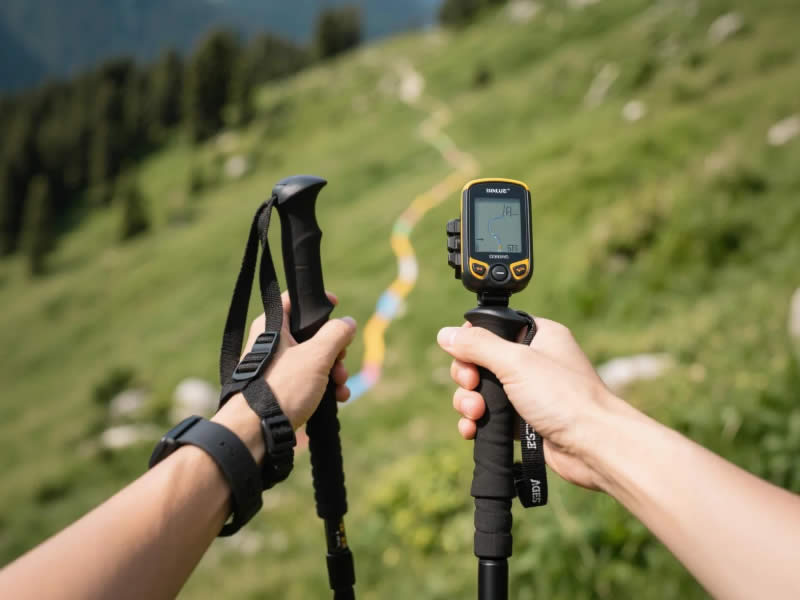
For hikers who love data—distance, elevation, route maps, and pace—the idea of integrating GPS directly into trekking poles is tantalizing. After all, your poles are already in your hands, pointed skyward, with a clear view of the sky. Why not build a GPS receiver into the grip or shaft? It would eliminate the need for a separate GPS watch or phone, and you’d never forget it. But as appealing as the concept sounds, the reality is that GPS trekking poles are not yet a practical product. Most so‑called “GPS poles” rely on your smartphone’s GPS, not an independent receiver. This article separates hype from reality, explains what’s available, and offers better alternatives for tracking your hiking routes.
Recommended trekking pole purchase link: https://s.click.aliexpress.com/e/_c4M7OWaN
What Would GPS Trekking Poles Do?
In an ideal world, a trekking pole with built‑in GPS would:
- Record your track (latitude, longitude, altitude, time).
- Calculate distance, speed, ascent, and descent.
- Store data internally or sync via Bluetooth to your phone.
- Possibly display basic navigation info (direction, distance to waypoint) on a small screen embedded in the grip.
- Have long battery life (days) and rugged durability.
Such a product would appeal to ultralight hikers who want to leave their phone behind, or to those who dislike wearing a watch. However, no major brand currently offers a true standalone GPS trekking pole.
What “GPS Poles” Actually Are
When you search for “GPS trekking poles,” you typically find one of two things:
1. Poles with a smartphone mount
Many poles now include a threaded mount on the grip that accepts a smartphone adapter. You attach your phone, run a GPS app (Gaia, AllTrails, Strava), and use the phone’s built‑in GPS. The pole serves as a monopod or selfie stick for navigation. This is not a GPS pole; it’s a phone holder.
2. Bluetooth‑connected poles
A few smart poles (e.g., Leki Smart Nordic) include sensors that track cadence, symmetry, and step count, and they use your phone’s GPS for location. The poles themselves have no GPS chip. They record distance by combining step count with known stride length, but for route mapping, they depend entirely on the phone. The poles communicate via Bluetooth to the app, which uses the phone’s GPS receiver.
3. GPS‑enabled trekking pole handles (rare)
Some startups have prototyped detachable GPS pods that screw into the top of a pole handle. These contain a GPS chip, battery, and Bluetooth. You record a track on the pod, then sync to your phone later. However, as of 2026, none have achieved commercial success due to poor battery life, unreliable satellite lock, and high cost ($150+ just for the pod, plus poles).
Why Standalone GPS Poles Don’t Exist (Yet)
Several technical and market barriers prevent true GPS trekking poles:
- Antenna placement – GPS antennas work best when oriented horizontally, not vertically. A pole held vertically has a poor view of the sky for satellite triangulation. You’d have to constantly hold the pole at an angle.
- Battery life – A continuous GPS receiver draws ~30–50 mA. To last a full day of hiking (10+ hours), you’d need a battery capacity of 500+ mAh. That’s heavy and bulky for a grip.
- Signal interference – Your hand wraps around the grip, blocking the antenna. Metal shafts can also interfere.
- Cost – Adding a GPS chip, antenna, battery, Bluetooth, and waterproofing would add $50–100 to manufacturing cost, making poles $200–300. Most hikers would rather spend that on a dedicated GPS watch that has a screen and does much more.
- Market size – Trekking pole users who need GPS are a small subset. Brands focus on lightweight, durable, affordable poles for the mass market.
Better Alternatives for Tracking Routes
Instead of chasing the chimera of GPS poles, use proven solutions:
| Solution | Pros | Cons |
|---|---|---|
| Smartphone + app | Already owned; excellent maps; easy sharing | Battery drain; phone may be fragile; requires pocket or armband |
| GPS watch (Garmin, Coros, Suunto) | Lightweight; long battery; tracks heart rate; works without phone | Expensive ($200–600); small screen |
| Handheld GPS (Garmin eTrex, GPSMAP) | Rugged; replaceable batteries; dedicated buttons | Bulky; extra device to carry |
| GPS tracker (SPOT, inReach) | Two‑way messaging; SOS; long battery | Subscription required; less detailed mapping |
| Standard poles + phone in pocket | Simple; no extra gear; works fine | Phone may get sweaty; less convenient to check |
For most hikers, the optimal combination is:
- Standard trekking poles – Lightweight, durable, inexpensive.
- Smartphone – In a chest pocket or hip belt, running a GPS app with offline maps (e.g., Gaia GPS, Organic Maps).
- Power bank – For multi‑day trips.
If you want wrist‑based tracking, add a GPS watch and use poles normally.
What About Poles with Integrated Compass or Altimeter?
You can find poles with a simple compass built into the grip (e.g., some Cascade Mountain Tech models). A few have an altimeter (barometric pressure sensor). These are passive devices that don’t require batteries and can give basic orientation or elevation. They are useful for backup navigation but do not record routes. They are not GPS.
The Future: Could Poles Get GPS?
As GPS chips shrink (e.g., u‑blox M10 series) and power consumption drops, it’s possible that within 5–10 years, a small GPS logger could be embedded in a pole grip without significant weight or cost. However, the antenna orientation problem remains. A more likely scenario is that smartphones and watches become so capable and battery‑efficient that dedicated GPS poles never take off. Why add complexity to a simple, reliable tool?
Final Thoughts
GPS trekking poles are largely a marketing myth. What’s sold as “GPS poles” are either phone mounts or Bluetooth‑connected poles that rely on your phone’s GPS. For tracking hiking routes, you are far better off using a standard pair of quality poles combined with a smartphone or GPS watch. These devices offer superior accuracy, battery life, mapping, and functionality. Don’t be seduced by the idea of all‑in‑one gear. Keep your poles simple and strong, and let your phone or watch handle the navigation. That way, you’ll have the best of both worlds: reliable support underfoot and precise tracking at your fingertips.




