




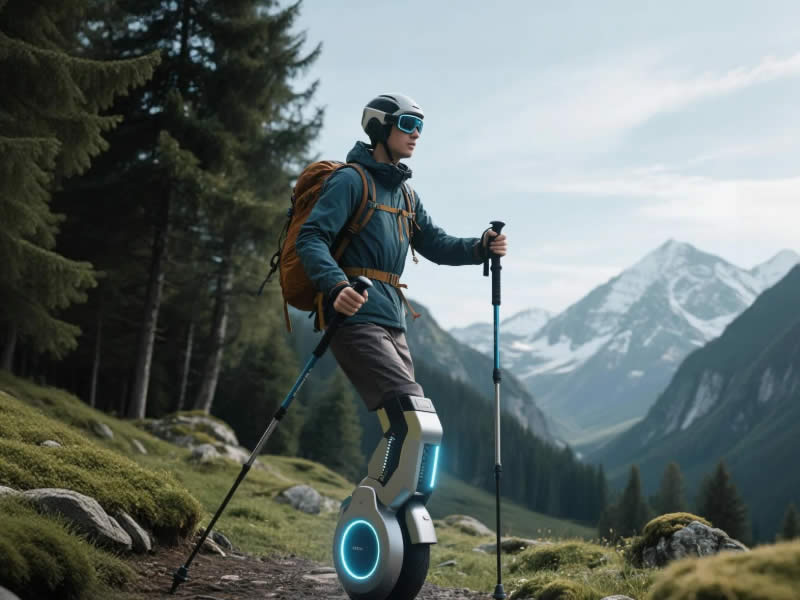
Future tech – self-balancing Trekking Poles?
Imagine you’re crossing a slippery log bridge, descending a loose scree slope, or navigating an icy trail. Your trekking poles are planted, but a sudden shift in weight sends you wobbling. What if your poles could actively counteract that imbalance—pushing back, stiffening, or adjusting their angle to keep you upright? This is the vision behind self‑balancing trekking poles: a futuristic concept that combines sensors, gyroscopes, and tiny motors to actively assist balance. While the idea is compelling, the reality is that such technology remains firmly in the realm of research and science fiction. This article explores the concept, the engineering hurdles, and whether we’ll ever see self‑balancing poles on the trail.
Recommended trekking pole purchase link: https://s.click.aliexpress.com/e/_c4M7OWaN
What Would Self‑Balancing Poles Do?
A self‑balancing trekking pole would go beyond passive support. It would actively sense the user’s motion and the terrain, then adjust its properties to prevent a fall. Potential features include:
- Dynamic stiffening – When the pole senses a sudden lateral acceleration (a slip), it could instantly lock the telescoping sections or increase shaft rigidity to provide a firm brace.
- Angle correction – A motorized joint in the shaft could rotate the tip to maintain optimal contact with the ground, even as the user leans.
- Counter‑force – Small reaction wheels or gyroscopes (similar to those in self‑balancing scooters) could generate torque to counteract a toppling motion.
- Haptic warning – Vibrations in the grip could alert the user to an impending loss of balance, allowing a corrective step.
In essence, the poles would act like an active stability system, akin to electronic stability control in cars or balance assistance in exoskeletons.
Why the Idea Is Attractive
Falls are a leading cause of injury among hikers, especially older adults. Trekking poles already reduce fall risk by providing additional points of contact. Self‑balancing poles could further reduce falls by reacting faster than human reflexes. For individuals with balance disorders, Parkinson’s disease, or recovering from stroke, such poles could be life‑changing. They might also appeal to trail runners seeking an edge on technical descents, or to mountaineers carrying heavy packs on unstable terrain.
The Enormous Technical Challenges
Despite the promise, self‑balancing poles face daunting hurdles:
1. Power and Weight
Any active system requires energy. Gyroscopes, motors, and microprocessors need batteries. A pair of poles would need a lightweight, high‑density power source. Current lithium‑ion batteries would add hundreds of grams—defeating the purpose of lightweight poles. Even if a 50‑gram battery could power the system for an hour, that’s insufficient for a day hike. Energy harvesting (from the pole’s motion) is theoretically possible but would generate negligible power.
2. Speed of Response
A fall happens in milliseconds. The sensor, processor, and actuator must react faster than the human nervous system (which is about 150‑300 ms for voluntary reactions). Achieving sub‑50 ms latency with low power is extremely challenging. Any delay would render the system useless.
3. Durability in Harsh Conditions
Trekking poles are abused: they’re stabbed into rocky ground, dragged through mud, soaked in rain, and frozen overnight. Delicate electronics, moving parts, and batteries would need military‑grade ruggedization. Waterproofing (IP68) is mandatory, but even then, impacts could shatter gyroscopes or strip gears.
4. Cost
A pair of high‑end carbon fiber poles costs $150–250. Adding self‑balancing technology could easily push the price to $1,000 or more. The market for such expensive, specialized poles would be tiny, limiting economies of scale.
5. Fail‑Safe Operation
If the electronics fail mid‑stride, what happens? The pole might lock up, become floppy, or even jerk unpredictably—potentially causing the very fall it was meant to prevent. Any self‑balancing system must be fail‑safe, reverting to a passive, predictable state when power is lost. This adds further complexity.
Current Research and Prototypes
As of 2026, there are no functional prototypes of self‑balancing trekking poles. However, related technologies offer glimpses:
- Active cane for the elderly – Researchers have built canes with motorized wheels or outriggers that prevent falls. These are bulky, heavy, and limited to flat indoor surfaces.
- Gyroscopic stabilizers – Used in some motorcycles and camera gimbals. Miniaturizing these for a pole is possible but power‑hungry.
- Wearable exoskeletons – Hip and knee exosuits can assist balance, but they are expensive and not yet trail‑ready.
A 2022 paper from the University of Michigan proposed a “smart walking stick” with a gyroscopic stabilizer, but the prototype weighed 2.5 kg (5.5 lbs)—far too heavy for a trekking pole. No subsequent commercial product has emerged.
A More Plausible Near‑Term Alternative
Instead of self‑balancing poles, a more realistic future technology is predictive balance assistance through other wearables:
- Smart hip belt – Worn around the waist, containing small reaction wheels or thrusters. It could detect a fall and generate a corrective torque before the poles even touch the ground.
- Exoskeleton shorts – Lightweight, soft exosuits that assist hip extension and balance, already in development for elderly mobility.
- Augmented reality glasses – Displaying a virtual horizon or balance cues to train better posture.
These devices could work with standard trekking poles, avoiding the need to ruggedize electronics inside the poles themselves.
What You Can Use Today
While waiting for sci‑fi poles, you can improve your balance on the trail with proven methods:
- Standard trekking poles – Used correctly, they already reduce fall risk by 30–50%.
- Balance training – Exercises like single‑leg stands, heel‑to‑toe walking, and bosu ball work improve proprioception.
- Strength training – Strong glutes, quads, and core muscles help you recover from stumbles.
- Trail selection – Choose terrain appropriate for your skill level.
The Future Outlook
Self‑balancing trekking poles are an intriguing concept, but they are unlikely to become a commercial reality in the next decade. The combination of power, weight, speed, durability, and cost challenges is simply too great. However, we may see hybrid approaches: for example, poles that communicate with a smart insole or a balance‑assisting backpack. The most promising near‑term innovation is haptic feedback (vibrations) to alert users of imbalance, rather than actively correcting it.
Final Thoughts
The idea of self‑balancing trekking poles captures the imagination: a tool that not only supports you but actively saves you from falling. It’s a noble goal, especially for aging populations and those with balance disorders. Yet the engineering reality is harsh. For the foreseeable future, your best balance aid remains your own body, trained through practice and strength, assisted by simple, lightweight, passive poles. Don’t hold your breath for self‑balancing poles—but do keep an eye on wearable exoskeletons and smart balance aids that might one day make falls a thing of the past. Until then, step carefully, plant firmly, and enjoy the trail with the reliable gear you have.




