




How Much Weight Can a Heavy Duty Carabiner Hold?
Heavy duty carabiners are engineered for critical applications where failure is not an option, but understanding their actual weight capacity requires more than just reading numbers on the side. The question of how much weight a heavy duty carabiner can hold involves understanding force measurements, loading directions, certification standards, and real-world usage conditions that significantly impact performance. This comprehensive guide breaks down the factors that determine true carabiner capacity and how to interpret manufacturer specifications for safe usage.
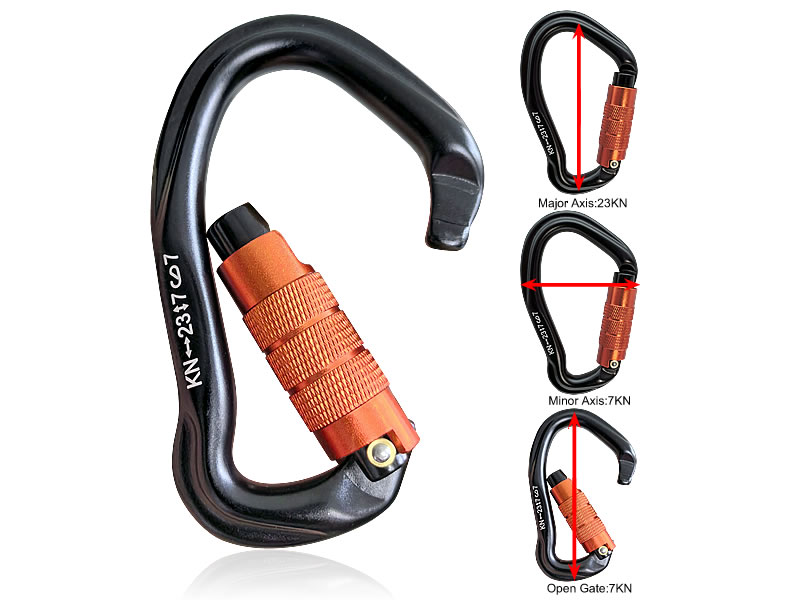
Understanding kN Ratings and Force Measurements
Carabiner strength is measured in kilonewtons (kN), not traditional weight units like pounds or kilograms. One kilonewton equals approximately 225 pounds of force. This distinction is crucial because carabiners experience dynamic forces that far exceed static weights. For example, a 176-pound (80 kg) climber can generate over 5 kN of force during a fall due to acceleration and shock loading.
Heavy duty carabiners typically feature three key strength ratings:
- Major axis strength (gate closed): 22-30 kN (4,945-6,744 pounds)
- Minor axis strength: 7-10 kN (1,574-2,248 pounds)
- Gate open strength: 6-9 kN (1,349-2,024 pounds)
These ratings represent minimum breaking strengths established under controlled laboratory conditions. Reputable manufacturers often build in safety margins, with actual failure points typically 10-20% higher than stated ratings.
Factors That Affect Real-World Capacity
Several critical factors influence how much weight a carabiner can safely hold in practical applications:
Loading Direction
The most significant factor affecting carabiner capacity is loading direction. When force is applied along the spine (major axis) with the gate properly closed, the carabiner achieves its maximum rated strength. Cross-loading (force applied across the minor axis) reduces capacity by 60-70%, while gate-open loading decreases strength by approximately 70%.
Material and Construction Quality
Aircraft-grade aluminum alloys (typically 7075-T6) offer an excellent strength-to-weight ratio, while steel carabiners provide maximum durability at the expense of increased weight. Forged carabiners generally offer superior strength compared to cast alternatives due to better grain structure alignment.
Gate Type and Mechanism
Locking mechanisms significantly impact safety but don't necessarily increase strength ratings. Screw-gate, auto-locking, and triple-action carabiners provide security against accidental opening but maintain similar strength ratings to non-locking versions of comparable design and materials.
Environmental Conditions
Extreme temperatures, chemical exposure, and UV radiation can degrade materials over time. Aluminum becomes brittle in extreme cold, while prolonged UV exposure can weaken nylon components in auto-locking mechanisms.
Certification Standards and Testing Protocols
Reputable heavy duty carabiners undergo rigorous testing to meet international standards:
UIAA Certification
The International Climbing and Mountaineering Federation requires:
- Minimum major axis strength: 20 kN
- Minimum minor axis strength: 7 kN
- Minimum gate-open strength: 6 kN
- Gate function tests under load
- Durability tests for locking mechanisms
CE Certification
European standards (EN 12275) establish similar requirements with additional documentation and batch testing protocols. CE-marked carabiners must maintain performance through temperature variations from -30°C to +50°C.
NFPA Standards
For rescue applications, National Fire Protection Association standards (NFPA 1983) specify even more rigorous testing, including:
- Higher minimum strength requirements
- Additional corrosion resistance tests
- Extended durability testing for locking mechanisms
Dynamic vs. Static Loading Considerations
The distinction between static and dynamic loading is crucial for understanding real-world capacity:
Static Loading
When weight is applied gradually and maintained consistently (like in rigging applications), carabiners can safely support loads approaching their rated capacity. However, most safety standards recommend working loads not exceed 10-15% of the minimum breaking strength.
Dynamic Loading
During falls or shock loading (common in climbing), forces can multiply dramatically. A factor 2 fall (falling twice the length of the rope above the protection) can generate forces exceeding 10 kN even with moderate weights. Modern climbing ropes reduce impact forces through elongation, but the carabiner must withstand peak loads.
Industry-Specific Requirements
Different applications demand specific carabiner characteristics:
Rock Climbing
Lightweight aluminum carabiners (22-28 kN) predominate, prioritizing weight savings during carries and climbs while maintaining safety margins for dynamic loads.
Rescue Operations
Rescue teams often prefer steel carabiners (30+ kN) for superior abrasion resistance and durability when working with rough surfaces like concrete and rock.
Industrial Applications
Construction and rigging applications typically use larger, heavier steel carabiners with higher ratings (30-50 kN) to accommodate repeated heavy static loads and rough handling.
Safety Factors and Working Load Limits
Industry standards incorporate significant safety factors between rated breaking strength and recommended working loads:
- Climbing applications: Safety factors typically range from 5:1 to 10:1
- Industrial rigging: Safety factors of 4:1 to 5:1 are common
- Rescue operations: Often maintain 10:1 safety factors for life-critical applications
These safety margins account for:
- Material fatigue over time
- Potential invisible damage
- Variations in manufacturing
- Unexpected loading scenarios
- Environmental degradation
Proper Usage for Maximum Safety
To ensure carabiners perform as rated:
Regular Inspection
Check for cracks, sharp edges, groove wear, gate malfunction, and corrosion before each use. Retire any carabiner showing signs of damage or excessive wear.
Correct Orientation
Always load along the major axis with the gate opposite the direction of pull and properly locked.
Avoid Cross-Loading
Use appropriate rigging techniques to prevent force from being applied across the minor axis.
Environmental Awareness
Understand how temperature extremes, chemicals, and UV exposure might affect performance in your specific application.
Conclusion
While heavy duty carabiners are rated for impressive forces—typically 22-30 kN (4,945-6,744 pounds) along the major axis—their real-world capacity depends on numerous factors including loading direction, equipment condition, and environmental factors. Understanding these variables is essential for safe usage in any application. Remember that these ratings represent minimum breaking strengths under ideal conditions, and responsible practices maintain significant safety margins between working loads and potential failure points. Whether you're climbing, rescuing, or working at height, respecting your equipment's limitations ensures that these critical safety devices perform as intended when it matters most.




