




Heavy duty carabiner weight capacity kN rating.
When your safety depends on a piece of gear, understanding its specifications is not just technical—it's critical. For heavy-duty carabiners, the single most important specification is the kN rating, which indicates its weight capacity and strength. But what does "kN" actually mean, and how does it translate to real-world safety? This guide demystifies the kN rating, ensuring you choose and use your carabiners with confidence.
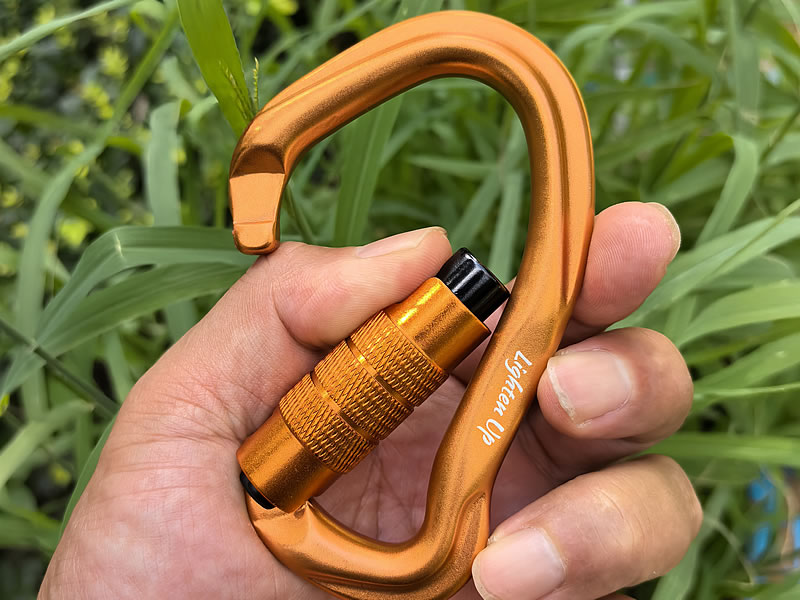
What is a kN? Breaking Down the KiloNewton
First, let's move away from pounds or kilograms. A kiloNewton (kN) is a unit of force, not just mass. This is a key distinction because in a fall, the forces exerted on your gear are dramatically higher than your static body weight.
- The Simple Conversion: 1 kN is approximately equal to 225 pounds (or 102 kilograms) of force. However, this is a force conversion under gravity, not a direct weight equivalent.
Decoding the Numbers on Your Carabiner
A heavy-duty carabiner will have its kN rating stamped directly onto its spine. You'll typically see three numbers, corresponding to different loading directions:
- Major Axis (Spine-Loaded): This is the strongest orientation, with the gate closed and load applied along the long spine. For a true heavy-duty carabiner, this rating is typically 22 kN to 30 kN or higher. This translates to a force capacity of roughly 4,945 lbs to 6,740 lbs. This is the rating used for most climbing, rigging, and lifting scenarios.
- Minor Axis (Cross-Loaded): This rating applies when force is applied across the carabiner's weaker, narrower side. This is a dangerous and common accident scenario. The rating is significantly lower, often around 7-10 kN (1,575 - 2,250 lbs), highlighting the importance of proper loading.
- Gate Open (With Gate Pressed): This is the weakest configuration. If the gate is accidentally held open against a rock or other object during a fall, strength can be reduced by up to 70%. Ratings here are often as low as 7-9 kN (1,575 - 2,025 lbs).
Why Are These Different Ratings So Important?
The three ratings aren't just technical details—they are a direct lesson in safety. They teach you that how you use the carabiner is as important as its maximum strength. A carabiner rated for 30 kN is not "heavy-duty" if it's cross-loaded or has an open gate; its effective strength is drastically reduced. Proper training ensures the load is always applied on the major axis with the gate closed and locked.
Choosing the Right Heavy-Duty Carabiner
The "right" kN rating depends entirely on your application:
- Rock Climbing & Mountaineering: For personal safety, most climbing-rated carabiners have a major axis strength of 22-28 kN, which is the industry standard and more than sufficient to withstand the immense forces of a severe fall.
- Industrial Rigging & Rescue: These applications often demand even higher strengths, with carabiners rated from 30 kN to 50 kN and beyond. These are built for critical, life-support systems where maximum safety margins are non-negotiable.
- General Use (Non-Life-Support): For attaching gear to a backpack or other non-critical tasks, carabiners with lower ratings (e.g., 10-15 kN) may be suitable. Never use a non-rated carabiner for any activity where a fall could occur.
Beyond the kN Rating: Material and Gate Type
A carabiner's strength is also a product of its material. Aluminum alloy carabiners are standard for climbing—they offer an excellent strength-to-weight ratio. Steel carabiners are heavier but stronger and more abrasion-resistant, making them ideal for industrial and rescue work.
Furthermore, a secure gate is vital. Screw-gate and auto-locking gates (like Triple-Action or Ball-Lock) prevent the gate from accidentally opening, which is essential for heavy-duty, safety-critical tasks.
Conclusion: Safety is in the Details
The kN rating on a heavy-duty carabiner is your primary guide to its capabilities. It tells a story of immense strength when used correctly, but also of critical vulnerabilities if misused. Always:
- Check the kN stamp before use.
- Load on the major axis with the gate closed.
- Choose a rating appropriate for your specific, intended use.
- Inspect your gear regularly for signs of wear or damage.
By understanding and respecting the kN rating, you transform a simple piece of metal into a reliable, life-saving tool.




