




ASTM F1774 standard for heavy duty carabiners.
When you're trusting your life to a piece of gear, "heavy-duty" is a marketing term until it's backed by a rigorous, third-party standard. For carabiners used in technical rope systems, that benchmark is the ASTM F1774 standard. But what does this alphanumeric code actually mean for you? It represents a comprehensive set of engineering and safety requirements that separate truly reliable, heavy-duty carabiners from general-use hardware.
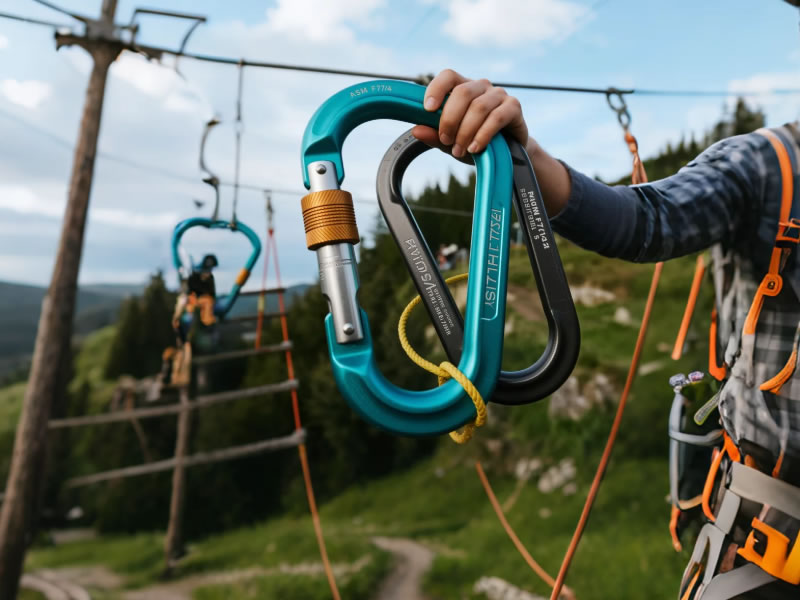
This article will demystify the ASTM F1774 standard, explaining its critical requirements, testing procedures, and why it should be a non-negotiable factor in your purchasing decisions for climbing, rescue, and industrial work.
What is ASTM International and Why Does it Matter?
ASTM International is a globally recognized organization that develops and publishes voluntary consensus technical standards for a vast range of materials, products, and services. Unlike a manufacturer's own claims, ASTM standards are created by committees of industry experts, including engineers, professional users, and manufacturers. This ensures the standards are practical, rigorous, and unbiased. When a carabiner is certified to ASTM F1774, it has passed independent laboratory tests verifying its performance against these consensus criteria.
Key Requirements of the ASTM F1774 Standard for Carabiners
The F1774 standard is specifically for "Karabiners" (an alternative spelling for carabiners) used in climbing and mountaineering. It goes far beyond a simple strength number, defining requirements for:
- Minimum Strength Ratings: This is the core of the standard. ASTM F1774 mandates the following minimum strength tests, which are significantly higher than those for non-specialty carabiners:Major Axis (Spine Load): 27 kN (approx. 6,070 lbf). This is the strength with the gate closed and loaded along its strongest axis.Minor Axis (Cross Load): 7 kN (approx. 1,570 lbf). This tests the carabiner when force is applied across its narrow side, a common accident scenario.Open Gate (Gate Open): 7 kN (approx. 1,570 lbf). This tests the carabiner in its weakest configuration, simulating the gate being pressed open against a rock.
- Gate Function and Strength: The standard specifies that the gate must open smoothly and close securely without operator manipulation. It also requires testing the gate mechanism itself to withstand repeated openings and closings, ensuring long-term reliability.
- Durability and Finish: The carabiner must be free of sharp edges and defects that could damage ropes or webbing. The finish must be durable enough to withstand normal use without compromising the integrity of the metal.
- Clear and Permanent Markings: Perhaps one of the most user-friendly aspects, ASTM F1774 requires that the carabiner be permanently marked with:The manufacturer's name or logo.Its major axis strength in kN.Its model identifier.
This allows users to instantly verify the capability and authenticity of the gear.
ASTM F1774 vs. UIAA: What's the Difference?
You may also see the UIAA (International Climbing and Mountaineering Federation) standard on carabiners. The UIAA is another highly respected body that sets safety standards for climbing equipment. The good news is that the UIAA and ASTM standards for carabiners are largely harmonized. The strength requirements (27 kN major axis, 7 kN minor/open gate) are identical. In many cases, a carabiner certified to one is certified to the other. Both represent the highest level of safety for recreational and professional use.
Why Choosing an ASTM F1774 Certified Carabiner is Critical
Selecting a carabiner that meets ASTM F1774 is not just about checking a box; it's about choosing verified safety.
- It Eliminates Guesswork: You are not relying on marketing claims like "super strong" or "heavy-duty." You have a verified, standardized measure of performance.
- It Ensures a Safety Margin: The 27 kN rating is designed to withstand the immense, dynamic forces generated in a fall, which can be many times a person's body weight.
- It Protects Against Real-World Accidents: By testing for cross-loading and open-gate scenarios, the standard ensures the carabiner retains significant strength even if used imperfectly in a moment of crisis.
Conclusion: Look for the Mark
For any application where a carabiner is part of a life-safety system—whether you're a rock climber, a firefighter, or an industrial rope access technician—the ASTM F1774 standard is your assurance of quality and reliability. Before you buy, always physically check the carabiner's spine for the kN rating and the manufacturer's information. By insisting on gear that meets ASTM F1774, you are making an informed decision to prioritize safety, backed by the collective expertise of an entire industry.




