




What is the breaking strength of a heavy duty carabiner?
When you clip a heavy-duty carabiner, you're placing immense trust in a small piece of metal. A fundamental question for any user—from a climber to a rescue professional—is: what is its breaking strength? The answer is more nuanced than a single number, as it hinges on understanding standardized ratings, force versus weight, and the critical importance of how the carabiner is loaded.
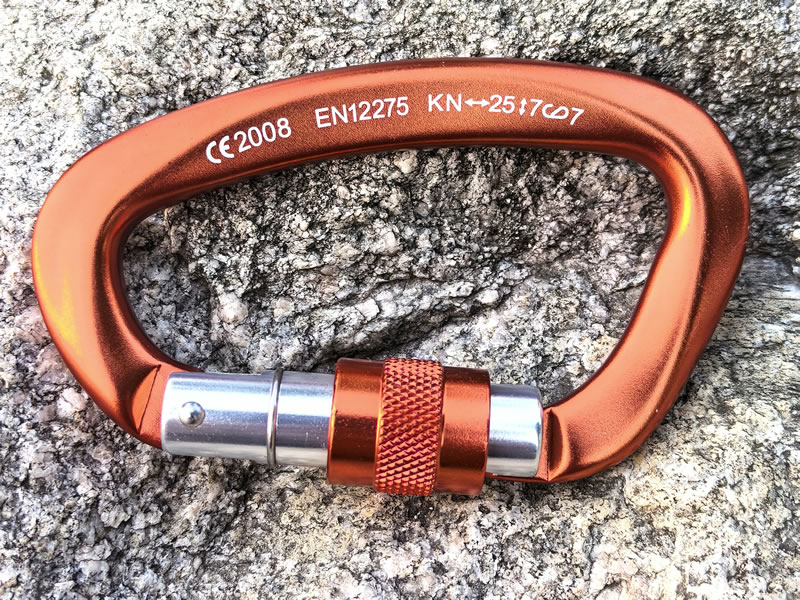
This article will delve into what "breaking strength" truly means for a heavy-duty carabiner, how it's measured, and why this knowledge is paramount for your safety.
It’s All in the kN: The Language of Force
The breaking strength of a carabiner is not measured in pounds or kilograms, but in kiloNewtons (kN). A Newton is a scientific unit of force. This distinction is crucial because in a fall, the force exerted on the carabiner is a product of mass, gravity, and, most importantly, deceleration (the shock load). One kiloNewton is approximately 225 pounds of force.
For a heavy-duty carabiner designed for life-safety applications like climbing or rescue, the benchmark breaking strength when loaded correctly is typically between 22 kN and 30 kN, or even higher.
- 22 kN translates to about 4,945 pounds of force.
- 24 kN translates to about 5,395 pounds of force.
- 27 kN (a common standard for climbing) translates to about 6,070 pounds of force.
- 30 kN translates to about 6,740 pounds of force.
These numbers seem astronomically high compared to a person's body weight for a critical reason: they are engineered to withstand the immense, dynamic impact forces of a worst-case-scenario fall.
The Three Breaking Strengths: Why Direction Matters
A carabiner's breaking strength is not a single value. You will find multiple kN ratings stamped on the spine of a certified carabiner, each corresponding to a different loading direction. This is the most important concept for users to grasp.
- Major-Axis Strength (Strongest): This is the breaking strength when the load is applied along the spine of the carabiner with the gate closed. This is the intended and strongest configuration. For a heavy-duty carabiner, this is the 22-30+ kN rating.
- Minor-Axis Strength (Weaker): This is the breaking strength when the carabiner is loaded across its narrow side (cross-loaded). This can happen accidentally in practice. The strength in this orientation is significantly lower, often around 7 kN (1,575 lbs). The stamped rating highlights the danger of improper loading.
- Open-Gate Strength (Weakest): This is the breaking strength when the gate is open and loaded. This simulates a potentially catastrophic accident where the gate is pressed against a rock and held open. This is the carabiner's weakest point, also typically around 7 kN (1,575 lbs).
Breaking Strength vs. Working Load Limit: The Safety Margin
It is vital to distinguish breaking strength from Working Load Limit (WLL). The breaking strength is the force at which the carabiner will catastrophically fail. The Working Load Limit is the maximum force that should be applied during normal, static use.
Engineering standards incorporate a large safety factor (often 3:1 to 10:1 for life-support equipment) between the WLL and the breaking strength. This massive margin accounts for dynamic forces, material fatigue, and manufacturing variances. You should never intentionally load a carabiner anywhere near its breaking strength.
Factors Influencing Breaking Strength
Several factors determine a carabiner's ultimate strength:
- Material: Aluminum alloys offer an excellent strength-to-weight ratio for climbing. Steel carabiners are heavier but have a higher breaking strength and better abrasion resistance, making them ideal for industrial and rescue settings.
- Design: The shape (e.g., D-shaped, oval, HMS) and engineering of the spine directly influence how force is distributed.
- Certification Standards: Carabiners meeting standards like UIAA 121 or ASTM F1774 have been independently tested to verify their breaking strengths under all required loading conditions.
Conclusion: Strength is a System
The breaking strength of a heavy-duty carabiner is a testament to modern engineering, but it is not a license for complacency. The ultimate strength of your safety system is determined by its weakest link—which could be the rope, the anchor, or the way the carabiner is used.
Always:
- Check the kN stamp on the carabiner itself.
- Load it correctly on its major axis with the gate closed and locked.
- Understand that the breaking strength is a final safeguard against extreme forces, not a target for use.
By respecting these ratings and principles, you ensure that this critical piece of equipment performs as designed, providing a reliable margin of safety when it matters most.




