




Heavy duty carabiner screw lock vs auto lock.
In the world of heavy-duty carabiners, where safety is non-negotiable, the locking mechanism is the heart of security. The primary question for many users isn't just about strength, but about operation: Screw Lock or Auto Lock? While both are designed to prevent the gate from accidentally opening, they represent two different philosophies in safety engineering—manual, deliberate control versus automated, rapid security.
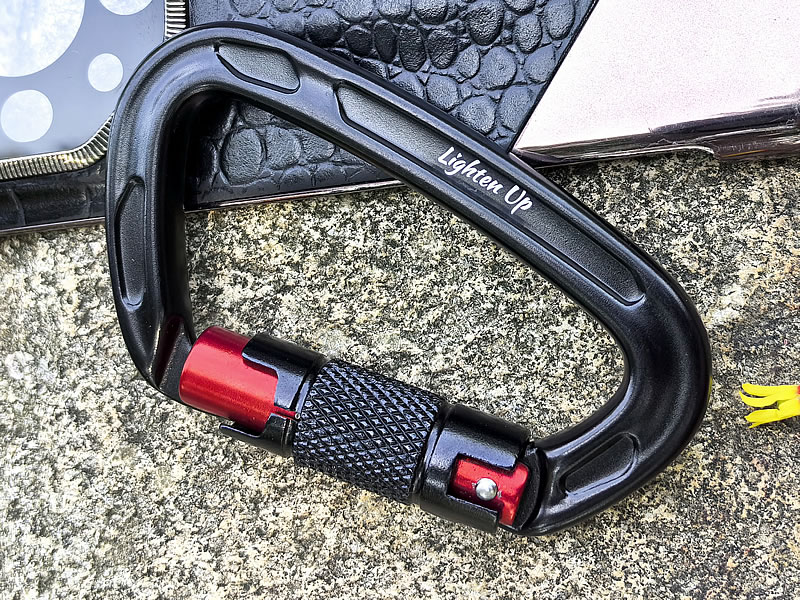
This in-depth guide will break down the mechanics, pros, cons, and ideal use cases for each type, empowering you to choose the right tool for your specific heavy-duty application, whether it's rock climbing, industrial work, or rescue operations.
Screw Lock Carabiners: The Time-Tested Classic
A screw lock carabiner features a threaded sleeve (collar) that rotates along the gate's spine.
- How it Works: After closing the gate, the user must manually twist the collar several times until it is fully seated against the carabiner's nose. To open, the process is reversed: the collar must be unscrewed before the gate can be pressed open.
- Advantages:Simplicity and Reliability: With fewer internal moving parts than complex auto-locking systems, the screw lock is mechanically straightforward, which can mean less potential for mechanical failure.Tactile Confirmation: The act of screwing the collar provides a clear, tactile confirmation that the gate is locked. It's a deliberate action that reinforces safe habits.Less Prone to Clogging: In dirty environments (e.g., mud, sand, ice), the simple threading is generally more resistant to clogging than the intricate springs and levers of some auto-lock designs.
- Disadvantages:Slower Operation: Screwing and unscrewing the collar takes time and requires two hands for efficient operation. This can be a significant drawback in situations requiring rapid clipping and unclipping.Risk of Human Error: The greatest weakness of a screw lock is the user. A carabiner is only secure if the collar is fully screwed down. An incomplete lock, known as a "cross-thread" or "half-lock," can vibrate open under load, creating a critical safety hazard.
Auto-Locking Carabiners: Engineered for Speed and Assurance
Auto-locking carabiners use an internal spring mechanism to lock the gate automatically as soon as it closes.
- How it Works: There are several subtypes (e.g., twist-lock, push-button, triple-action, ball-lock), but the core principle is the same: a spring-loaded mechanism engages when the gate shuts. Unlocking requires a specific, often two-stage, action like pushing and then twisting, or pulling a lever, before the gate can be opened.
- Advantages:Automatic Safety: The primary benefit is that the locking action is passive and immediate. It eliminates the risk of user forgetfulness, as the gate locks itself upon closure.Faster and More Efficient: For activities requiring frequent clipping, such as sport climbing or work-at-height tasks, auto-lockers are significantly faster and can often be operated single-handedly with practice.Positive Audible/Tactile Feedback: Most high-quality auto-lockers provide a distinct and satisfying "click" when the gate locks, giving clear auditory and tactile confirmation.
- Disadvantages:Increased Complexity: More moving parts mean a higher potential for mechanical failure. The springs, balls, or levers can wear out or become damaged.Susceptibility to Debris: Dirt, sand, or ice can easily jam the intricate mechanism, preventing it from locking or, worse, unlocking.Higher Cost: Auto-locking carabiners are typically more expensive to manufacture and purchase than their screw-lock counterparts.
Making the Right Choice for Your Needs
The "best" choice is entirely dependent on your application and environment.
- Choose a Screw Lock Carabiner if:Your activity does not require rapid, repeated clipping (e.g., attaching a belay device, setting up a static anchor).You are operating in particularly gritty, muddy, or icy conditions where mechanism jamming is a concern.You prefer mechanical simplicity and a direct, manual control over your equipment.
- Choose an Auto-Locking Carabiner if:Speed and efficiency are critical, such as in sport climbing, quickdraws, or industrial rope access where you are constantly moving and clipping.You want the added safety assurance of a mechanism that does not rely solely on your memory to be locked after every clip.The working environment is relatively clean and free of fine debris.
The Universal Rule: Visual Inspection
Regardless of which type you choose, one rule remains paramount: Always perform a visual and physical check to confirm the gate is fully locked before loading the carabiner. For a screw lock, ensure the collar is flush against the nose. For an auto-lock, look for a clear visual indicator (like a colored ring being hidden) and listen for the "click." Trust, but always verify.
Conclusion:
Both screw lock and auto-lock heavy-duty carabiners are exceptionally safe when used correctly and are mandated by industry standards for life-support systems. The screw lock offers robust, simple security for deliberate setups, while the auto-lock provides rapid, fail-safe operation for dynamic tasks. Understanding their differences is key to building a safe and efficient kit, allowing you to match the tool precisely to the task at hand.




