




Best threadlock mechanism for heavy duty carabiner.
The phrase "threadlock mechanism for a heavy-duty carabiner" can be misleading. Unlike screws and bolts on machinery, the primary safety mechanism of a carabiner is its locking gate, not an internal threadlocker. However, the question is insightful because it touches on a critical issue: preventing unintended loosening. For heavy-duty applications, the "best" mechanism is one that reliably secures the gate, and the choice primarily involves the type of gate lock and, secondarily, the role of thread-locking compounds in the carabiner's construction.
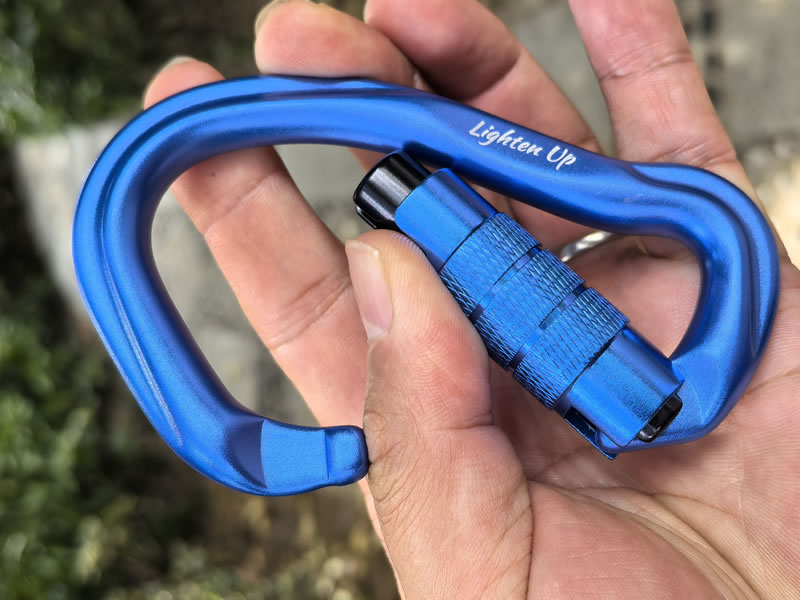
This article will clarify the concept, explore the most secure locking gate systems, and explain where threadlocker like Loctite may legitimately be used in a carabiner's assembly.
Clarifying the Concept: Gate Locks vs. Threadlocker
First, it's essential to distinguish between two types of "threads":
- The Gate Lock Mechanism: This is the user-facing system that prevents the gate from opening accidentally. Examples include screw-gate, twist-lock, and triple-action auto-lock mechanisms. This is the primary safety feature.
- Internal Assembly Threads: These are the small, factory-set screws and pins that hold the gate mechanism itself together (e.g., the hinge pin). These are not meant to be adjusted by the user.
When people ask about "threadlock," they are often concerned about the first point—preventing the gate from unscrewing or vibrating open. The solution is not an adhesive, but rather choosing a superior locking gate design.
Evaluating the Best Locking Gate Mechanisms
The "best" mechanism depends on the specific need for security versus speed. Here are the top contenders for heavy-duty use:
1. Triple-Action / Quad-Action Auto-Lock
This is often considered the gold standard for security in demanding environments like rescue and industrial work.
- How it Works: Opening the gate requires a specific, multi-step sequence (e.g., push down, twist, then pull open). This complex action makes it virtually impossible for the gate to open accidentally from contact with rocks, ropes, or equipment.
- Advantage: Offers the highest level of "foolproof" security without relying on the user to manually lock it. It locks automatically upon closing.
- Consideration: It has more moving parts that could potentially be compromised by mud or ice, though high-quality models are designed to resist this.
2. Magnetic Auto-Lock (Magnetron®)
A innovative mechanism used by brands like Petzl, which replaces springs with magnets.
- How it Works: Powerful magnets instantly snap the gate shut and keep it locked. Opening requires a deliberate twisting motion.
- Advantage: Extremely fast and easy to operate with one hand. It has no springs to wear out or compress in cold weather and is highly resistant to clogging from mud or ice.
- Consideration: While extremely secure, it's crucial to check that metallic debris does not interfere with the magnetic field.
3. Screw-Gate
The traditional and simplest locking mechanism.
- How it Works: The user manually screws a collar down the gate's spine until it stops.
- Advantage: Mechanical simplicity and reliability.
- Disadvantage: Its security is entirely user-dependent. A gate that is not fully screwed down or that vibrates loose over time presents a significant risk. For this reason, many professional standards now recommend auto-locking systems over manual screw-gates for critical applications.
The Actual Role of Threadlocker in Carabiners
This is where a thread-locking adhesive, such as Loctite, legitimately comes into play—but not on the gate collar you operate.
- Application: Manufacturers often apply a medium-strength threadlocker (like Loctite 243) to the internal set screws or pins that hold the gate's hinge mechanism in place.
- Purpose: This prevents these vital internal components from vibrating loose over the carabiner's lifespan, which would cause the gate to become wobbly or fail.
- Important Note: This is a factory-level process. Users should never apply threadlocker to a carabiner's moving parts, such as the gate collar. Doing so could seal the mechanism shut, attract dirt, and void the warranty and safety certification.
Conclusion: Security is a System
The "best threadlock mechanism" for a heavy-duty carabiner is, in reality, the best automatic locking gate system. For ultimate security where user error must be eliminated, a triple-action auto-locker or a magnetic lock is superior to a manual screw-gate.
Regardless of the mechanism, the most critical safety practice is user vigilance. Always perform a visual and physical inspection to confirm the gate is fully locked before trusting your life to it. Look for the manufacturer's markings and ensure the carabiner meets relevant safety standards (e.g., UIAA, ASTM), which certify that the entire assembly, including any factory-applied threadlocker, is fit for purpose. Choose the mechanism that best suits your environment and need for speed, but never compromise on a thorough pre-use check.




