




What is the strength of a heavy duty D-shaped carabiner?
When selecting a heavy-duty carabiner, the D-shape is often hailed for its optimal balance of strength, weight, and functionality. But what exactly is its strength? The answer lies in a standardized number stamped on its spine: the kN rating. For a heavy-duty D-shaped carabiner, the typical major-axis strength ranges from 22 kN to 30 kN or higher, translating to a breaking strength of approximately 4,945 to 6,740 pounds of force.
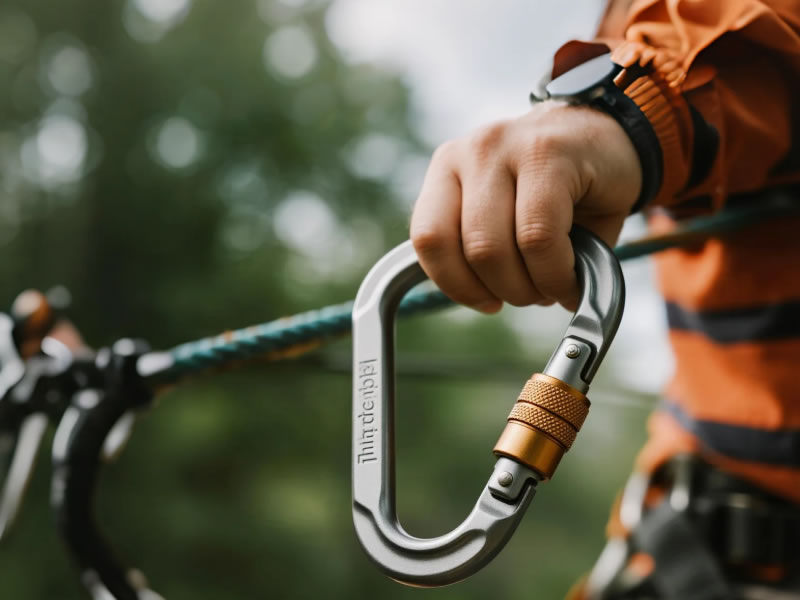
This article will dissect what this kN rating means, why the D-shape is so efficient, and how to interpret this strength in real-world applications to ensure your safety.
Decoding the kN Rating: The Language of Force
The strength of a carabiner is not measured in weight (like pounds or kilograms) but in force, using kiloNewtons (kN). This distinction is critical because in a fall, the force on the carabiner is a dynamic impact, far exceeding a static load. One kN equals about 225 pounds of force.
A heavy-duty D-shaped carabiner will have its strength ratings stamped on its spine, usually showing three values:
- Major-Axis Strength (e.g., 24 kN): This is the most important rating. It indicates the force required to break the carabiner when loaded along its spine with the gate closed. This is the configuration used in proper, intended operation.
- Minor-Axis Strength (e.g., 8 kN): This is the strength when the carabiner is loaded across its width (cross-loaded). This is significantly lower and highlights the danger of improper use.
- Open-Gate Strength (e.g., 9 kN): This is the strength with the gate open, simulating a worst-case scenario where the gate is pressed against a rock.
The Engineering Advantage of the D-Shape
The D-shape is not arbitrary; it's a result of functional engineering that provides key benefits over oval or asymmetrical/D-shaped carabiners:
- Superior Strength-to-Weight Ratio: The design directs the load from the rope end directly onto the non-gated, solid spine. This creates a more efficient load path compared to an oval carabiner, where force is distributed less effectively. This allows manufacturers to use less material to achieve the same strength, resulting in a lighter carabiner—a crucial advantage in climbing.
- Enhanced Gate Security: The straight spine helps keep the carabiner in a stable orientation, reducing the tendency for the rope to push against and unintentionally open the gate, a phenomenon more common with oval shapes.
- Cable-Friendly Design: The straighter spine provides a larger, smoother surface for dogbone slings on quickdraws, reducing wear and tear.
Heavy-Duty D-Carabiner vs. Other Shapes
- vs. Oval Carabiners: Ovals are symmetrical and work well for gear loops or certain clipping situations. However, their load is not directed as efficiently to the spine, meaning they are typically weaker for their weight than a D-shape.
- vs. Asymmetrical/HMS Carabiners: These have a larger, curved opening to accommodate a Munter hitch. Their strength is comparable to D-shapes, but the larger size can sometimes mean a slight weight penalty. The D-shape is generally the most efficient for straight-up strength and weight savings.
Application: Is a D-Shape Carabiner Right for You?
The strength of a heavy-duty D-shaped carabiner makes it an excellent, versatile choice for a wide range of applications:
- Rock & Ice Climbing Quickdraws: The D-shape is the standard for the rope-end carabiner on a quickdraw due to its strength and gate stability.
- Critical Safety Points: It is ideal for connecting a belay device or for use at a top-rope anchor where maximum strength and reliability are required.
- Industrial and Rescue Work: In these fields, where strength and abrasion resistance are paramount, heavy-duty steel D-shaped carabiners with ratings of 30 kN and above are commonplace.
Conclusion: Strength is More Than a Number
The strength of a heavy-duty D-shaped carabiner—typically 22-30 kN—provides a massive safety margin for life-critical activities. However, this strength is only fully realized when the carabiner is used correctly. Always:
- Load it on its major axis (the spine).
- Ensure the gate is fully closed and locked.
- Check the kN stamp to verify it meets the requirements for your activity (e.g., UIAA certification for climbing requires a minimum of 20 kN major-axis strength).
By understanding both the rated strength and the intelligent design of the D-shape, you can confidently select and use this essential piece of safety equipment. Its proven efficiency makes it a cornerstone of safety in vertical worlds.




