




Heavy duty carabiner with maximum gate clearance.
In the world of heavy-duty carabiners, strength is paramount, but it's not the only factor. For professionals in rigging, rescue, and industrial trades, the ease of connecting the carabiner can be just as critical as its breaking strength. This is where maximum gate clearance becomes a key feature. A heavy-duty carabiner designed with a wide gate opening combines brute-force strength with unparalleled functional efficiency, making complex connections faster, safer, and less frustrating.
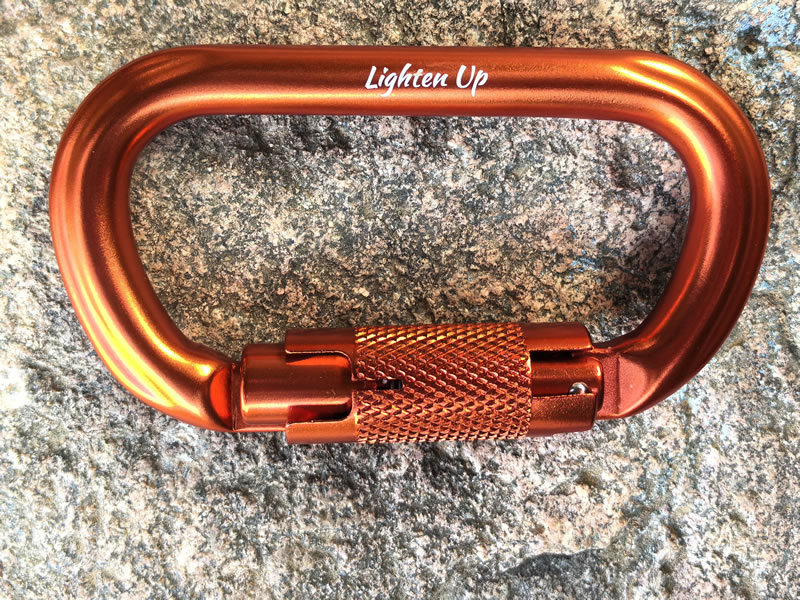
This article explores the importance of gate clearance, identifies the carabiner shapes that offer it, and guides you in selecting the right tool for applications where space and speed are essential.
What is Gate Clearance and Why Does It Matter?
Gate clearance (or gate opening) refers to the usable space between the carabiner's nose (the tip of the gate) and the opposite spine when the gate is fully open. A carabiner with maximum gate clearance provides a wide, unobstructed opening.
This feature is crucial for several reasons:
- Clipping Bulky Objects: It allows you to easily attach thick rope diameters, multiple slings or webbing loops, large shackles, or other hardware that would be impossible to fit into a standard carabiner.
- Speed and Efficiency: In high-stress situations like rescue operations, the ability to clip quickly and confidently without fumbling is a significant safety and operational advantage.
- Reduced User Error: A larger target area minimizes the chance of missing the clip or dropping an item, especially when wearing gloves or working in poor visibility.
Carabiner Shapes that Maximize Gate Clearance
Not all carabiner shapes are created equal when it comes to gate opening. The standard D-shape, while excellent for strength-to-weight ratio, typically has a narrower gate.
The following shapes are engineered for maximum clearance:
- HMS/Pear-shaped Carabiners: This is the quintessential high-clearance design. The large, teardrop-shaped body creates a massive gate opening. HMS (from the German "Halbmastwurfsicherung") carabiners are specifically designed for use with a Munter hitch but have become the go-to choice for any application requiring a large mouth. They are ideal for belaying, anchoring, and connecting complex rigging systems.
- Oval Carabiners: The symmetrical oval shape provides a consistent, wide opening that is excellent for clipping multiple items or for use in pulley systems where the carabiner needs to rotate freely without twisting the sling.
- Asymmetrical D-Shape (with a curved spine): Some D-shaped carabiners feature a subtly curved spine that increases the gate opening compared to a straight-spine D, offering a good compromise between strength efficiency and clearance.
The Trade-Off: Strength and Weight Considerations
Pursuing maximum gate clearance often involves engineering trade-offs:
- Weight: A larger gate and body require more material. Pear-shaped and oval carabiners are generally heavier than their standard D-shaped counterparts of similar strength.
- Strength-to-Weight Ratio: The D-shape is renowned for directing load efficiently to the spine. While pear-shaped and oval carabiners are still extremely strong (often rated to the same 22-30+ kN major-axis strength), they may be slightly less efficient, meaning they could be heavier for the same strength rating.
However, for the intended heavy-duty applications—where the ability to clip large objects reliably is a primary requirement—this trade-off is almost always justified.
Key Applications for High-Clearance Carabiners
- Search and Rescue (SAR): For building complex anchor systems quickly and attaching various pieces of equipment under pressure.
- Industrial Rope Access: Technicians often need to connect thick ropes, backup devices, and heavy hardware. A wide-gate carabiner simplifies these tasks.
- Arborism: Arborists frequently work with large-diameter ropes and rigging plates, where easy clipping is essential.
- Belay Stations: An HMS carabiner is the standard for a belay device, as it easily accommodates the device and provides room for a Munter hitch.
Conclusion: Matching the Tool to the Task
A heavy-duty carabiner with maximum gate clearance is a specialized tool for specialized jobs. It prioritizes functional utility and operational speed without compromising on core safety.
When selecting one, ensure it features a locking mechanism (screw-gate or auto-lock) appropriate for your environment and has a kN rating that meets or exceeds the demands of your work (typically 27 kN and above for rescue and industrial use).
Ultimately, the goal is to have the right tool for the task. If your work involves frequent, complex connections with bulky equipment, opting for a carabiner with maximum gate clearance is not a luxury—it's a strategic decision that enhances both safety and efficiency on the job.




