




ISO standard for climbing carabiners.
For climbers around the world, trust in their equipment is non-negotiable. While many are familiar with the UIAA (International Climbing and Mountaineering Federation) safety label, there is an equally critical, broader international benchmark: the ISO standard for climbing carabiners, known as ISO 22845. This standard, titled "Personal equipment for protection against falls — Karabiners," represents a harmonized global effort to ensure that every carabiner meeting its requirements provides a uniform and verifiable level of safety, regardless of where it is manufactured or sold.
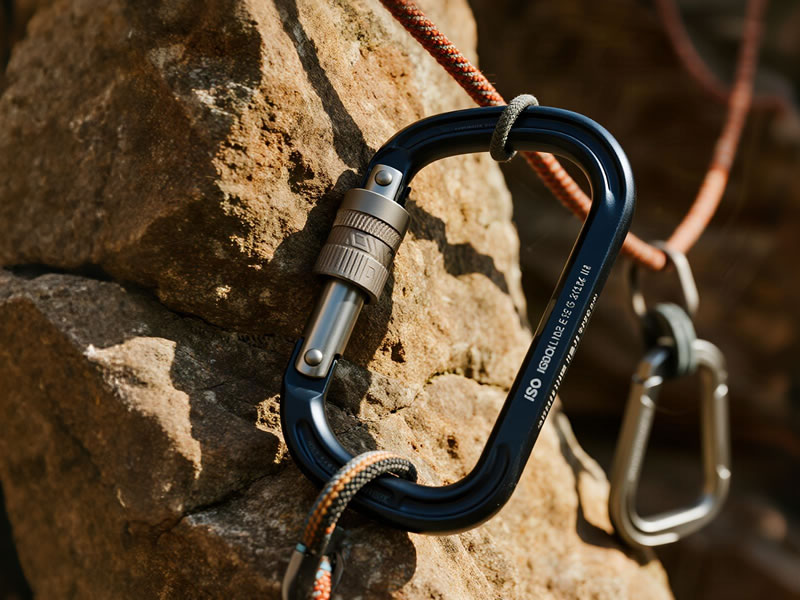
Understanding the ISO 22845 standard is key to recognizing the rigorous testing and engineering that goes into the carabiners we bet our lives on.
What is ISO and Why Does it Matter?
The International Organization for Standardization (ISO) is an independent, non-governmental international body that develops and publishes voluntary consensus standards to ensure the quality, safety, and efficiency of products, services, and systems. An ISO standard is the result of agreement among experts from countries around the world. For manufacturers, ISO certification facilitates international trade by demonstrating compliance with a recognized global benchmark. For consumers, it provides a universal mark of safety and reliability.
Key Requirements of ISO 22845 for Climbing Carabiners
The ISO 22845 standard specifies minimum safety and performance requirements that are largely harmonized with the UIAA 121 standard. This means that for most practical purposes, a carabiner passing one standard will pass the other. The key requirements include:
- Minimum Strength Ratings: The standard mandates rigorous destructive testing in three critical configurations:Major Axis (Gate Closed): The carabiner must withstand a minimum force of 20 kN (approximately 4,500 lbf) without breaking.Minor Axis (Cross-Loaded): It must withstand a minimum force of 7 kN (approximately 1,570 lbf) when loaded across its narrow width.Open Gate (Gate Open): It must withstand a minimum force of 7 kN with the gate held open, simulating a worst-case scenario.
- Gate Functionality: The gate mechanism must open and close smoothly without catching. The standard tests for secure closure, requiring that the gate cannot be opened simply by pressing on the base. For locking carabiners, the locking mechanism must remain secure under defined test conditions.
- Durability and Finish: The carabiner must be free of sharp edges or burrs that could damage a rope. Its finish must be durable enough to withstand corrosion and the abrasion of normal use.
- Markings: The carabiner must be permanently and clearly marked with:The manufacturer's name or logo.The model identifier.Its strength in kN (e.g., 22 kN, 24 kN, etc.).
ISO 22845 vs. UIAA 121: What's the Difference?
For the end-user, the difference is minimal. The two organizations work closely together, and the key strength requirements (20 kN major axis, 7 kN minor/open gate) are identical. The primary distinction lies in their scope and recognition:
- UIAA is a federation specifically focused on mountaineering and climbing. Its standards are highly respected within the climbing community.
- ISO is a broader international body. Its standards are recognized by national governments and regulatory bodies worldwide. ISO 22845 ensures a product meets a globally accepted level of safety, which is crucial for international supply chains.
In practice, most major manufacturers test their carabiners to meet both standards, and you will often see both logos or references in product documentation.
Why Certification to an ISO Standard is Critical
Choosing a carabiner certified to ISO 22845 (or UIAA 121) is not a mere preference—it is a fundamental safety practice.
- Independent Verification: Certification implies that the carabiner has been tested by an independent, accredited laboratory, not just the manufacturer itself.
- Validation of Design: It confirms that the carabiner's design, materials, and manufacturing process can consistently produce a product that meets stringent safety margins.
- Dynamic Force Rating: The kN ratings are designed to account for the immense dynamic forces generated in a fall, which can far exceed a climber's static weight.
Conclusion: Look for the Mark
As a climber, your first instinct before clipping a carabiner should be to check its spine for the strength rating and to look for evidence of its certification. Whether it bears a specific ISO mark or a UIAA label, you are looking for proof that it conforms to an internationally recognized standard like ISO 22845.
This standard is the culmination of global expertise, designed to protect lives. By understanding and insisting on certified equipment, you are not just making a purchase; you are making an informed decision to prioritize safety, backed by the most rigorous testing protocols in the world. It is this universal language of safety that allows climbers to confidently touch the rock, ice, and mountains, no matter their location.




