




Heavy Duty Carabiner vs Standard Carabiner: Choosing the Right Tool for Safety
When your safety depends on a piece of equipment, understanding its capabilities is not just important—it's critical. Carabiners, the essential connecting links used in everything from rock climbing to industrial safety systems, are broadly categorized into two types: heavy-duty and standard. The choice between them hinges on the level of risk and the demands of the specific application. Selecting the wrong one can have grave consequences.
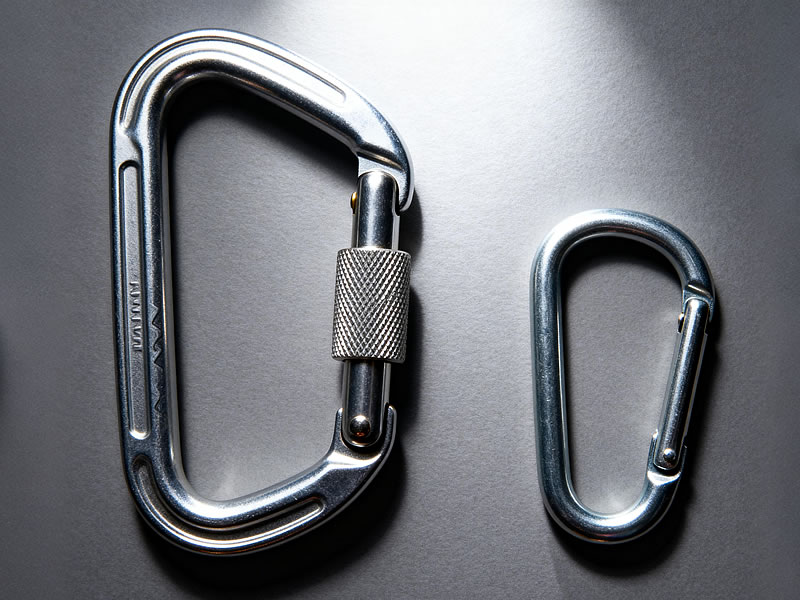
This guide will break down the key differences in strength, materials, design, and intended use to help you make an informed decision.
💪 Core Differences: Strength and Application
The most significant difference lies in their strength ratings, which are measured in kilonewtons (kN). One kN is approximately equivalent to 225 pounds of force.
- Heavy-Duty Carabiners: These are engineered for life-saving applications. They are built to withstand immense forces, such as those generated in a fall. Their strength ratings are substantially higher. For example, a standard for rescue anchorages requires a minimum strength of 40 kN (approx. 9,000 lbf) in all directions -4. Heavy-duty models, like those made for fire brigades or industrial work, often have major axis (spine-to-gate) strength ratings of 22 kN (approx. 4,950 lbf) or much higher -10. They are essential for rock climbing, rope rescue, construction, and any scenario where human life is on the line.
- Standard Carabiners: These are designed for light-duty, non-life-critical tasks. You might find them on keychains, for organizing gear on a backpack, or for securing lightweight equipment. While some may have decent strength, they are not certified for safety-critical loads. A standard carabiner's strength when open can be as little as one-third of its closed strength -5, making them highly vulnerable to failure if the gate is accidentally opened under load.
The table below summarizes the primary distinctions:
| Feature | Heavy-Duty Carabiner | Standard Carabiner |
|---|---|---|
| Primary Use | Life-saving applications (climbing, rescue, industrial safety) | Everyday, non-critical tasks (keychains, gear organization) |
| Strength Rating | Typically 22 kN and above (often 25+ kN) -10 | Not standardized for safety; significantly lower |
| Material | Often steel for durability and abrasion resistance, or high-strength aluminum alloys -7-10 | Typically aluminum or lightweight titanium for EDC -2 |
| Locking Mechanism | Almost always features a locking gate (screw-gate, auto-locking) to prevent accidental opening -9 | Usually a simple, non-locking spring gate |
| Weight | Heavier (e.g., 163g for a steel model -7) | Lighter (e.g., 50g for an aluminum climbing carabiner -5) |
🔒 Design and Materials: Built for Different Purposes
The intended use drives the design and material selection.
- Shape and Gate Design: Heavy-duty carabiners often feature a D-shape or asymmetric design. This shape directs the load onto the strong spine, maximizing strength-to-weight ratio -5. Their locking mechanisms are complex, requiring at least two distinct, consecutive manual movements to open the gate, which prevents accidental release -9. Standard carabiners may have an O-shape, which offers good range of motion but is weaker under load, as the force is distributed evenly around the shape -6.
- Material Choice: Heavy-duty carabiners are frequently made from zinc-plated steel, offering great strength and durability for high-workload environments like lowering systems or rescue -7. For climbing where weight is a concern, high-strength aluminum alloys are used. Standard carabiners prioritize portability, using lighter materials like aluminum or even titanium for everyday carry (EDC) tools -2.
✅ How to Make the Right Choice
Your choice should be guided by a simple principle: when in doubt, go for the heavy-duty option if safety is a factor.
- For climbing, mountaineering, rope rescue, or industrial work at height: You must use a locking, heavy-duty carabiner that complies with relevant safety standards like ASTM F1774 (for the US) or EN 362 -9-10. Always check for the strength and certification markings engraved on the carabiner's spine.
- For securing heavy gear (like fitness bands) or in environments with abrasion: A heavy-duty carabiner with a high kN rating (e.g., one rated for 3,000 kg / 6,600 lbs) is appropriate to ensure reliability under significant stress -1.
- For keys, a lightweight water bottle, or organizing items in a bag: A standard, non-locking carabiner is perfectly adequate and more convenient due to its light weight.
Inspection and Maintenance
Regardless of type, regularly inspect your carabiners. Look for cracks, deep grooves, sharp edges, or gate malfunction. If a carabiner has been dropped from height onto a hard surface or shows signs of wear, it should be retired immediately, as internal damage may not be visible -8.
Conclusion: There is no overlap between these two categories. A standard carabiner's convenience is its virtue for daily tasks, but it is a severe safety hazard if used for climbing or protection. A heavy-duty carabiner is the only choice when the stakes are high. Always match the tool to the task, and never compromise on certified safety for critical applications.




