




What is the best heavy duty carabiner for rigging?
Selecting the best heavy-duty carabiner for rigging is a decision where there is no room for error. Unlike general-purpose climbing, rigging involves complex forces, sustained loads, and often abrasive environments. The "best" carabiner is not a single model but one that meets a stringent set of strength, material, and safety criteria tailored to your specific rigging scenario.
Recommended trekking pole purchase link: https://s.click.aliexpress.com/e/_c4M7OWaN
This guide will break down the essential features you need to prioritize, ensuring your choice provides maximum safety and reliability.
🔑 Key Features of a Rigging-Specific Carabiner
The demands of rigging—whether for rescue training, construction, or stage production—exceed those of recreational climbing. Here are the non-negotiable characteristics:
1. Certified Strength Ratings (The kN Benchmark)
The most critical factor is the carabiner's strength rating, measured in kilonewtons (kN). One kN is approximately 225 pounds of force. For rigging, you need significantly higher strength than standard climbing carabiners.
- Major Axis Strength: This is the force applied along the spine of the carabiner. For heavy-duty rigging, look for a major axis strength rating that is substantially higher than that of standard climbing carabiners (which are often around 22-28 kN) -2-6. For context, fixed anchorages used in professional rope rescue training must be designed to hold a minimum of 40 kN in all directions -3. While the carabiner itself isn't the anchorage, this figure highlights the level of strength required in professional systems.
- Gate Open Strength: A carabiner's strength is drastically reduced when the gate is open. A superior rigging carabiner will have a high gate-open strength rating to prevent catastrophic failure from an accidental impact against the gate.
2. Material: Steel vs. Aluminum
The material choice is a trade-off between ultimate durability and weight.
- Steel: For most rigging applications, steel is the preferred material -4-9. Steel carabiners offer superior abrasion resistance and are less likely to be damaged when contacting sharp edges or other metal hardware. They are ideal for permanent or semi-permanent setups and environments where the gear will see heavy, repeated use. The downside is greater weight -4.
- Aluminum: Aluminum carabiners are lighter, which is an advantage if portability is a key concern -4. However, aluminum is softer and more susceptible to wear and damage from sharp or abrasive surfaces -4. While high-quality aluminum alloys can have breaking strengths comparable to steel, their lower durability often makes them less suitable for demanding rigging work where contact with other equipment is likely -4.
3. Locking Mechanism: Absolute Gate Security
A secure locking mechanism is non-negotiable. For rigging, you should only use locking carabiners, which require at least two distinct, consecutive manual actions to open the gate -7. The two most common types are:
- Screw-gate: A manually threaded sleeve that screws down to cover the gate.
- Auto-locking (Twist-lock): An automatic mechanism that locks when the gate closes, often requiring a twisting motion to unlock. These provide an extra layer of safety, especially in situations where a user might forget to manually screw the gate shut -9.
4. Optimal Shape: Why D-Shape is Superior for Rigging
The shape of the carabiner determines how efficiently it manages load.
- D-Shape: The D-shape is highly recommended for rigging -9. Its design directs the load onto the strong, straight spine, creating an optimal strength-to-weight ratio and maximizing its efficiency under heavy force -2-6.
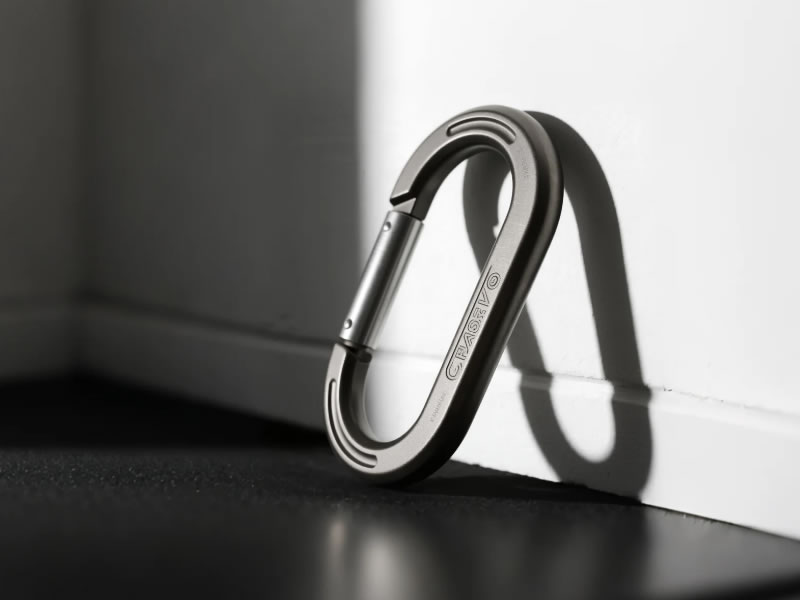
- Oval Shape: Oval carabiners distribute the load more evenly across their shape, which generally results in a lower strength-to-weight ratio compared to a D-shaped carabiner of similar size -2-6. They are best reserved for non-critical, lightweight applications.
The table below provides a quick comparison of these critical features:
| Feature | Importance for Rigging | Recommendation |
|---|---|---|
| Strength (Major Axis) | Must withstand high and sustained loads. | Look for ratings significantly higher than standard climbing carabiners (e.g., 30 kN and above). |
| Material | Determines durability and abrasion resistance. | Steel is preferred for its toughness and longevity in demanding environments -4-9. |
| Locking Mechanism | Prevents accidental opening, which can reduce strength by up to two-thirds. | A secure locking gate (screw-gate or auto-locking) is essential -4-7. |
| Shape | Affects efficiency of load distribution. | D-shape is superior for directing force to the spine and maximizing strength -2-6-9. |
✅ How to Choose and Inspect Your Carabiner
- Check the Engravings: Before use, always look for the strength ratings (in kN) and certification marks (like ASTM F1774 for climbing and mountaineering carabiners or other relevant standards) engraved on the carabiner's spine -7-9. This is your guarantee that it has been independently tested.
- Inspect Before Every Use: Examine the carabiner for any signs of cracks, deep grooves, sharp edges, or gate malfunction. If a carabiner has been dropped from a height or shows significant wear, it should be retired, as internal damage may not be visible -4.
- Match the Tool to the Task: Consider the specific demands of your rigging system. Will the carabiner be under constant tension? Could it rub against a rough surface? Your answers will guide you toward the right material and strength.
Conclusion
The best heavy-duty carabiner for rigging is defined by its exceptional certified strength, durable steel construction, secure locking gate, and efficient D-shape design. There is no single "best" brand, but there is a clear set of specifications that ensure safety and reliability. By prioritizing these features and conducting rigorous pre-use inspections, you can build rigging systems that are not only effective but, most importantly, safe. Remember, in rigging, your equipment is the foundation of security—never compromise on its quality.




