




Heavy duty carabiner for sailing vs for climbing.
Choosing the right heavy-duty carabiner is a critical safety decision. However, the "best" carabiner is entirely dependent on its environment and use case. Sailing and climbing are two demanding activities that subject gear to extreme forces, but in fundamentally different ways. Using climbing gear for sailing, or vice versa, can lead to catastrophic equipment failure. This article explores the key differences in material, design, and safety standards to help you select the correct carabiner for your needs.
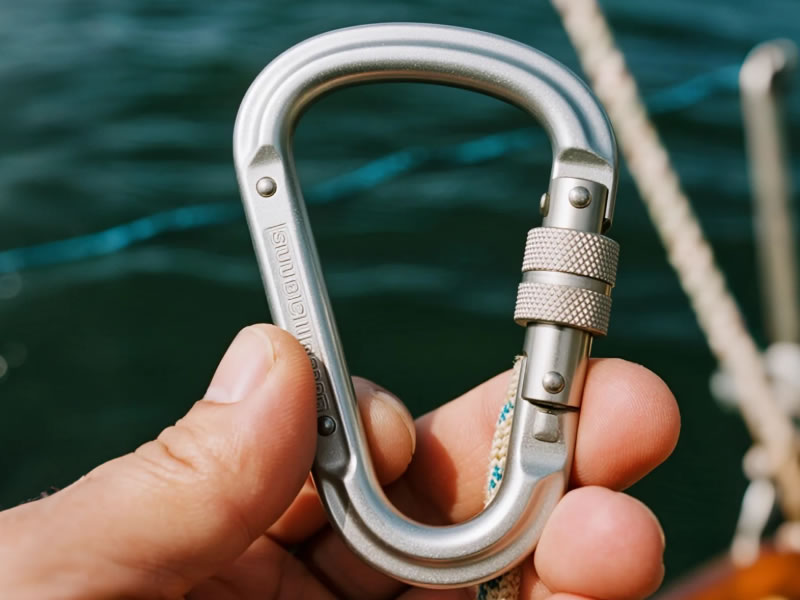
The table below provides a quick overview of the primary differences between carabiners designed for these two distinct purposes.
| Feature | Sailing Carabiner | Climbing Carabiner |
|---|---|---|
| Primary Enemy | Saltwater corrosion | High-impact forces (falls) |
| Material | Stainless steel is preferred for its superior corrosion resistance -8. | Aluminum alloys (e.g., 7075 aviation aluminum) are favored for their high strength-to-weight ratio -1-3. |
| Strength Focus | High tensile strength for constant load-bearing (e.g., 25kN breaking strength) -1. | High impact force absorption (e.g., withstanding forces of 22-28kN or more) -2-3. |
| Locking Mechanism | Screw-gate or self-closing mechanisms designed to function even when corroded or fouled. | Secure locking gates (screw-gate or auto-locking) are essential for safety -4. |
| Typical Shape | Often O-shaped for easy clipping and compatibility with ropes and deck hardware -4. | Often D-shaped or asymmetric to direct load onto the spine for maximum strength -3-4. |
🚨 Material Matters: Corrosion Resistance vs. Weight Savings
The most significant difference lies in the choice of material, dictated by the environment.
- For Sailing: Corrosion Resistance is Paramount. The constant exposure to saltwater is brutally corrosive. Therefore, stainless steel is the preferred material for sailing carabiners -8. Its primary advantage is its ability to resist rust and corrosion, ensuring the integrity of the metal remains intact over time. Weight is less of a concern than longevity and reliability in a corrosive environment.
- For Climbing: Strength-to-Weight Ratio is Key. Climbers need to carry their gear, so every gram counts. Heavy-duty climbing carabiners are typically made from high-strength aluminum alloys (such as 7075 aviation aluminum) which are both light and capable of withstanding immense forces -1-3. While aluminum can corrode, it is not subjected to the same persistent, aggressive conditions as in a marine environment. Steel carabiners are used in climbing for specific applications like via ferrata or rescue, where abrasion resistance is prioritized over weight -3-8.
🔩 Design and Function: Shape and Locking Mechanisms
The design priorities for carabiners in these sports also diverge due to different operational needs.
- Shape and Use Case: In climbing, the D-shape or asymmetric D-shape is dominant because it efficiently directs the load onto the strong spine, offering the highest strength-to-weight ratio -3-4. For sailing, an O-shaped carabiner is common as it allows for easier clipping and less fiddly operation, which can be crucial when working on a moving deck -4.
- Locking Mechanisms: Both applications require secure locking mechanisms, but the challenges differ. A climbing carabiner must have a ultra-reliable locking gate (screw-gate or auto-locking) to prevent it from accidentally opening if bumped against the rock -4. For sailing, the mechanism must be designed to resist jamming from salt crystal buildup or debris, with a focus on smooth operation even after prolonged exposure to the elements.
⚖️ Strength Standards and Certifications
Both types of carabiners are built for strength, but they are tested against different criteria and standards.
- Climbing carabiners are rigorously certified by organizations like the UIAA (International Climbing and Mountaineering Federation) or to standards like ASTM F1774 -3. Their strength is measured in kilonewtons (kN), with a major axis strength of 22 kN to 28 kN (approximately 4,950 to 6,300 pounds-force) being common for heavy-duty models -2-3. They are specifically tested to withstand the dynamic shock of a falling climber.
- Sailing carabiners also have high breaking strengths (e.g., 25kN) -1, but they are engineered for constant tensile loads rather than high-impact shocks. They may be certified under marine or industrial equipment standards that focus on longevity and performance in corrosive environments. It is crucial to understand that a carabiner marked "Not for climbing" -5-7 should never, under any circumstances, be used to protect a human life in a fall.
✅ How to Make the Right Choice
Your choice should be absolute:
- For climbing, mountaineering, or any activity where a fall could occur: You must use a UIAA- or ASTM-certified climbing carabiner. Its material, design, and testing are specifically tailored for life-saving applications.
- For sailing, boating, or any marine environment: Choose a corrosion-resistant carabiner made from stainless steel or other marine-grade alloys. Ensure it is rated for the loads you expect it to carry.
- Inspection is Non-Negotiable: Regardless of use, regularly inspect your carabiners for cracks, deep grooves, corrosion, or gate malfunctions. Retire any gear that shows signs of damage or wear -3.
Conclusion
The distinction between a heavy-duty sailing carabiner and a climbing carabiner is a matter of specialization over generalization. Climbing carabiners are optimized for lightweight strength and impact resistance, while sailing carabiners are engineered for maximum corrosion resistance and durability under constant load. Using the right tool for the job is not just about performance—it is a fundamental matter of safety. Always choose gear that is specifically designed and certified for your intended activity.




