




Comparing Locking Mechanisms on Heavy Duty Carabiners
When your safety depends on a carabiner, the locking mechanism is not just a feature—it's your primary defense against catastrophic failure. A heavy-duty carabiner might have immense strength, but if its gate can open accidentally, that strength is irrelevant. Understanding the differences between the main types of locking mechanisms is crucial for selecting the right tool for climbing, industrial work, or rescue operations. This guide will delve into the pros, cons, and ideal applications of screw-gate, auto-locking, and triple-action carabiners.
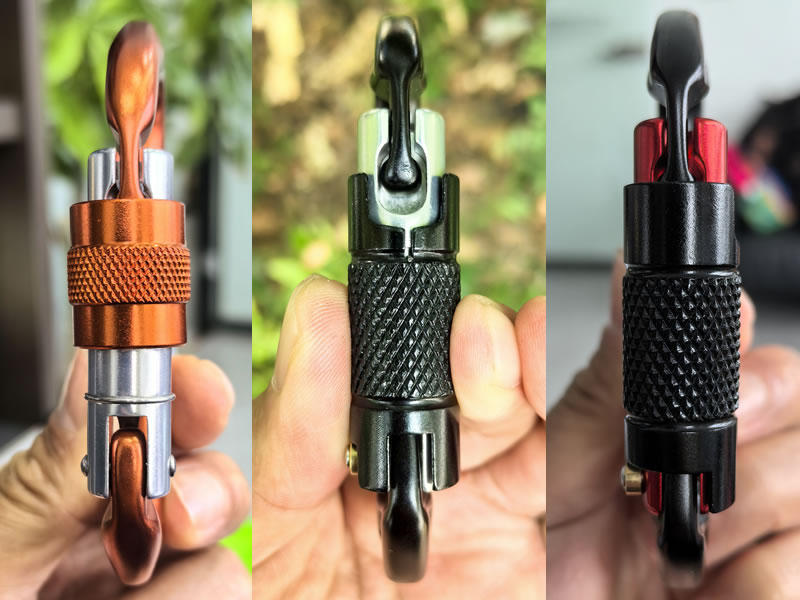
Recommended trekking pole purchase link: https://s.click.aliexpress.com/e/_c4M7OWaN
1. The Classic: Screw-Gate Locking Carabiners
The screw-gate is the most traditional and widely recognized locking mechanism.
- How it Works: A threaded sleeve rotates along the gate's spine. To lock it, you manually screw the sleeve down until it contacts the carabiner's nose. To unlock, you unscrew it back.
- Advantages:Simplicity: Easy to understand and operate.Reliability: Fewer moving parts mean less potential for mechanical failure.Visual Check: It's immediately obvious if the sleeve is fully screwed shut.
- Disadvantages:User Error: It can be accidentally left partially or completely unscrewed.Slower Operation: Requires two hands and more time to open and close securely.Frozen Threads: Dirt, ice, or grit can jam the threads, making it difficult to operate.
Best For: General climbing where speed isn't critical, fixed anchors, and situations where simplicity is valued.
2. The Modern Standard: Auto-Locking Carabiners (Twist-Lock)
Auto-locking carabiners were designed to address the human error factor of screw-gates. Popular types include Petzl's Ball-Lock and Black Diamond's Magnetron® systems.
- How it Works: A spring-loaded mechanism automatically engages when the gate closes. Unlocking requires a specific, deliberate action, typically twisting the locking collar before the gate can be opened.
- Advantages:Enhanced Safety: Eliminates the risk of forgetting to screw the sleeve shut.One-Handed Operation: Many models can be manipulated easily with one hand, a significant advantage for climbers and rescuers.Speed: Much faster to secure than a screw-gate.
- Disadvantages:Complexity: More internal parts can potentially be compromised by mud, sand, or ice.Maintenance: May require more careful cleaning and inspection.Cost: Typically more expensive than basic screw-gate carabiners.
Best For: Sport climbing, alpine climbing, and work-at-height where one-handed operation and speed are beneficial.
3. The Gold Standard: Triple-Action Locking Carabiners
For the highest level of security, triple-action locks (sometimes called triple-locks) are the preferred choice in high-risk environments.
- How it Works: As the name implies, opening the gate requires three distinct motions in the correct sequence: 1) Push a lever, 2) Twist the collar, and 3) Pull the gate open. This is often referred to as the "push, twist, pull" action.
- Advantages:Maximum Security: The multi-step process makes it virtually impossible for the gate to open accidentally from contact with ropes, rock, or gear.High-Risk Reliability: The design is inherently resistant to being knocked open.
- Disadvantages:Slowest Operation: The multi-step process takes the most time.Two-Handed Use: Almost always requires two hands to operate efficiently.Weight and Bulk: Often the heaviest and bulkiest option.
Best For: Rescue operations, big wall climbing, hauling systems, and any scenario where the carabiner might be subjected to repeated impacts or dragging over surfaces.
Choosing the Right Lock: A Quick Guide
- Priority on Simplicity and Reliability? Choose a Screw-Gate.
- Priority on Speed and Accident Prevention? Choose an Auto-Locking carabiner.
- Priority on Absolute, Uncompromising Security? Choose a Triple-Action lock.
Conclusion: Safety is in the Mechanism
There is no single "best" locking mechanism; the right choice depends entirely on your specific application and risk assessment. A screw-gate may be perfect for a permanent anchor, while an auto-locker is ideal for a busy climber's belay device, and a triple-action is essential for a technical rescue rig.
Regardless of your choice, the fundamental rules remain the same: always purchase carabiners from reputable brands, look for relevant certifications (UIAA, CE), and, most importantly, perform a visual and physical check every time to ensure the gate is fully locked before loading. Your vigilance, combined with the right mechanism, is what ultimately ensures safety.




