




How to Check if a Heavy Duty Carabiner is Safe: A Comprehensive Pre-Use Inspection Guide
Your safety in any vertical, rigging, or load-bearing situation depends entirely on the integrity of your equipment. A heavy-duty carabiner might look and feel robust, but its safety is not guaranteed by appearance alone. Whether it's a trusted brand like Petzl or a budget-friendly option, performing a thorough pre-use inspection is a non-negotiable ritual. This guide will walk you through the critical steps to assess if your carabiner is safe for service.
The Four Pillars of Carabiner Safety Inspection
A proper check follows a simple but meticulous sequence: Certify, Inspect, Feel, and Act.
1. Certify: Verify Its Origins and Purpose
Before you even touch the hardware, you must know its history and intended use.
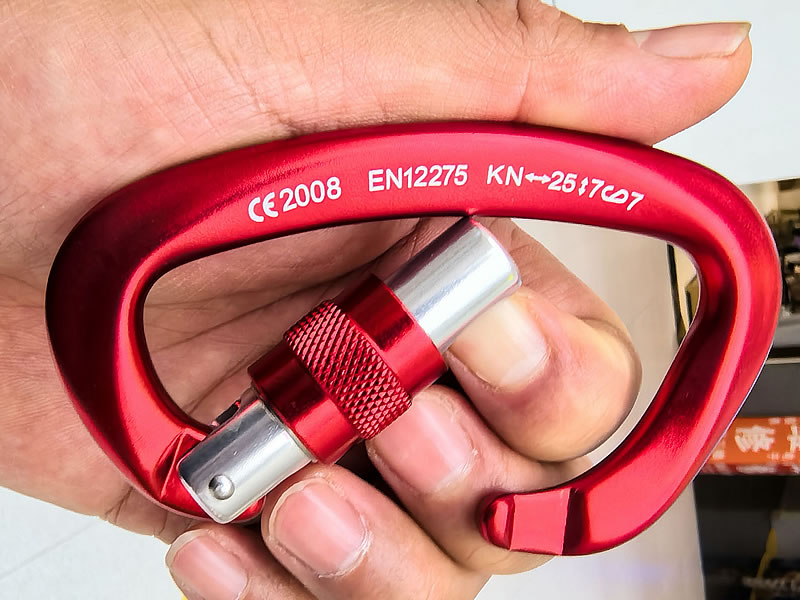
- Check for Markings: A safe, professionally-manufactured carabiner will have clear, laser-engraved (not painted) markings. Look for:Brand Name & Model: Identifies the manufacturer.Strength Ratings: Expressed in kN (KiloNewtons). Look for three values: major axis (e.g., 22-30 kN), minor axis, and gate open.Certification Marks: The most critical are CE (European Conformity) and UIAA (International Climbing and Mountaineering Federation). These marks mean the carabiner has passed independent tests for strength, gate function, and durability.
- Know the History: If the carabiner is used, do you know its history? Has it been dropped from height, loaded shockingly, or used in an abrasive chemical environment? If the history is unknown, be extra vigilant or retire it.
2. Inspect: The Visual Examination
Hold the carabiner under a good light and slowly rotate it, examining every millimeter of its surface.
- Cracks and Deformations: Look for any hairline cracks, especially near the nose and the spine. Check if the shape is symmetrical and not bent or warped.
- Corrosion and Pitting: Surface rust can often be cleaned off, but deep pitting creates stress points that can lead to failure. Galvanized steel carabiners are more resistant, but all metals can corrode.
- Wear Grooves: Deep grooves worn into the metal by repeated rope or sling contact are a major red flag. A slight polish is normal, but any groove you can feel with your fingernail significantly weakens the structure.
- Gate Damage: Inspect the gate for cracks and ensure the nose (the hooking mechanism) is not chipped or damaged.
3. Feel: The Functional Test
How the carabiner feels in operation is as important as how it looks.
- Gate Action: Open and close the gate repeatedly. It should move smoothly without grinding, grit, or sticking.Non-Locking Gate: It should snap shut crisply and fully under the power of its spring.Screw-Gate/Locking Sleeve: It should thread easily and smoothly, engaging fully without cross-threading. The sleeve should not wobble excessively.Auto-Locking Gate (e.g., Petzl Ball-Lock, Triple-Lock): Test the automatic mechanism. It should engage every time the gate closes and require a deliberate, multi-step action to open.
- Play and Wiggle: When locked closed, there should be minimal side-to-side play in the gate. Some play is normal in well-used carabiners, but excessive movement indicates wear in the pivot points.
Critical Considerations Beyond the Physical Check
- Application is Everything: A carabiner can pass a visual and tactile inspection but still be unsafe for your intended use. A carabiner certified for climbing (UIAA) is not automatically safe for a backyard swing. The constant, cyclical loading of a swing can cause metal fatigue in a way climbing falls do not. Always use equipment designed for its specific, repetitive load.
- The "When in Doubt, Throw it Out" Rule: This is the golden rule of safety. If you have any uncertainty about a carabiner's integrity—if a mark looks questionable, if the gate action feels slightly off, or if its history is unknown—the only safe choice is to retire it permanently. The cost of a new carabiner is insignificant compared to the cost of a failure.
How to Retire a Carabiner
Don't just throw a retired carabiner in the trash where someone might retrieve and use it. Render it permanently unusable by bending it in a vice or cutting it with an angle grinder before disposal.
Final Verdict
A safe heavy-duty carabiner is one that is certified for your specific activity, has a known and gentle history, passes a rigorous visual inspection, and functions with crisp, reliable mechanics. By making this five-minute inspection a mandatory habit, you transform from a passive user into an active participant in your own safety, ensuring that this critical piece of hardware performs its job flawlessly when it matters most.




