




What to Do If a Heavy Duty Carabiner Is Dropped from Height: A Critical Safety Protocol
The sickening sound of metal hitting the ground after a fall is one that every climber, arborist, or rigger dreads. In that moment, a critical question arises: is my gear still safe? When a heavy-duty carabiner is dropped from even a moderate height, its structural integrity can be compromised in ways that are invisible to the naked eye. The standard safety protocol in the professional world is unambiguous, but understanding the "why" behind the rule is essential for making informed, life-saving decisions.
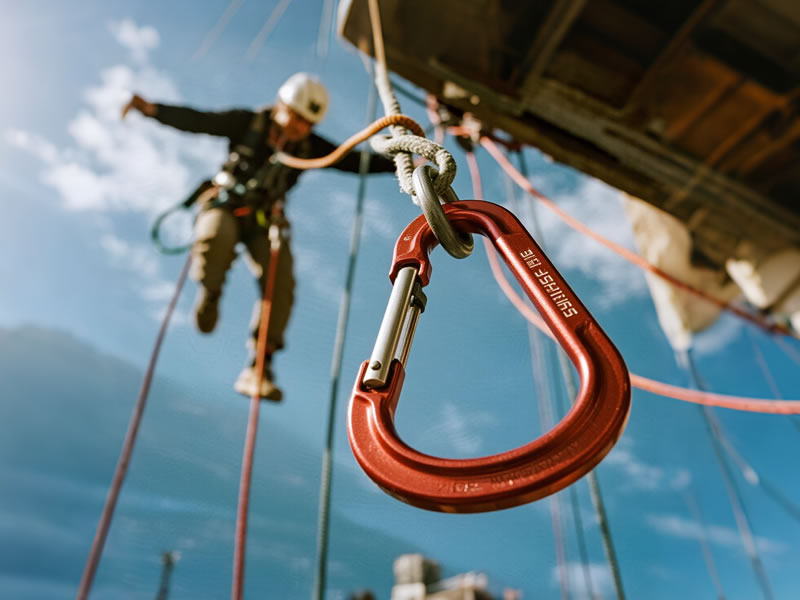
The Immediate Aftermath: The "Retire First, Ask Questions Later" Rule
The single most important action to take is immediate and non-negotiable: remove the carabiner from life-support service. Do not clip it back to your harness. Do not tell yourself you'll "inspect it later." Its status for any critical application—climbing, rope access, rigging, or rescue—is instantly changed to "suspect." This is the golden rule taught by every reputable safety organization and gear manufacturer, including Petzl, Black Diamond, and the UIAA.
The Invisible Enemy: Understanding Internal Damage
Why is a simple drop so dangerous for a piece of metal rated to withstand forces of 20 kN or more? The answer lies in the physics of impact and the nature of high-strength alloys.
- Microfractures: When a carabiner hits a hard surface like rock or concrete, the energy of the impact is concentrated on a tiny point. High-strength aluminum or steel, while incredibly strong, can be relatively brittle. This sudden, localized stress can create microscopic cracks, often originating from the nose, the spine, or the gate mechanism. These microfractures are stress concentrators—tiny fault lines that can propagate suddenly and catastrophically under future load.
- Compromised Heat Treatment: The strength of a carabiner is achieved through precise heat treatment. A severe impact can alter the metal's crystalline structure in the affected area, creating a "soft" spot or, conversely, making it more brittle. This change is undetectable without specialized equipment like an X-ray or dye penetrant test.
- Gate and Mechanism Misalignment: Even if the carabiner's body survives intact, the delicate gate mechanism is highly vulnerable. The impact can bend the gate pin, misalign the latch, or damage the spring. A gate that doesn't close properly can reduce the carabiner's strength by up to 70% if loaded open.
The Inspection Process: A Forensic Look
After the carabiner has been retired from life-support, you can perform a detailed inspection. This is not to justify putting it back into service, but to confirm the decision to retire it.
- Visual Check: Under a bright light, use a magnifying glass to scrutinize the entire surface, paying close attention to the high-stress areas: the nose, the spine, and the gate. Look for any tiny cracks, chips, or deformation.
- Tactile Check: Run your fingernail over every surface. Sometimes, a microfracture can be felt as a sharp edge or a catch before it is visible.
- Functional Gate Test: Does the gate open and close as smoothly as before? Does it snap shut crisply? Does a locking gate engage fully without any new resistance or grinding? Any change in operation is a sign of internal damage.
The Final Decision: To Retire or Repurpose?
The only safe course of action for a carabiner dropped from a significant height (generally considered anything over 10-15 feet / 3-5 meters onto a hard surface) is permanent retirement from any load-bearing use.
However, if the drop was minimal (e.g., from waist-height onto soft ground) and your forensic inspection reveals absolutely zero signs of damage—visual, tactile, or functional—some professionals may make a risk-based decision to downgrade the carabiner.
Downgrading means:
- It is never again used for climbing, fall protection, or human support.
- It may be repurposed for non-critical, low-consequence applications, such as:A dedicated gear organizer on your pack.A keychain.A water bottle clip.
Even in a downgraded state, it should be marked (e.g., with red tape or paint) and its history known to anyone who might handle it.
Conclusion: The Cost of Complacency
The fundamental principle is one of risk management. The consequence of a carabiner failing during a climb or while supporting a load is severe injury or death. Weigh this against the cost of a replacement carabiner—typically between $15 and $30. The risk-reward calculation is unequivocal.
When a heavy-duty carabiner is dropped from height, honor its service and retire it. Cutting it in half with an angle grinder ensures it can never be mistakenly used again. This disciplined approach is not paranoia; it is a core tenet of a safety culture that respects the immense forces placed upon our equipment and prioritizes life above all else. In the vertical world, there is no room for "maybe" when it comes to gear integrity.




