




What is a climbing carabiner?
At first glance, a climbing carabiner is a deceptively simple piece of gear: a D-, oval-, or asymmetrically-shaped piece of metal with a spring-loaded gate. However, to define it merely as a "metal clip" is to vastly underestimate its role. In the world of climbing and vertical pursuits, the carabiner is a fundamental and critical connector, a lifeline that forms the essential links in the safety chain between a climber, their rope, and the anchor. Its design is a masterpiece of functional engineering, balancing immense strength with lightweight efficiency.
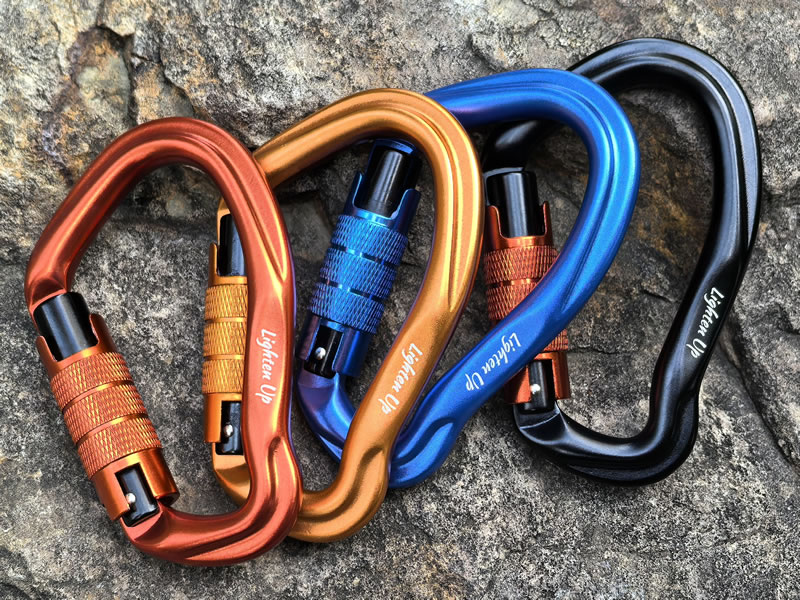
This article will delve into the anatomy, types, and critical safety standards that define what a climbing carabiner truly is.
The Core Anatomy: More Than Just a Clip
Understanding the parts of a carabiner is key to understanding its function:
- The Spine: The longest and strongest side, designed to bear the majority of the load.
- The Gate: The moving part that opens and closes, secured by a spring. This allows for quick attachment and detachment.
- The Nose: The hook-like end of the gate where it engages with the carabiner's body. Different nose designs (e.g., keylock vs. notch) affect snagging.
- The Basket: The wider, curved end opposite the spine. This is where a rope typically sits during use.
- The Locking Sleeve/Screw: Found on locking carabiners, this mechanism rotates to cover the gate, preventing accidental opening.
The Two Main Families: Non-Locking vs. Locking
Carabiners are broadly categorized by their gate security:
1. Non-Locking Carabiners:
These feature a simple, spring-loaded gate that is manually opened. They are prized for their speed and ease of use.
- Primary Use: They are almost exclusively used in pairs to create quickdraws. One carabiner, often with a bent gate for easy rope clipping, attaches to the rope, while the other, a straight-gate carabiner, clips into a bolt hanger or gear.
- Why No Lock? In a quickdraw, the rope-side carabiner is designed so that the rope's movement is unlikely to open the gate. The bolt-side carabiner is held in a stable position against the rock, minimizing the risk of accidental opening.
2. Locking Carabiners:
These incorporate a locking mechanism that secures the gate in the closed position, providing a redundant and much safer connection.
- Types of Locks:Screw-Gate: A sleeve is manually screwed down to cover the gate. Reliable but requires a conscious action to secure.Auto-Locking (e.g., Petzl Ball-Lock, Triple-Lock): These mechanisms automatically lock when the gate closes. Unlocking requires a two-step, often twisting or pushing, action. These are superior for situations where a climber might forget to screw a gate shut.
- Primary Use: Any critical connection where failure would be catastrophic. This includes connecting a belay device to the harness, attaching a rope to an anchor, hauling gear, or rappelling.
Material and Strength: The Science of Trust
- Material: The vast majority of climbing carabiners are made from aluminum alloy. This provides an excellent strength-to-weight ratio, allowing them to be incredibly strong without being overly heavy. Steel carabiners are used for specialized, high-abrasion applications like via ferrata or some industrial rigging, but their weight makes them unsuitable for a standard climbing rack.
- Strength Ratings: Every certified climbing carabiner is stamped with three key strength ratings, measured in KiloNewtons (kN). One kN is approximately 225 pounds of force.Major Axis (e.g., 22-25 kN): The strength when loaded along the spine with the gate closed. This is the strongest configuration.Minor Axis (e.g., 7-9 kN): The strength when loaded across the weaker, narrower dimension. This demonstrates its resistance to being loaded in a cross-loaded orientation.Gate Open (e.g., 7-10 kN): The strength when the gate is open and loaded on the major axis. This is significantly lower, highlighting why a secure gate is vital.
Certification: The Mark of Safety
A true climbing carabiner is not just a hardware store clip. It must be independently certified to rigorous safety standards. Look for the UIAA (International Climbing and Mountaineering Federation) and/or CE (European Conformity) marks. These certifications guarantee that the carabiner has been tested to meet or exceed minimum strength, gate function, and durability requirements.
In conclusion, a climbing carabiner is a precision-engineered safety device. It is the indispensable link that allows climbers to safely push their limits, a small but mighty piece of gear that carries the ultimate responsibility. Understanding its design, proper use, and limitations is the first step in building a solid foundation of climbing safety.




