




How does a climbing carabiner work?
At its most basic, a climbing carabiner appears to be a simple metal clip. However, its function is the result of sophisticated engineering designed for one critical purpose: to be an incredibly strong, reliable, and fail-safe connector in a life-support system. Understanding how it works isn't just about mechanics; it's about appreciating the physics of safety that allow climbers to trust their lives to this piece of gear.
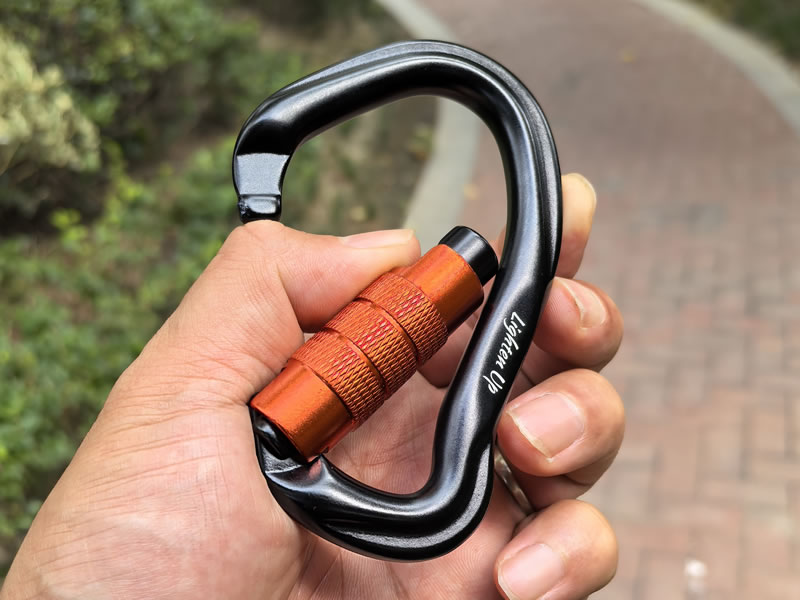
The Core Components: A Team Effort
A carabiner's functionality stems from the interplay of its key parts:
- The Spine and Basket: The spine is the solid, non-moving side of the carabiner, engineered to be the strongest part. The basket is the large, curved end that provides a cavity for the rope or sling to sit in, guiding the load towards the spine.
- The Gate: This is the moving part. A spring, housed within the gate's hinge, provides constant tension to keep it in the closed position. This "spring-loaded" mechanism is what allows for quick, one-handed operation.
- The Nose: This is the end of the gate that engages with the carabiner body. A well-designed nose (like a "keylock" system) prevents snagging on ropes, slings, or bolt hangers.
- The Locking Mechanism (on Locking Carabiners): This is the critical safety redundancy. It can be a manually threaded sleeve (screw-gate) or an automated mechanism (auto-locking) that physically blocks the gate from being pushed open accidentally.
The Physics of Strength: It's All About Direction
How a carabiner is loaded is fundamental to how it works. Its strength is not uniform in all directions.
- Optimal Loading (Major Axis): A carabiner is designed to be loaded along its major axis—from the spine down to the opposite end of the gate. In this orientation, the force is distributed across the strongest part of its structure. A typical climbing carabiner is rated between 22 and 30 kN (KiloNewtons) in this position, meaning it can withstand a force equivalent to over 5,000 pounds.
- Dangerous Loading Scenarios: The carabiner is significantly weaker in other orientations, which is why correct usage is paramount.Cross-Loading: This occurs when force is applied across the minor axis (from the gate to the spine). In this position, the strength can be reduced by as much as 65-70%, creating a severe risk of failure.Gate-Open Loading: If the gate is open and the carabiner is loaded on the major axis, its strength plummets, often to just 7-10 kN. The open gate creates the weakest point in the structure.
The spring-loaded gate works to prevent these scenarios by automatically closing and, when locked, providing a physical barrier to opening.
The Locking Mechanism: The Layer of Redundancy
While a non-locking carabiner's spring is usually sufficient in controlled situations (like a quickdraw on a bolt), a locking carabiner adds a vital layer of security.
- Screw-Gate: The user manually rotates a sleeve down over the gate. This prevents the gate from being flicked open by an impact or rubbing against the rock. The "working" part here is the physical barrier created by the sleeve.
- Auto-Locking (e.g., TwIST, Ball-Lock): These mechanisms work through a spring-assisted or magnetic system that automatically engages a lock when the gate closes. To open it, the user must perform a two-step motion, like a push-and-twist. This "works" by eliminating human error—you can't forget to lock it.
The Material Science: Lightness and Strength
Carabiners work effectively because of the materials they are made from. The vast majority are crafted from aluminum alloy. This material provides an exceptional strength-to-weight ratio, allowing a piece that weighs only a few ounces to hold the weight of a car. The alloy is also ductile, meaning it will often show signs of deformation before a complete brittle fracture, giving a visual warning of impending failure.
Conclusion: A Symphony of Simple Parts
A climbing carabiner works through a symphony of simple components—a spring, a gate, and a strong metal frame—all orchestrated by precise engineering and rigorous testing (UIAA/CE certified). Its function is to create a secure, strong, and quick-to-use connection point. However, its "work" is only successful when the user understands and respects its operating principles: always load it on its major axis, ensure the gate is closed and properly locked for critical connections, and inspect it regularly for wear. In the end, the carabiner is a brilliantly designed tool, but its safe operation is a partnership between human knowledge and mechanical integrity.




