




What are the different types of climbing carabiners?
For those new to climbing, the array of metal clips on a harness or in a gear store can be overwhelming. While they may look similar at first glance, climbing carabiners are specialized tools, with each type designed for a specific role within the safety system. Using the right carabiner in the correct context is a fundamental aspect of climbing safety and efficiency. This guide will break down the different types of climbing carabiners by their locking mechanism, shape, and specialized designs.
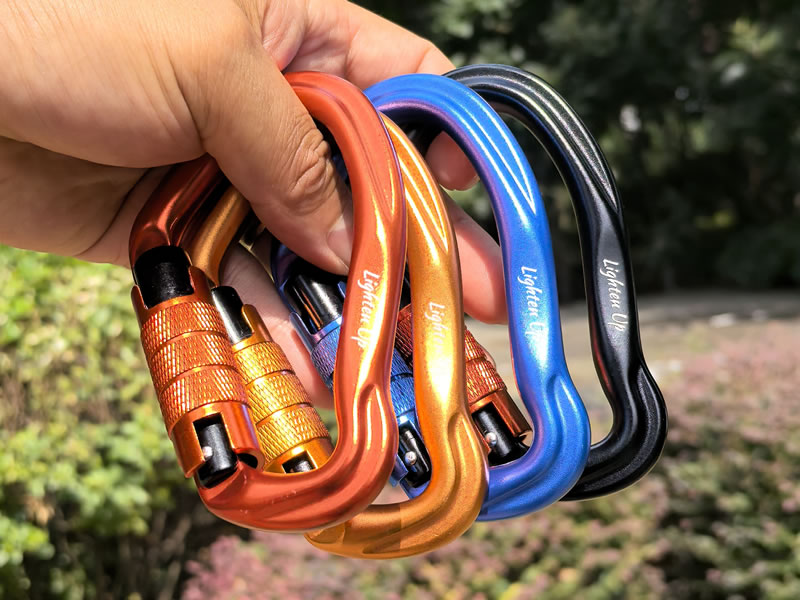
The Primary Divide: Non-Locking vs. Locking
The most fundamental classification separates carabiners based on their gate security.
1. Non-Locking Carabiners
These are the workhorses of a climber's rack, characterized by a simple, spring-loaded gate that is not secured by a locking mechanism.
- Primary Use: Their speed and lightness make them ideal for situations where the risk of the gate accidentally opening is minimized by design. They are almost exclusively used in quickdraws—two non-lockers connected by a sewn sling.
- Sub-types:Straight-Gate: The standard, versatile option. Reliable and strong, used for both the bolt-end and rope-end of quickdraws.Bent-Gate: The gate is slightly curved inward. This design facilitates smoother and faster rope clipping, as the rope can more easily push the gate open. These are typically reserved for the rope-end of quickdraws on sport climbs.
2. Locking Carabiners
These feature a mechanism that secures the gate in the closed position, providing a redundant, fail-safe connection for critical points.
- Primary Use: Any connection where failure would be catastrophic. This includes attaching a belay device to your harness, connecting the rope to an anchor, rappelling, or any hauling system.
- Sub-types (by mechanism):Screw-Gate: The classic locking carabiner. A threaded sleeve is manually screwed down to cover the gate. Reliable and cost-effective, but requires a conscious action to lock and can accidentally unscrew if rubbed against the rock.Auto-Locking / Triple-Action: These (e.g., Petzl Ball Lock, Black Diamond Magnetron) automatically lock when the gate closes. Unlocking requires a two- or three-step action, like pushing and twisting. They are superior for preventing user error but are often more complex and expensive.Double-Action Auto-Locking (e.g., Petzl TwistLock): A subtype that requires two actions to open (e.g., twisting and pulling), offering a balance between security and simplicity.
Shapes Matter: Strength, Weight, and Function
The shape of a carabiner influences its strength-to-weight ratio and how it handles the rope.
- Oval: The classic, symmetrical shape. Ovals are strong and keep the rope centered, which is good for certain gear loops. However, they are the heaviest for their strength and have largely been superseded by more efficient shapes for most climbing applications.
- D-Shape: This design shifts the load onto the stronger, straight spine. This creates a higher strength-to-weight ratio than an oval and tends to orient the rope away from the gate, reducing the chance of the rope forcing the gate open.
- Asymmetric D (or HMS): An exaggerated D-shape with a much larger basket on one side. This is the ideal shape for belaying and rappelling, as the large basket provides room for a Munter hitch and reduces rope drag when using a belay device. Many belay-specific carabiners are this shape.
- Pearabiner (HMS): A specific type of asymmetric shape that is wide at the bottom and narrow at the top, resembling a pear. It is the standard for use with a Munter hitch and many belay devices.
Specialized Carabiners
Beyond the basic categories, several specialized carabiners exist for specific tasks:
- Quickdraws: Pre-assembled pairs of non-locking carabiners connected by a sewn sling. They often feature a stiff-gate (sometimes wire-gate) carabiner for the bolt side and a snag-free, bent-gate carabiner for the rope side.
- Wire-Gate Carabiners: These use a wire instead of a solid metal gate. They are lighter, less prone to freezing shut in cold conditions, and have less gate "flutter" in a fall, which can slightly increase strength.
- Pulley Carabiners: These feature an integrated pulley wheel on the spine, designed for efficient hauling systems or for use in crevasse rescue.
Choosing the Right Carabiner
Your choice should be dictated by the task:
- Building a Sport Climbing Rack: A set of 10-15 quickdraws (using non-locking wire-gate or bent-gate carabiners).
- Belay Kit: One large, asymmetric D-shaped locking carabiner (screw-gate or auto-locking) for your belay device.
- Anchor Building: Several standard D-shaped locking carabiners.
No matter the type, always ensure your carabiners are UIAA and/or CE certified. This mark is your guarantee that the gear has been independently tested to meet the rigorous safety standards required for climbing. By understanding these differences, you can build a rack that is not only efficient but, most importantly, safe.




