




What is the strength of a climbing carabiner?
When you pick up a climbing carabiner, you'll notice a series of numbers and letters stamped on its spine, such as "22 kN" or "30 kN." These figures are not just arbitrary marketing terms; they are the lifeblood of the carabiner's identity, representing its certified strength and its ability to keep you safe. Understanding what these numbers mean, and just as importantly, how they apply in real-world scenarios, is fundamental to safe climbing practices. The strength of a carabiner is a story of physics, engineering, and context.
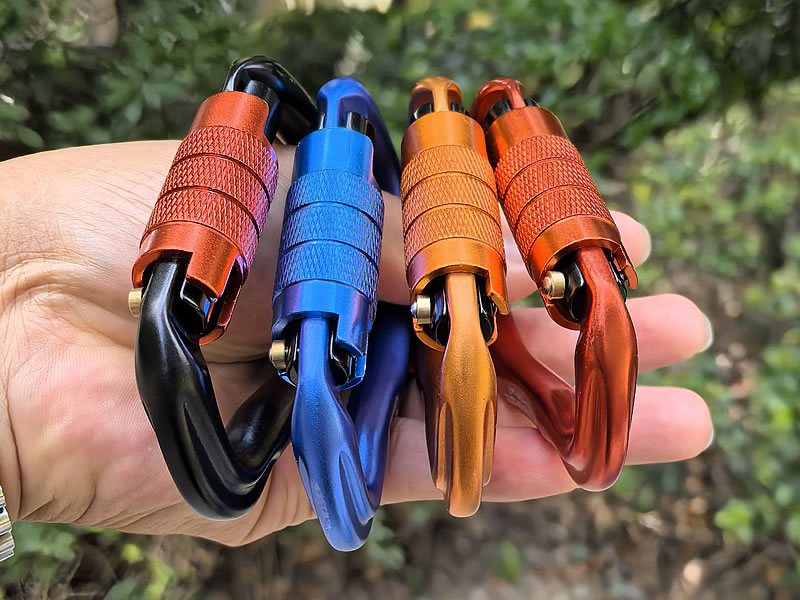
The Language of Force: What is a kN?
The first key to understanding carabiner strength is the unit of measurement: the kilonewton (kN). A newton is the international standard unit of force. One kilonewton is equal to 1,000 newtons, and crucially, 1 kN is approximately 225 pounds (or 102 kilograms) of force.
This might sound confusing—why not just use pounds? The reason is that carabiners are tested to withstand a specific force, not a static weight. A fall in climbing generates a dynamic, shock-loaded force that can be many times greater than the climber's static body weight. Using kN allows for precise, standardized measurement of these dynamic loads across the global industry.
The Three Critical Strength Ratings
A carabiner's strength is not a single number. It is rated for three distinct loading scenarios, and a safe climber must understand the difference.
- Major Axis Strength (Closed Gate):This is the number most people associate with a carabiner's strength, typically ranging from 22 kN to 30 kN for a standard carabiner. This rating indicates the force the carabiner can withstand when pulled from end to end along its spine with the gate closed. To put this in perspective, a 24 kN rating means the carabiner can hold roughly 5,400 pounds of force. This is the strongest configuration and the way a carabiner is designed to be loaded.
- Minor Axis Strength (Cross-Loaded):This is a significantly lower number, usually between 7 kN and 9 kN. This rating tests the carabiner's strength when force is applied across its weakest dimension—from the gate to the spine. In a real-world scenario, this happens if the carabiner is twisted in an anchor or quickdraw, causing the rope to sit against the gate side. A cross-loaded carabiner can fail at forces as low as 1,500 pounds, highlighting why proper orientation is critical.
- Open Gate Strength:This is the carabiner's Achilles' heel, with ratings typically around 7 kN to 10 kN. This tests the strength when the gate is open and the carabiner is loaded on its major axis. An open gate creates the weakest structural point. In a fall, if the rope or rock somehow forces the gate open, the carabiner's strength can be reduced by over 2/3rds.
Material Matters: Aluminum vs. Steel
The material a carabiner is made from directly impacts its strength-to-weight ratio.
- Aluminum Alloy: This is the standard for virtually all climbing carabiners. It offers an exceptional balance of high strength and low weight, allowing a piece rated for 24 kN to weigh only 50-60 grams.
- Steel: Steel carabiners are significantly stronger and more resistant to abrasion, but they are also much heavier. They are used for specialized applications like via ferrata sets, industrial rigging, or some permanent anchors where weight is less of a concern than long-term durability.
Safety Factors and Real-World Implications
You might be thinking, "If I weigh 180 lbs, why do I need a carabiner rated for 5,000 lbs?" The answer lies in the safety factor. The UIAA and CE standards require a massive safety margin. The forces generated in a fall, especially a severe "factor fall," can be immense—easily reaching 5-6 kN on the climber and much higher on the top piece of protection. The high kN ratings ensure that the carabiner is the strongest, most reliable link in the safety chain, and will not be the point of failure.
Conclusion: Strength is More Than a Number
The strength of a climbing carabiner is a carefully engineered and certified property. It is not a single value but a profile that changes dramatically based on how it is used. The stamped kN ratings are your guide, telling you the carabiner's immense capability when loaded correctly (major axis, gate closed) and its alarming vulnerability when misused (cross-loaded or gate open).
Therefore, a carabiner's true strength is realized only through informed use. It is a partnership between the engineered resilience of the metal and the climber's knowledge to use it properly. Always check for UIAA or CE certification to ensure these ratings are legitimate, and make it a habit to inspect your carabiners regularly for any signs of wear, cracks, or gate damage. Your safety doesn't just depend on the number stamped on the spine, but on your understanding of what it means.




