




How Much Weight Can a Climbing Carabiner Hold?
This is one of the most common and crucial questions asked by new climbers and curious observers alike. The intuitive answer might seem simple, but the reality is rooted in the complex physics of climbing falls and safety engineering. While you might be looking for a number in pounds or kilograms, the true answer requires understanding the difference between static weight and dynamic force. A climbing carabiner isn't designed to simply "hold weight"; it's engineered to withstand the immense, shock-loaded forces generated during a fall.
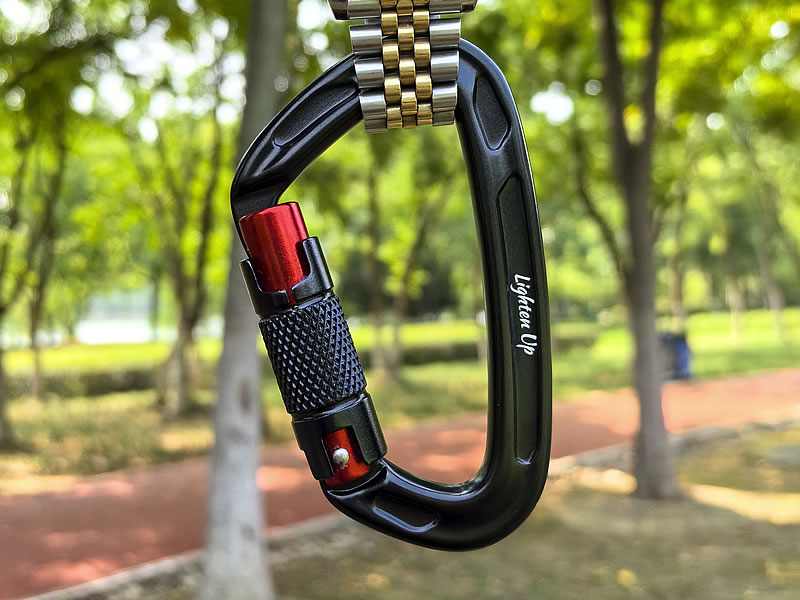
The Language of Force: kN, Not Pounds
The first and most important concept is the unit of measurement: the kilonewton (kN). You'll find this number stamped on the spine of every certified climbing carabiner. A newton is a unit of force, and one kilonewton is equal to 1,000 newtons. For practical reference, 1 kN is approximately 225 pounds (102 kg) of force.
This distinction is vital. When you stand on a scale, you are measuring mass under gravity. When a climber falls, the rope system creates a dynamic deceleration, generating a force that can be many times greater than the climber's static weight.
Decoding the Stamped Numbers: A Tale of Three Strengths
A carabiner's capacity isn't a single figure. It has three distinct strength ratings, each for a different loading scenario:
- Major Axis Strength (Closed Gate): This is the famous number, typically 22 kN to 30 kN for a standard carabiner. This represents the force the carabiner can withstand when pulled from end to end along its spine with the gate properly closed.What this "weight" translates to: A 24 kN carabiner can hold about 5,400 pounds (2,450 kg) of static force in this ideal orientation.
- Minor Axis Strength (Cross-Loaded): This rating is significantly lower, usually 7 kN to 9 kN. This tests the carabiner when force is applied across its weak axis—pushing the gate toward the spine. This can happen in a real fall if the carabiner is twisted in a quickdraw.The dramatic drop: In this dangerous orientation, the same carabiner's capacity plummets to roughly 1,800 pounds (816 kg) of force.
- Open Gate Strength: This is the carabiner's weakest point, also around 7 kN to 10 kN. This tests its strength when the gate is open and loaded on the major axis.The critical takeaway: An open gate can reduce the carabiner's strength by over two-thirds, making it vital to use locking carabiners for critical connections and to ensure non-lockers are not prone to being forced open.
The Safety Factor: Why the Numbers Are So High
If a typical fall might generate 3-6 kN of force on a carabiner, why are they rated to 24 kN? The answer is the safety factor. Governing bodies like the UIAA (International Climbing and Mountaineering Federation) require this massive margin for several reasons:
- Shock Loading: A fall is not a gentle application of force; it's a violent, instantaneous shock load.
- Material Fatigue: Over time, carabiners can develop microscopic cracks from use and abrasion.
- Environmental Factors: Corrosion and wear can subtly weaken the metal.
- System Redundancy: In a well-built anchor, multiple carabiners share the load. The high rating ensures that if one piece were to fail, the others would not be immediately overloaded.
This safety factor ensures the carabiner is the strongest, most reliable link in your safety chain.
So, How Much "Weight" Can It Really Hold?
Under perfect, static laboratory conditions—loaded along its major axis with the gate closed—a 24 kN carabiner will not break until a force equivalent to over 5,000 pounds is applied. This is an astonishing strength-to-weight ratio for a piece of aluminum that weighs little more than a AA battery.
However, in the real world, the question is the wrong one to ask. The correct question is: "What force can it withstand in a fall?" And the answer is: far more than you will ever likely generate in a real climbing fall, provided it is used correctly.
Conclusion: It's About Use, Not Just Weight
The capacity of a climbing carabiner is a testament to modern engineering. Its impressive kN rating is your assurance of safety, but that safety is conditional on your knowledge. The carabiner's true strength is only realized when it is:
- Certified (look for UIAA or CE marks).
- Used correctly (loaded on its major axis, gate closed and locked when necessary).
- Well-maintained (regularly inspected for cracks, grooves, and gate malfunctions).
So, while you can marvel at the fact that the clip on your harness can theoretically hold the weight of a small car, remember that its real value is in its proven ability to reliably arrest the dynamic force of a human fall, time and time again. Trust the engineering, but respect the conditions required for it to perform.




