




What Does kN Rating Mean on a Climbing Carabiner?
If you've ever held a climbing carabiner, you've noticed the enigmatic "kN" stamped on its spine. To the uninitiated, it might seem like technical jargon, but for anyone who trusts their life to this piece of equipment, understanding the kN rating is non-negotiable. It is the fundamental language of strength and safety, a precise measurement that tells you exactly what your gear can withstand. Far from being an abstract engineering term, the kN rating is a direct promise of reliability.
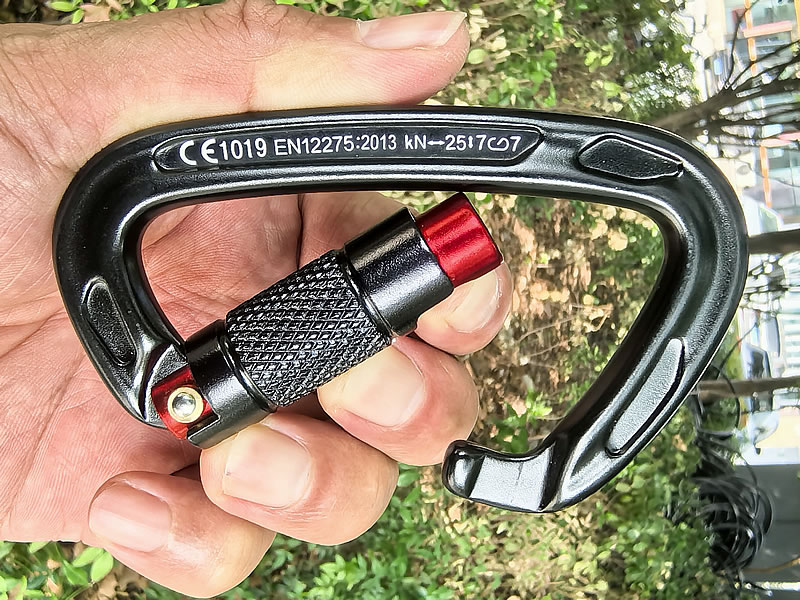
Buy Link: https://www.aliexpress.com/item/1005008983964737.html
This article will decode exactly what a kilonewton is, what the different ratings mean, and why this knowledge is critical for your safety on the rock.
Beyond Weight: Understanding Force vs. Mass
The most common misconception is that kN relates directly to static weight, like the pounds you see on a scale. This is a dangerous oversimplification. Climbing gear is rated for force, not just mass.
- Mass is the amount of matter in an object (measured in kg or lbs).
- Force is a push or pull upon an object, resulting from its interaction with another object. In climbing, this is the dynamic, shock-loaded pull generated during a fall.
The unit, therefore, is the kilonewton (kN), where 1 kN is equal to 1,000 newtons (the standard international unit of force). For a quick and practical reference, 1 kN is approximately 225 pounds (or 102 kilograms) of force.
The Three Faces of Strength: Decoding the Stamped Numbers
A carabiner doesn't have just one strength; it has three, each corresponding to a different way it can be loaded in a real-world scenario. This is why you often see multiple kN values.
1. Major Axis Strength (Closed Gate) - The Primary Rating
This is the largest number, typically between 22 kN and 30 kN for a standard carabiner.
- What it means: This is the force the carabiner can withstand when pulled apart along its strongest dimension—from the spine to the opposite end—with the gate closed and locked. This is how a carabiner is intended to be used.
- Real-world translation: A 24 kN rating means the carabiner can hold roughly 5,400 lbs of force in an ideal, straight-pull configuration.
2. Minor Axis Strength (Cross-Loaded) - The Warning
This is a significantly lower number, usually between 7 kN and 9 kN.
- What it means: This tests the carabiner's strength when force is applied across its weakest dimension—from the gate to the spine. This happens when a carabiner is twisted in a quickdraw or anchor, causing the rope to press against the gate.
- Why it matters: This rating highlights a critical vulnerability. A cross-loaded carabiner can fail at forces as low as 1,800 lbs, demonstrating why proper orientation is essential.
3. Open Gate Strength - The Achilles' Heel
This rating is also low, typically around 7 kN to 10 kN.
- What it means: This measures the strength when the gate is open and the carabiner is loaded on its major axis.
- Why it matters: An open gate creates the weakest structural point. In a fall, if the rope or rock forces the gate open, the carabiner's strength can be reduced by over two-thirds. This is the primary reason we use locking carabiners for critical connections like belaying and anchors.
The Safety Factor: Why the Margin is So Immense
You might wonder why a carabiner rated for 5,400 lbs is necessary to hold a 180 lb climber. The answer lies in the physics of a falling body. The force generated in a fall isn't just your weight; it's a product of the fall factor (the ratio of the fall height to the amount of rope out) and the deceleration provided by the rope's elasticity.
A severe fall can easily generate 5-6 kN of force on the climber's body and even higher forces on the top carabiner in the system. The UIAA (International Climbing and Mountaineering Federation) mandates a high safety factor to account for:
- Dynamic Shock Loading: The violent, instantaneous nature of a fall.
- Material Fatigue: Wear and tear over time from abrasion and minor impacts.
- Environmental Degradation: The effects of corrosion and UV exposure.
- Manufacturing Tolerances: Ensuring every carabiner, even at the lower end of the quality spectrum, is incredibly strong.
This massive safety margin ensures the carabiner is the strongest, most reliable link in your safety chain.
Conclusion: More Than a Number, A Lifeline
The kN rating on your carabiner is a concise summary of its engineered resilience. It tells a story of immense strength when used correctly, and specific vulnerabilities when misused. It is not a static weight capacity but a dynamic force rating designed to keep you safe in the worst-case scenario.
Therefore, understanding kN is the first step in a partnership with your gear. It empowers you to use it correctly—always loading it on its major axis, ensuring gates are closed and locked, and avoiding cross-loading. Always look for the UIAA or CE certification mark alongside the kN rating, as this is your guarantee that the carabiner has been independently tested to meet these rigorous international safety standards. In the vertical world, this knowledge isn't just power—it's protection.




