




What is the difference between a carabiner for climbing and a regular carabiner?
At first glance, a carabiner from a climbing shop and one from a hardware store might look similar—both are metal clips with a spring-loaded gate. However, this superficial resemblance is dangerously misleading. The difference between a climbing carabiner and a regular carabiner is the difference between a life-saving device engineered for worst-case scenarios and a general-purpose utility clip. Using one in place of the other can lead to catastrophic failure. This article will dissect the critical distinctions in engineering, certification, and intended use.
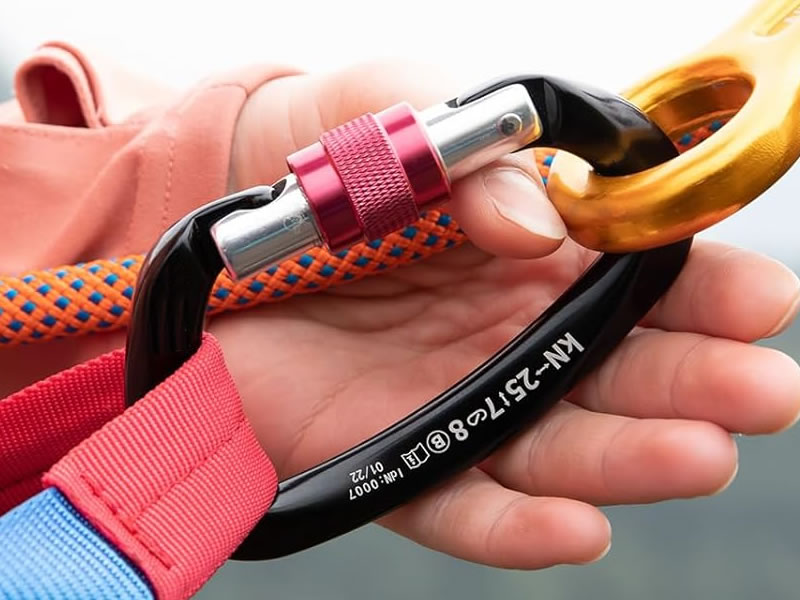
The Foundation: Certification and Standards
Climbing Carabiner:
- Independent Certification: Every legitimate climbing carabiner is independently tested and certified to meet rigorous international safety standards. The most common are the UIAA (International Climbing and Mountaineering Federation) and CE (European Conformity) marks.
- What Certification Means: This certification is a guarantee. It means the carabiner has passed a battery of tests for strength, gate function, durability, and resistance to accidental opening. The manufacturing process is consistently monitored for quality control.
Regular Carabiner:
- No Safety Certification: Regular carabiners, often sold in multi-packs for keychains or gear organization, have no such certification. They may be tested by the manufacturer for basic functionality, but there is no independent verification of their strength or reliability for life-support applications.
- Unverified Claims: They might be advertised as "heavy-duty," but this is a marketing term, not a certified standard. Their strength ratings, if provided at all, are often unverified and may not account for real-world variables like metal fatigue or gate failure.
The Engineering: Materials, Strength, and Design
1. Material and Strength:
- Climbing Carabiner: Made from high-strength aluminum alloy (or steel for specific applications), these are engineered for an exceptional strength-to-weight ratio. Their strength is precisely measured and stamped on the spine in kilonewtons (kN). A typical major axis strength is 22-28 kN, meaning it can withstand a force of approximately 5,000-6,300 pounds.
- Regular Carabiner: Often made from lower-grade aluminum, steel, or even zinc alloy, these are designed for cost-effectiveness, not maximum strength. Their failure point is unpredictable and typically far lower than a climbing carabiner. They are not rated to handle dynamic shock loads.
2. Gate Mechanism:
- Climbing Carabiner: The gate is a critical safety component. It must open and close smoothly under all conditions and is designed to minimize the risk of being accidentally opened by the rope or rock. Locking carabiners feature secure screw-gate or auto-locking mechanisms to prevent this.
- Regular Carabiner: The gate is often a weak point. The spring may be weak, leading to a gate that is easily forced open. The latch mechanism may be poorly designed, making it susceptible to "gate lash" (inadvertent opening) under load.
3. Testing for Real-World Scenarios:
A climbing carabiner is tested in three specific ways that a regular carabiner is not:
- Major Axis (Spine Load): As described above.
- Minor Axis (Cross-Loaded): This simulates the carabiner being loaded sideways. A climbing carabiner is tested for this (rated ~7-9 kN), while a regular carabiner could fail instantly.
- Gate Open Strength: This tests the carabiner in its weakest possible state. A climbing carabiner is still rated for this (~7-10 kN), whereas a regular carabiner's gate may deform or break completely.
The Critical Difference: Dynamic vs. Static Loads
This is the most crucial concept to understand.
- Climbing Carabiners are designed for dynamic loads. A climbing fall generates a massive, instantaneous shock force that is many times greater than the climber's static weight. The carabiner must absorb this energy without breaking, bending, or having its gate snap open.
- Regular Carabiners are only suitable for static loads. They are designed to hold a relatively constant weight, like a set of keys or a water bottle on a backpack. The violent, jerking force of a fall will almost certainly cause them to fail.
The Consequences of Misuse
Using a regular carabiner for climbing, a swing set, or any other life-support application is an extreme gamble with the highest possible stakes. The consequences are not merely theoretical:
- Gate Failure: The weak spring or latch can allow the gate to open under load, reducing the strength to zero.
- Metal Fracture: The inferior alloy can develop cracks or snap suddenly under a shock load.
- Unpredictable Behavior: Without certification, you have no way of knowing the true failure point or how it will perform.
Conclusion: Purpose-Built for Safety
The difference ultimately boils down to intent and verification. A climbing carabiner is a precision safety tool, born from decades of research, testing, and tragic lessons learned. Its every aspect is optimized for one purpose: to keep you safe in a fall.
A regular carabiner is a convenient utility clip. It is excellent for organizing your gear but should never, under any circumstances, be trusted with your life or the life of another.
The Rule of Thumb: If a failure of the equipment could result in injury or death, you must use a carabiner that is specifically certified for that purpose (UIAA/CE for climbing). There is no substitution, no workaround, and no excuse. The peace of mind that comes with certified gear is worth infinitely more than the few dollars saved by using a hardware store clip.




