




What is the standard kN rating for a climbing carabiner
If you're new to climbing, the "kN" rating stamped on every carabiner can seem like a mysterious code. However, understanding this number is fundamental to your safety. The kN, or kilonewton, rating isn't just a random figure; it's a precisely measured guarantee of the carabiner's strength under specific conditions. While many climbers know that a higher kN is "stronger," the full story involves three distinct ratings that tell you exactly how the carabiner will perform in both ideal and worst-case scenarios.
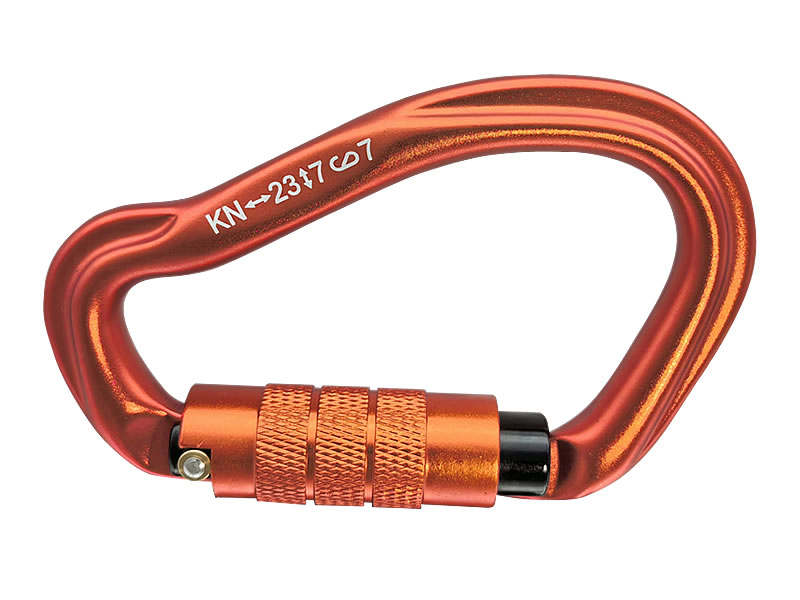
So, what is the standard? For a typical non-locking or locking carabiner used in sport or trad climbing, the standard major axis strength rating falls between 20 kN and 28 kN. But to truly understand what this means for your safety, we must break down what this number represents and why other, smaller numbers on the carabiner are equally important.
The Language of Force: What is a kN?
Before discussing the standard, we must understand the unit. A kilonewton (kN) is a unit of force, not weight. While it can be converted (1 kN is approximately 225 pounds or 102 kilograms of force), this conversion can be misleading in a climbing context. Carabiners are not designed to hold a static weight like a crane; they are engineered to withstand the immense, dynamic, shock-loaded force generated during a fall. The kN rating describes the maximum force the carabiner can withstand in a controlled test before deforming or breaking.
The Three Standard Ratings: A Carabiner's Full Report Card
Every certified climbing carabiner must display three strength ratings, each representing a different type of load. Focusing only on the largest number gives you an incomplete picture.
1. The Gold Standard: Major Axis Strength (Closed Gate)
- Standard Range: 20 kN to 28 kN
- This is the rating most climbers refer to. It represents the force the carabiner can withstand when pulled apart along its spine—the way it's designed to be loaded—with the gate closed and locked.
- What it means: A carabiner rated at 24 kN can hold about 5,400 pounds of force in this optimal orientation. This immense strength provides a massive safety margin, as even a severe fall typically generates only 3-6 kN of force on the top piece of gear.
2. The Critical Warning: Minor Axis Strength (Cross-Loaded)
- Standard Range: 7 kN to 9 kN
- This tests the carabiner's strength when force is applied across its weakest dimension—from the gate to the spine. This dangerous situation can occur if the carabiner twists in a quickdraw or anchor.
- What it means: The standard here is dramatically lower. The same carabiner that can hold 5,400 lbs when loaded correctly may fail at only 1,800 lbs when cross-loaded. This highlights why proper carabiner orientation is a critical safety skill.
3. The Achilles' Heel: Open Gate Strength
- Standard Range: 7 kN to 10 kN
- This measures the strength when the gate is open and the carabiner is loaded on its major axis.
- What it means: An open gate creates the weakest point in the entire structure. This rating explains why locking carabiners are mandatory for belaying and critical anchors—a non-locker could see its strength drop by over two-thirds if the gate is accidentally forced open by the rope or rock.
Why the High Safety Margin?
You might wonder why a carabiner needs to be rated for 5,000+ pounds of force when a climber weighs far less. The answer lies in physics and safety factors. The force in a fall isn't just your body weight; it's a product of the fall factor and the deceleration provided by the rope. Governing bodies like the UIAA mandate these high ratings to account for:
- Shock Loading: The violent, instantaneous nature of a fall.
- Material Fatigue: Wear and tear over time from abrasion.
- Manufacturing Tolerances: Ensuring every single carabiner meets the minimum standard.
Conclusion: Beyond the Single Number
The standard kN rating for a climbing carabiner is not a single number but a profile of resilience. The 20-28 kN major axis rating is your baseline for confidence, but the 7-9 kN cross-load and open gate ratings are your crucial warnings. When you check your gear, look for all three numbers and the UIAA or CE certification mark that validates them.
Ultimately, the carabiner's kN rating is a testament to modern engineering, but its safety is only fully realized through informed use. Your knowledge of these ratings—and the discipline to avoid cross-loading and to always lock critical carabiners—is what transforms this standardized piece of metal into a trustworthy lifeline.




