




Climbing Carabiner Strength Chart: Your Guide to kN Ratings and Safety
Navigating the world of climbing carabiners can be complex, but a fundamental understanding of their strength ratings is non-negotiable for safety. While a simple chart provides the numbers, truly grasping their meaning is what empowers you to make safe decisions on the rock. This article serves as your in-depth guide to the climbing carabiner strength chart, explaining not just the "what," but the crucial "why" and "how" behind the numbers.
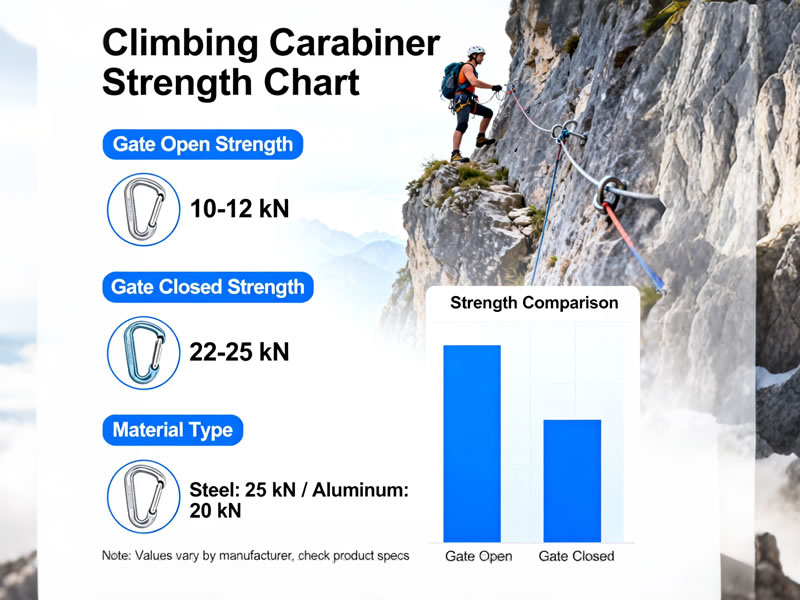
Understanding the Core Concept: kN as a Unit of Force
First, it's vital to understand that carabiner strength is measured in kilonewtons (kN), a unit of force. This is different from static weight. 1 kN is approximately 225 pounds (102 kg) of force. These ratings represent the maximum force the carabiner can withstand in a controlled test before permanent deformation or failure occurs. The forces in a climbing fall are dynamic and shock-loaded, making these high ratings essential for creating a safe margin.
The Standard Climbing Carabiner Strength Chart
The chart below outlines the typical strength ratings you will find on a certified UIAA/CE climbing carabiner. These are minimum standards, and many modern carabiners exceed them.
| Loading Scenario | Standard Strength Range | Approximate Force in Pounds | Real-World Context & Importance |
|---|---|---|---|
| Major Axis (Closed Gate) | 22 kN - 28 kN | 4,950 - 6,300 lbs | This is the ideal and strongest configuration. The force is applied along the spine, which is how the carabiner is designed to be loaded. This massive rating provides the safety margin for catching a fall. |
| Minor Axis (Cross-Loaded) | 7 kN - 9 kN | 1,575 - 2,025 lbs | This is a dangerously weak orientation. It occurs when force is applied from the gate to the spine. The rating is low because the structure is not designed to handle load this way. This highlights why proper carabiner orientation is critical. |
| Gate Open (Major Axis) | 7 kN - 10 kN | 1,575 - 2,250 lbs | This is the carabiner's Achilles' heel. An open gate drastically reduces strength, creating the weakest point. This is the primary reason locking carabiners are mandatory for belaying and critical anchors. |
Breaking Down the Chart: What the Data Really Means
1. The Gold Standard: Major Axis Strength
The 22-28 kN rating is your benchmark for a carabiner's core capability. When you see a carabiner advertised as a "24 kN 'biner," this is the number they're referencing. This strength is achieved through sophisticated engineering and heat treatment of aluminum alloys (or steel for specific applications). The fact that this rating is consistent across most general-purpose carabiners means that when used correctly, the carabiner should never be the weakest link in your safety system.
2. The Critical Warnings: Cross-Loaded and Open Gate Strengths
These are not secondary numbers; they are vital safety warnings. The dramatic drop in strength—from over 5,000 lbs to under 2,000 lbs—illustrates the consequences of misuse.
- Cross-Loading commonly occurs in improperly extended anchors or when a quickdraw twists during a fall. Visually inspecting your system to ensure carabiners are not twisted can prevent this.
- Open Gate Strength is why a non-locking carabiner is perfectly safe on a quickdraw (where the system design minimizes the risk of the gate being pushed open) but would be dangerously unsafe for directly connecting your rope to an anchor.
Material Impact: Aluminum vs. Steel
While the chart above applies broadly, the material affects the strength profile:
- Aluminum Carabiners: The standard for climbing. They offer the excellent strength-to-weight ratio shown in the chart. A typical wire-gate carabiner might weigh 50 grams but still hold 24 kN.
- Steel Carabiners: These are significantly stronger on the major axis (often 40-50 kN) and far more resistant to abrasion. However, they are 3-4 times heavier. Their use is typically reserved for permanent anchors, via ferrata sets, and industrial applications.
How to Use This Chart for Safety
A strength chart is useless without practical application. Here’s how to use this knowledge:
- Read the Stamp: Every carabiner has its unique ratings stamped on the spine. Don't assume; always check.
- Prioritize Proper Use: The chart's most important lesson is that your actions determine the strength. Always aim for major axis, closed gate loading.
- Choose the Right Tool: Use locking carabiners with high major-axis ratings (23 kN+) for belaying and anchors. For quickdraws, the standard 22-24 kN non-locking carabiner is perfectly adequate and lightweight.
- Inspect for Damage: A strength chart applies to a new carabiner. Deep grooves, cracks, or gate damage will significantly lower these values. Retire compromised gear immediately.
Conclusion: Knowledge is Your Best Safety Gear
A climbing carabiner strength chart is more than a table of numbers; it is a narrative of engineered safety and the critical importance of user knowledge. The high major-axis rating is your assurance of the gear's intrinsic capability, while the lower cross-load and open-gate ratings are stark reminders of your responsibility as the user.
By internalizing the information in this chart, you move beyond simply clipping gear to understanding the forces at play. You become an active participant in your own safety, capable of building systems that maximize the equipment's strength and minimize its vulnerabilities. In climbing, your best piece of protection will always be the knowledge in your head.




